What Size Mattress Should I Get: Find Your Perfect Fit
For most adults, a queen mattress offers the best balance of sleeping space, comfort, and room size.
Choosing what size mattress should I get depends on more than your height or budget. Your sleep position, body size, bedroom layout, partner, pets, and plans for the future all matter. After comparing standard mattress dimensions and seeing common buying mistakes, I created this guide to help you choose with confidence.
How to choose the right mattress size
The best way to decide what size mattress should I get is to start with your real sleeping needs. A mattress should give you enough room to move without forcing you to crowd the room or overspend.
Think about these key questions:
• Will one person or two people sleep on it?
• Do you move a lot during sleep?
• Do you share the bed with children or pets?
• How tall are you?
• How much floor space can your bedroom spare?
• Will you move soon?
• Do you need space for nightstands, drawers, or walking paths?
A mattress can feel comfortable in a showroom but cramped at home. Measure your room before you shop. Leave at least 24 inches of walking space around the open sides of the bed when possible.

Standard mattress sizes and dimensions
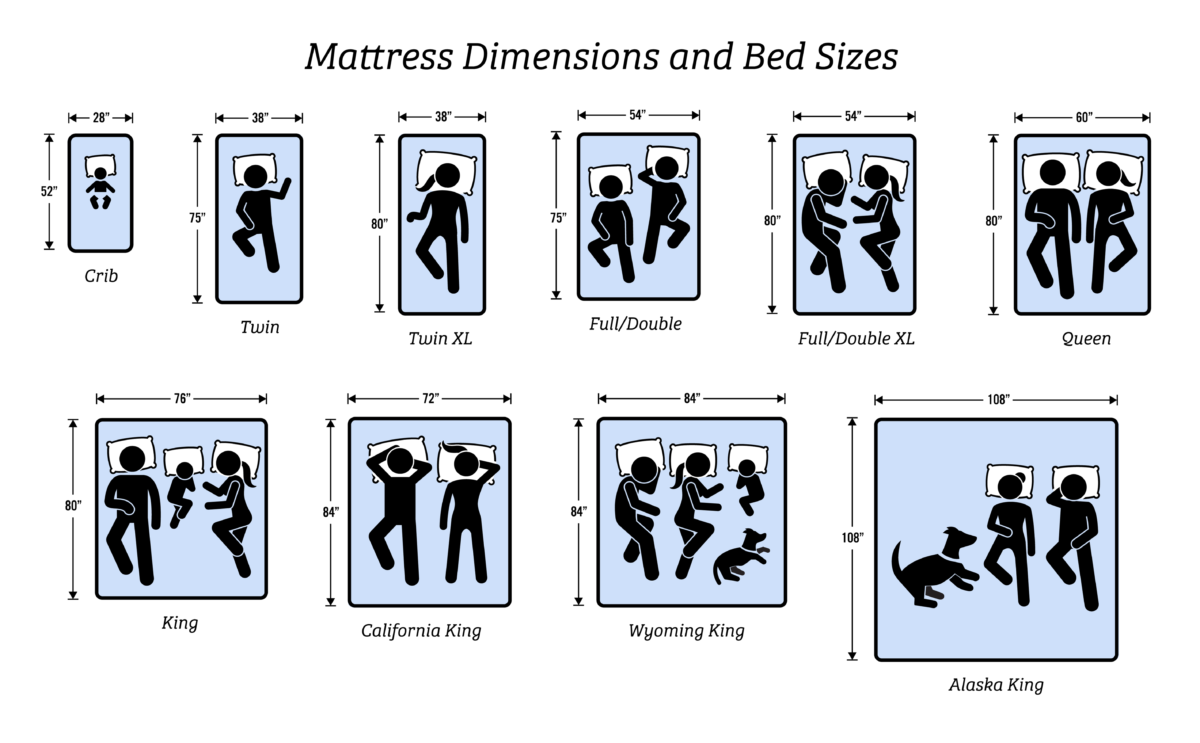
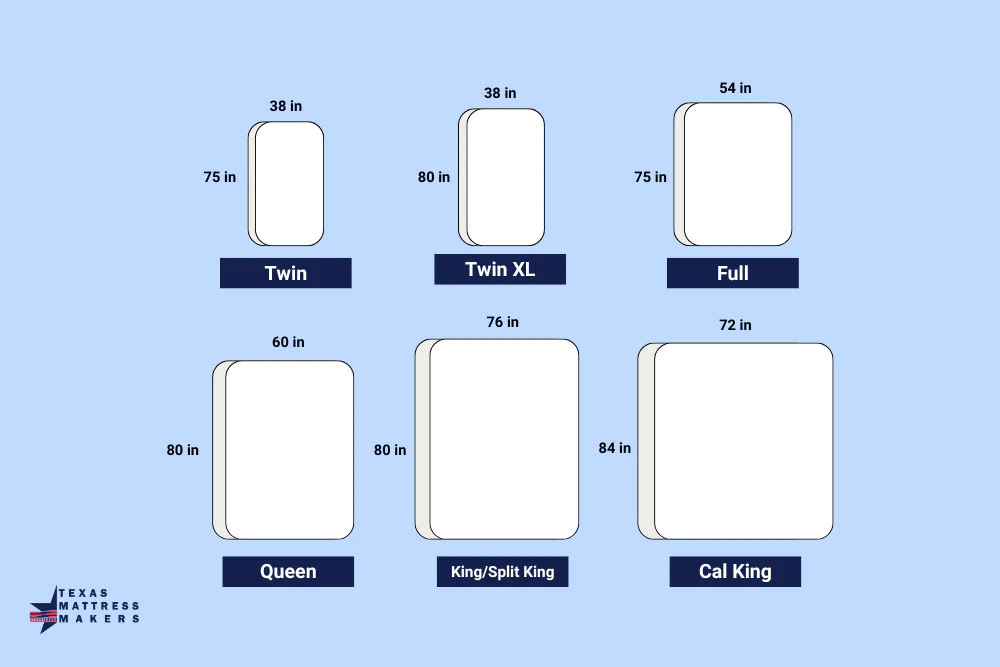
Knowing standard mattress dimensions makes the choice much easier. Mattress sizes can vary slightly by brand, but these are the common dimensions in the United States.
| Mattress size | Approximate dimensions | Best for |
|---|---|---|
| Twin | 38 by 75 inches | Children, teens, and small rooms |
| Twin XL | 38 by 80 inches | Tall teens, college dorms, and solo adults |
| Full | 54 by 75 inches | Solo sleepers who want more space |
| Queen | 60 by 80 inches | Couples and most adult bedrooms |
| King | 76 by 80 inches | Couples who want maximum width |
| California king | 72 by 84 inches | Tall couples and long, narrow rooms |
These sizes describe the mattress only. The bed frame, headboard, footboard, and side rails add several inches. Always check the full product measurements before buying furniture.
If you are unsure what size mattress should I get, a queen is usually the safest starting point for adults. It offers 30 inches of width per person when shared, which is less than a twin but enough for many couples.
Twin and twin XL mattresses
A twin mattress works well for children, bunk beds, guest rooms, and very small bedrooms. It is also a practical choice for a solo sleeper who does not need much space.
A twin XL has the same width as a twin but adds 5 inches of length. That extra length makes it a better option for taller teens and adults. Twin XL mattresses are common in college dorms because they fit narrow rooms while giving tall sleepers more legroom.
Choose a twin if:
• The sleeper is under about 6 feet tall.
• The room is small.
• The bed is for a child or bunk frame.
• You need a low-cost guest bed.
Choose a twin XL if:
• The sleeper is tall.
• The room is narrow but long.
• You are furnishing a dorm or studio.
• You want more legroom without a wider bed.
A twin or twin XL may feel tight for an adult who changes positions often. If you sleep with a pet or child, the limited width can become uncomfortable very quickly.

Full-size mattresses
A full mattress, also called a double mattress, measures about 54 by 75 inches. It gives one person much more room than a twin and works well in guest rooms or smaller primary bedrooms.
A full bed can fit two people, but it may feel narrow for regular couples. Each person gets about 27 inches of width, which is similar to sharing a crib-sized space from side to side. That may work for occasional use, but it can limit movement.
A full mattress is often a good choice for:
• Teenagers who want more room.
• Solo adults in small apartments.
• Guest bedrooms.
• Couples who sleep close and have limited floor space.
• People who want a larger bed without queen-size costs.
One mistake I often see is choosing a full mattress for a couple simply because it fits the room. The bed may fit, but the sleepers may not. Measure the room, then consider how much personal space each person needs.

Queen mattresses
For many shoppers, the answer to what size mattress should I get is a queen. A queen mattress measures about 60 by 80 inches and fits most adult bedrooms.
A queen offers a useful middle ground. It is wide enough for most couples, long enough for people up to around 6 feet 3 inches, and more affordable than a king. It also leaves more space for furniture and movement around the room.
A queen mattress is a strong choice if:
• One or two adults will sleep on it.
• You want a common size with many options.
• You may move homes in the future.
• Your bedroom is at least moderately sized.
• You want easier access to sheets and bed frames.
Queen mattresses are also easy to resell or replace because they are widely used. Sheets, protectors, adjustable bases, and frames are available in many price ranges.
For most first-time mattress shoppers, a queen provides the best mix of comfort, value, availability, and flexibility.

King and California king mattresses
A standard king mattress measures about 76 by 80 inches. It gives each person about the width of a twin bed, which makes it a great choice for couples who value personal space.
A California king measures about 72 by 84 inches. It is 4 inches narrower and 4 inches longer than a standard king. This makes it useful for tall sleepers or rooms with a long, narrow layout.
Choose a standard king if:
• You and your partner want more width.
• You share the bed with children or pets.
• You spread out while sleeping.
• Your bedroom is wide enough for the frame and walking paths.
Choose a California king if:
• One or both sleepers are tall.
• Your room is long rather than wide.
• You prefer extra legroom.
• You want a long bed with less width.
A king mattress is not automatically better. A large bed can overwhelm a small bedroom, make cleaning harder, and leave little room for dressers or chairs. The best answer to what size mattress should I get must include the room, not just the bed.

What mattress size is best for couples?
Most couples do well with a queen, king, or California king mattress. The right choice depends on body size, sleep habits, bedroom space, and budget.
A queen is suitable for couples who sleep close together or have a smaller room. A king is better for couples who move often, have different sleep schedules, or share the bed with children and pets.
Consider a king if one partner:
• Tosses and turns often.
• Needs more personal space.
• Gets up during the night.
• Sleeps with a large dog.
• Has a different bedtime or wake time.
Consider a queen if:
• The room is smaller than about 10 by 12 feet.
• You want more open floor space.
• You plan to move often.
• You have a strict budget.
• You and your partner sleep close together.
When couples ask what size mattress should I get, I suggest lying in your normal sleep positions together. Keep your elbows and knees inside your side of the mattress. If either person touches the edge, consider moving up one size.

What mattress size is best for tall people?
Tall sleepers need to focus on mattress length. Your feet should not hang over the edge, and you should have a few inches of extra space above your head.
A twin XL, queen, king, or California king provides 80 to 84 inches of length. A standard twin and full mattress are only 75 inches long, so they may feel short for taller adults.
Use this simple guide:
• Under 6 feet: A 75-inch mattress may work, but 80 inches offers more comfort.
• Around 6 feet to 6 feet 3 inches: Choose an 80-inch mattress.
• Above 6 feet 3 inches: Consider a California king or another 84-inch option.
Your sleep position also matters. Back and stomach sleepers often need more length than curled-up side sleepers. Mattress thickness does not add usable sleeping length, so do not confuse a thicker mattress with a longer one.
If you are unsure what size mattress should I get as a tall person, measure from the top of your head to your heels while lying flat. Add at least 4 to 6 inches for comfortable movement.

How bedroom size affects your mattress choice
Your bedroom should support the mattress, not feel like a storage box around it. A good layout leaves space to walk, open drawers, and make the bed.
As a general guide:
• A twin can work in a room around 7 by 10 feet.
• A full often fits a room around 10 by 10 feet.
• A queen usually works best in a room around 10 by 10 or 10 by 12 feet.
• A king often needs a room around 12 by 12 feet or larger.
• A California king usually suits a room around 12 by 12 feet or longer.
These are planning guidelines, not strict rules. Door placement, closets, windows, and furniture can change the layout. Use painter’s tape to mark the mattress footprint on the floor. This simple test often reveals whether the bed will leave enough space.
One of the most useful lessons I have learned is to measure the entire sleep setup. A queen mattress may fit, but a bulky headboard and two nightstands can make the room feel crowded.
Mattress size and sleeping position
Your sleeping position can help answer what size mattress should I get. Side sleepers often move their knees and arms into wider positions, while back sleepers may stay closer to the center.
Side sleepers may prefer a queen or king because they need room to bend their knees and shift their hips. Back sleepers can often use a smaller mattress, but couples still need enough width to avoid disturbing each other.
Stomach sleepers may need extra length because their bodies often stretch out. Combination sleepers usually benefit from more width because they change positions throughout the night.
If you sleep with a partner, also think about motion. A larger mattress creates more distance between sleepers, but mattress construction matters too. Memory foam often limits motion transfer, while some spring designs may allow more movement across the surface.
Size cannot fix every comfort problem. A mattress that is too firm, too soft, or poorly suited to your body can still cause discomfort, even when it is large enough.
Mattress size for children and teenagers
Children can sleep well on a twin mattress, especially when bedroom space is limited. A twin XL can be a smart long-term choice for a tall child or teenager.
Parents often choose a full mattress for teenagers because it gives extra room and may last into adulthood. The higher upfront cost can make sense if the bed will be used for many years.
Think about:
• The child’s current height.
• Expected growth.
• Room size.
• Whether friends may sleep over.
• Whether the mattress will move to a guest room later.
A full mattress may be useful for a teenager who likes to read, study, or relax in bed. A twin may be enough for a child who uses the bed mainly for sleep.
When deciding what size mattress should I get for a child, balance present needs with future use. Buying the largest size is not always wise if it leaves no room for play or storage.
Mattress size, bed frames, and accessories
A mattress needs a suitable frame or foundation. A frame that is too small can damage the mattress edges, while one that is too large may allow the mattress to shift.
Check these details before ordering:
• The exact mattress dimensions.
• The inner size of the bed frame.
• The weight limit of the frame.
• The number and spacing of support slats.
• Whether the mattress needs a foundation.
• The size of sheets, protectors, and blankets.
Split king setups deserve extra attention. A split king usually uses two Twin XL mattresses side by side. It can work well with an adjustable base, but you may notice a gap or feel movement between the two sides.
Also check delivery access. Measure hallways, stairways, elevators, and door openings. A mattress that fits the bedroom may not fit through the route to reach it.
Common mistakes when choosing a mattress size
Many mattress problems begin before the mattress arrives. A few simple checks can prevent costly returns.
Avoid these mistakes:
• Buying based only on price.
• Forgetting to measure the bedroom.
• Ignoring your partner’s sleep habits.
• Choosing a full mattress for two adults without testing it.
• Forgetting the frame size.
• Assuming a thicker mattress is longer.
• Buying sheets before confirming the exact size.
• Ignoring return rules and trial periods.
• Choosing a king for a room that cannot support it.
A return policy can protect you, but returns may involve fees, pickup limits, or time restrictions. Read the policy before opening the mattress. Also check the warranty, since many warranties require proper support.
The best answer to what size mattress should I get comes from combining measurements, sleep habits, and future plans. No online chart can replace those three checks.
A simple mattress size decision process
Use this process before you buy:
-
Count the regular sleepers. Decide whether the bed is for one person, two people, children, or pets.
-
Measure the room. Record the length and width, then mark the mattress size on the floor.
-
Check your height. Choose an 80-inch or 84-inch mattress if a 75-inch bed may feel short.
-
Think about movement. Choose more width if you toss, turn, or spread out.
-
Consider your budget. Include the frame, foundation, sheets, protector, delivery, and taxes.
-
Plan for the future. Ask whether the bed may move to another room or home.
-
Test the size together. Lie down in your normal positions for at least 10 minutes.
-
Review the return policy. Confirm the trial period, fees, and pickup process.
This process makes what size mattress should I get much less confusing. It turns a vague shopping question into a practical decision.
Frequently asked questions about what size mattress should I get
Is a queen mattress big enough for two adults?
A queen mattress is large enough for many couples, especially those who sleep close together. If either person needs a lot of personal space, a king may provide better comfort.
Should I get a king or queen mattress?
Choose a queen for better value and more open room space. Choose a king if you toss and turn, share the bed with children or pets, or want more personal sleeping space.
What mattress size is best for a tall person?
A mattress that is at least 80 inches long works well for many tall sleepers. People over about 6 feet 3 inches may prefer a California king or another 84-inch mattress.
Is a full mattress good for couples?
A full mattress can work for couples in a small room, but it may feel narrow for nightly use. Each person gets only about 27 inches of width, so a queen is usually more comfortable.
Can a twin XL mattress fit two people?
Two Twin XL mattresses placed together create the same overall size as a standard king. One Twin XL mattress alone is designed for one sleeper.
Does mattress thickness affect the size I need?
Thickness affects height and support, but it does not add useful length or width. Choose the mattress footprint first, then select a thickness that suits your comfort and bed frame.
What mattress size is best for a guest room?
A full or queen mattress usually works well in a guest room. Choose a full for a smaller room and a queen if you want to host couples comfortably.
Conclusion
The right mattress size should give you enough room to sleep well without taking over your bedroom or budget. A twin suits children and compact spaces, a full gives solo sleepers extra room, a queen works for most adults, and a king or California king offers more personal space and length.
Before deciding what size mattress should I get, measure your room, consider your sleep habits, check your height, and include your partner or pets in the plan. Mark the mattress size on the floor before ordering, then review the frame measurements and return policy.
Take those steps today, compare your best two options, and choose the mattress that supports both your sleep and your daily space.

Appliance Review Expert
Lucas Ramirez is a trusted voice at HomeFixGrid.com, known for his clear, practical, and creatively written guides that simplify appliance care for everyday homeowners. With a strong focus on hands-on testing and real-world problem-solving, Lucas brings expert insight into appliance reviews and troubleshooting techniques. Her work empowers readers to confidently maintain, repair, and choose the right appliances for their homes.