Why Are Microwaves Used In Satellite Communication: 2026 Guide
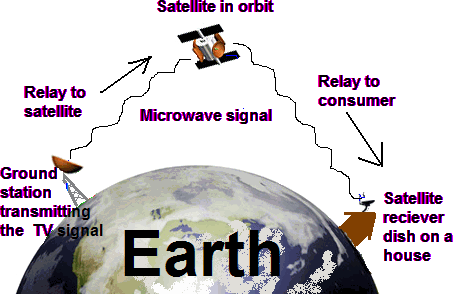
Microwaves are used in satellite communication because they travel through the atmosphere easily and carry large amounts of data.
When I first started working with telecommunications systems, I was fascinated by how invisible waves could bridge the massive gap between Earth and space. I still am. Microwaves form the quiet, high‑capacity link that keeps GPS, satellite TV, live international broadcasts, and satellite internet working. They pass through clouds and most layers of the atmosphere with low loss. They also let us pack a lot of data into a narrow beam. In this article I explain, in plain terms, the main technical reasons microwaves are used in satellite communication and share practical insights from hands‑on work with dishes and links.
Why Microwaves Are Perfect for Space Data
Microwaves sit at high radio frequencies. High frequency gives high bandwidth. Bandwidth is the size of the pipe for data. A bigger pipe moves more bits per second. That makes it possible to stream 4K video, run satellite internet, or send large files fast between ground stations and orbiting satellites.
Microwaves are also directional. We shape a beam with a parabolic antenna or phased array. The beam stays tight. That means we can aim energy at a single satellite thousands of miles away. We don’t waste power sending the signal in all directions.
In my experience setting up satellite dishes, the final alignment is always precise. A tiny change in angle can drop throughput. The narrow beam of a microwave link is both a strength and a tuning challenge. Proper pointing gives high gain and low interference. Poor pointing costs you data rate and link margin.
Microwave links also work well with modern modulation and error correction. Techniques like QPSK, 8PSK, QAM, LDPC, and turbo codes squeeze more bits into each hertz of bandwidth. That improves spectral efficiency and makes satellite links much more cost effective.
The Atmospheric Advantage
One big hurdle for any wireless link is the atmosphere. Lower frequency radio waves can reflect off the ionosphere. They can also be absorbed or scattered by weather. Microwaves fall into frequency windows that pass through the atmosphere with low loss. This is why microwaves are used in satellite communication for reliable sky links.
Even when it rains or the sky is cloudy, microwaves can often reach the satellite. That said, very heavy rain can cause rain fade. Rain fade is more of a problem at higher microwave frequencies, such as Ka‑band. Engineers design systems with extra link margin and adaptive coding to handle this. That keeps data flowing in bad weather.
There are also known absorption lines in the spectrum. Water vapor and oxygen cause higher loss near certain frequencies (for example, near 22 GHz and 60 GHz). Satellite systems avoid those bands for long, clear links. Instead, they use bands such as L, C, Ku, and Ka depending on the mission and required capacity.
Managing Signal Efficiency and Power
Short wavelengths mean small antennas. Wavelength is inversely tied to frequency. At microwave frequencies you can build compact dishes and arrays. Smaller antennas save mass and space on a satellite. They also make ground terminals cheaper and easier to install. If we used lower frequencies, the antennas would be huge and heavy.
Weight and power shape every satellite design. Power comes from solar panels and batteries. Amplifiers like traveling‑wave tube amplifiers (TWTAs) or solid‑state power amplifiers (SSPAs) consume power and add mass. Using microwaves lets designers use compact transponders and smaller power budgets. That extends satellite life and cuts launch costs.
From a link design view, you also work with EIRP, antenna gain, receiver noise figure, and G/T. These terms feed into the link budget. A good link budget shows you how much margin you have against noise, weather loss, and interference. In practice, more margin means fewer outages and clearer service for users.
On the ground side, modern antennas can be fixed dishes, steerable antennas, or flat phased arrays for low‑profile installs. Phased arrays enable fast beam steering for LEO constellations. Parabolic dishes remain common for geostationary and fixed links because of their simple, high‑gain design.
Frequently Asked Questions of why are microwaves used in satellite communication
Do microwaves used in satellites harm humans?
No. The microwaves used for satellite communication are low power and are regulated. They are very different from the high power waves inside your kitchen microwave. Ground‑station transmitters follow strict safety rules. Antenna siting and limits protect people and equipment.
Can weather affect microwave satellite signals?
Yes. Heavy rain, snow, and thick clouds can reduce signal strength. This is called rain fade or atmospheric attenuation. Engineers use techniques like adaptive coding and modulation, automatic power control, and site diversity to reduce outages. They also choose frequency bands with lower rain loss for critical links.
Why not use light waves instead of microwaves?
Laser or optical links are a growing option. They offer very high data rates. But optical waves are easily blocked by clouds, fog, and dust. That makes them less practical for general all‑weather ground links today. Microwaves give a more reliable, weather‑tolerant path between satellites and ground stations.
How much data can these microwaves carry?
Microwaves span wide bands. That lets them carry a lot of bandwidth. With modern modulation, a single microwave channel can carry many gigabits per second. High‑Throughput Satellites (HTS) using Ka and Ku bands deliver tens to hundreds of Gbps for broadband services.
Do these signals travel at the speed of light?
Yes. All electromagnetic waves, including microwaves, travel at the speed of light in a vacuum. In the atmosphere the speed is very close to that. This gives low latency for links to satellites in low Earth orbit (LEO) and predictable round‑trip delays for geostationary satellites.
Common Satellite Frequency Bands and Uses
Understanding the common bands helps explain why microwaves are used in satellite communication.
- L‑band (1–2 GHz): Used for GPS, some mobile satcom, and maritime services. Good through rain and foliage. Lower bandwidth but robust.
- C‑band (4–8 GHz): Used for TV distribution and some satellite backhaul. Less rain fade than higher bands. Requires bigger antennas.
- Ku‑band (12–18 GHz): Widely used for VSAT, broadcast, and consumer satellite internet. Higher bandwidth with manageable rain fade.
- Ka‑band (26–40 GHz): Used by high‑throughput satellites. Very high capacity but more sensitive to rain fade and atmosphere.
Choosing a band is a trade‑off between bandwidth, antenna size, propagation, and cost.
How engineers reduce rain fade and interference
To keep links stable, engineers use:
- Link margin and conservative link budgets.
- Adaptive coding and modulation to lower data rate when the channel degrades.
- Power control to boost uplink power during fades.
- Site diversity—switching to an alternate ground station if one is stormy.
- Frequency planning and filters to avoid interference from other services.
Practical tips from my field work
When I tune a dish in the field I always:
- Check the clear line of sight and remove nearby obstructions.
- Use a compass and inclinometer, then fine tune with a signal meter.
- Verify modulation and error rates, not just signal strength.
- Document the pointing and settings for future maintenance.
These simple steps save time and reduce downtime for the link.
Conclusion
Using microwaves in satellite technology is a smart match of physics and engineering. These frequencies give high bandwidth, narrow beams, and good atmospheric transparency. That makes them ideal for satellite internet, broadcast, GPS, and many other services.
From hands‑on dish alignment to writing link budgets, I see the same theme: microwaves give a practical, cost‑effective path to high data rates from orbit. As satellite tech evolves—LEO constellations, optical intersatellite links, and higher frequency payloads—the role of microwaves remains central for reliable ground links.
Keep asking questions and testing systems. The more you learn about antennas, bands, and link design, the clearer the invisible network becomes. Explore more resources on orbital engineering and satellite communications to deepen your knowledge of this connected world.

Appliance Review Expert
Lucas Ramirez is a trusted voice at HomeFixGrid.com, known for his clear, practical, and creatively written guides that simplify appliance care for everyday homeowners. With a strong focus on hands-on testing and real-world problem-solving, Lucas brings expert insight into appliance reviews and troubleshooting techniques. Her work empowers readers to confidently maintain, repair, and choose the right appliances for their homes.