

What Is The Best Medium Firm Mattress: Comfort Guide
The best medium-firm mattress for most people is one that feels supportive without creating hard pressure points. In the United States, that often means a mattress rated about 6 to 7 on a 10-point firmness scale, but firmness labels are not standardized. A “medium-firm” mattress from one U.S. brand may feel softer or harder than one from another.
For many adults, a medium-firm mattress is a sensible starting point because it can support the hips and spine while still cushioning the shoulders. Research on adults with chronic, nonspecific low-back pain also found better results with medium-firm mattresses than with firm mattresses in one randomized trial. That does not make medium-firm the right choice for everyone.
The best choice depends on your sleep position, body weight, pain points, heat preference, partner, budget, and the mattress return policy. This guide explains how to choose one without relying on a firmness label alone.
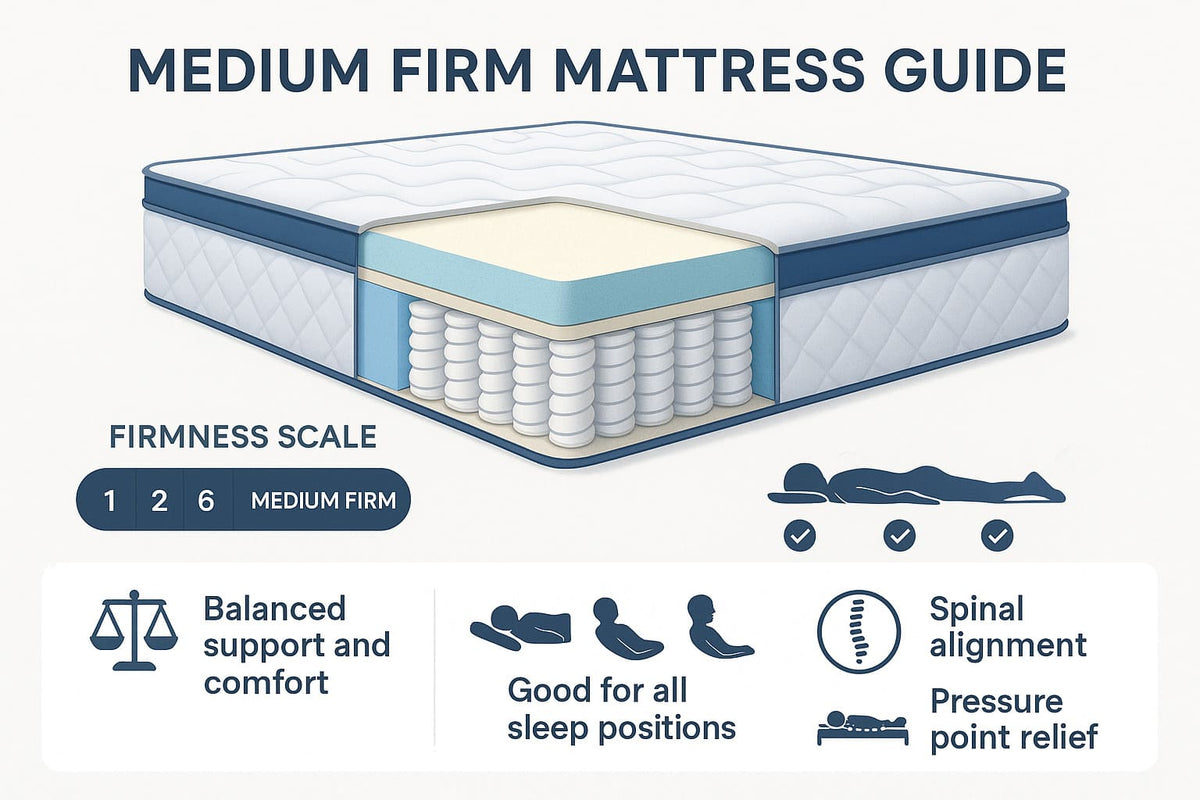
Quick answer: Which medium-firm mattress is best?
The best medium-firm mattress is usually a hybrid mattress with pocketed coils and a comfort layer of foam or latex. This design gives you:
- Better edge support than many all-foam beds
- More airflow than dense memory foam
- Support for back and combination sleepers
- A balance of pressure relief and ease of movement
- Good suitability for couples with different sleep styles
A medium-firm all-foam mattress may be better if you want strong motion isolation and a quieter bed. A latex hybrid may suit you if you want a springier feel, good airflow, and durable materials.
There is no single best model for every sleeper. Instead, look for the right feel, support, construction, and trial terms.
What does “medium-firm” mean?
Medium-firm usually describes a mattress that feels supportive but not rigid. On a common 1-to-10 scale, with 10 as the firmest, medium-firm is often described as a 6 or 7.
This scale is only a guide. Mattress makers use their own testing methods, and your body changes the feel. A 200-pound sleeper may sink more into a mattress than a 130-pound sleeper. A side sleeper may feel more pressure at the shoulder than a back sleeper.
Firmness and support are also different:
- Firmness is how hard or soft the surface feels.
- Support is how well the mattress keeps your body aligned.
- Pressure relief is how well it reduces force at the shoulders, hips, knees, and other contact areas.
- Responsiveness is how quickly the mattress pushes back when you move.
A soft mattress can still be supportive. A firm mattress can still provide poor support if it does not match your body shape.
Who should choose a medium-firm mattress?
A medium-firm mattress is often a strong starting point for back sleepers, combination sleepers, and couples who want a middle-ground feel. It may also help sleepers who dislike the deep “sinking” sensation of very soft memory foam.
Back sleepers
Back sleepers often need enough support to prevent the pelvis from dropping too far into the mattress. A medium-firm surface can help keep the lower back in a neutral position while still cushioning the upper back.
If you are lighter in weight, a mattress rated 6 may feel quite firm. If you are heavier, that same mattress may feel closer to medium or medium-soft.
Combination sleepers
Combination sleepers change positions during the night. They often need a mattress that allows easy movement without feeling unstable.
A hybrid or latex mattress can work well because its responsive surface makes it easier to turn. Dense memory foam may still work, but choose a design with a responsive comfort layer rather than a very deep, slow-sinking one.
Couples
Medium-firm mattresses can suit couples because they sit between two common preferences: one person may want cushioning while the other wants a firmer feel.
For couples, also check:
- Motion isolation
- Edge support
- Mattress width
- Weight limits
- Temperature control
- The company’s return process
A mattress can feel comfortable for one person but become less comfortable when two people share it.
People with back pain
A medium-firm mattress may be worth trying if you have general, nonspecific low-back discomfort. A randomized study published in The Lancet compared medium-firm and firm mattresses in adults with chronic nonspecific low-back pain and reported better pain and disability outcomes with medium-firm mattresses after 90 days.
This finding does not prove that every person with back pain needs a medium-firm mattress. Back pain has many causes. Seek medical care for severe pain, new weakness, numbness, loss of bladder or bowel control, fever, unexplained weight loss, or pain after a major injury.

What mattress type is best for medium-firm support?
The best construction depends on the feel you want. The table below compares the main types sold in the U.S.
| Mattress type | Main feel | Strengths | Limits | Best for |
|---|---|---|---|---|
| Hybrid | Balanced, responsive | Good support, airflow, and edge stability | Often heavier and more costly | Back sleepers, couples, combination sleepers |
| All-foam | Quiet, contouring | Strong motion isolation and pressure relief | Can sleep warmer or feel harder to move on | Side sleepers and light sleepers |
| Latex | Buoyant and springy | Airflow, easy movement, durable feel | Less body-hugging and often pricier | Hot sleepers and combination sleepers |
| Innerspring | Firm and bouncy | Airflow and edge support | May provide less pressure relief | Firm-bed fans and heavier sleepers |
| Adjustable air | Customizable | Each side can use a different firmness | More parts and higher cost | Couples with different needs |
Medium-firm hybrid mattresses
A hybrid combines coils with foam, latex, or another comfort material. Pocketed coils move more independently than old-style connected coils, which can reduce motion transfer.
A hybrid is often the safest general choice when you want medium-firm support. Look for a comfort layer thick enough to cushion the shoulders and hips. A very thin comfort layer may feel hard, even when the product is labeled medium-firm.
Medium-firm memory foam mattresses
Memory foam spreads body weight and can reduce motion transfer. It may be useful for side sleepers or couples.
The trade-off is that some memory foam beds retain heat or make movement harder. A mattress with convoluted foam, breathable covers, cooling materials, or a thinner top layer may feel less warm, but marketing terms such as “cooling” do not guarantee a cool sleep experience.
Medium-firm latex mattresses
Latex usually feels springy rather than slow and sinking. It allows easier movement and often has good airflow.
Latex can be made from natural or synthetic materials. “Natural latex” does not automatically mean the whole mattress is made from natural materials. Check the full material list and certification details.
Medium-firm innerspring mattresses
Traditional innerspring mattresses may feel firm, bouncy, and cool. They can offer useful edge support, but they may not provide enough cushioning for side sleepers.
If you choose an innerspring mattress, look for a comfort layer that protects the shoulders and hips. Otherwise, the mattress may create pressure points.
How firm should your mattress be by sleep position?
Your sleep position is one of the most useful ways to narrow your choice.
| Sleep position | Usual starting range | What to look for |
|---|---|---|
| Side sleeper | Medium-soft to medium-firm | Shoulder and hip cushioning |
| Back sleeper | Medium-firm to firm | Even support under the pelvis and lower back |
| Stomach sleeper | Medium-firm to firm | Enough resistance to prevent the midsection from sinking |
| Combination sleeper | Medium to medium-firm | Easy movement and balanced pressure relief |
These ranges are starting points, not rules. Body weight changes how deeply you sink into the mattress.
If you sleep on your side
Side sleepers need enough cushioning at the shoulder and hip. A mattress that feels medium-firm in a store may feel too firm at home if it does not allow those areas to sink slightly.
Choose a comfort system with foam or latex that can spread pressure. If your shoulder goes numb or your hip aches after sleeping on your side, the mattress may be too firm or too thin on top.
If you sleep on your back
Back sleepers often do well with a medium-firm hybrid or foam mattress. The key is even support rather than maximum firmness.
When lying on your back, your lower back should not feel forced upward, and your hips should not sink much lower than your chest. A small pillow under the knees may also reduce strain for some people, but it does not fix a mattress that is a poor match.
If you sleep on your stomach
Stomach sleepers often need more surface resistance. If the midsection sinks too deeply, it may place the lower back in an uncomfortable position.
A medium-firm mattress may work for lighter stomach sleepers. Heavier stomach sleepers may need a firmer support core, a thinner comfort layer, or a reinforced hybrid design.
If you change positions
Combination sleepers should focus on responsiveness. You should be able to roll from your back to your side without feeling trapped.
Latex, pocketed coils, and responsive polyfoam usually make movement easier than thick, slow-response memory foam.

How body weight changes the best medium-firm mattress
Body weight affects both pressure relief and support. A useful rule is that heavier sleepers often experience a mattress as softer, while lighter sleepers often experience the same mattress as firmer.
Sleepers under about 130 pounds
A mattress labeled medium-firm may feel firm because your body may not sink deeply into the comfort layers. Side sleepers in this group may prefer a softer top over a supportive core.
Sleepers around 130 to 230 pounds
This range often matches the firmness scale used in general mattress descriptions. A true medium-firm mattress may feel close to its advertised rating, although body shape still matters.
Sleepers over about 230 pounds
A medium-firm mattress may feel softer and may compress more under the hips and shoulders. Look for:
- A strong support core
- Durable coils or a dense foam base
- Reinforced edges
- A suitable weight limit
- Enough comfort material to prevent pressure points
A mattress marketed as “firm” may feel medium-firm to a heavier sleeper. Product-specific weight limits matter more than a general firmness label.
What should you check before buying?
A good medium-firm mattress is not just about the surface feel. Review the support core, materials, trial policy, warranty, and foundation requirements.
Mattress trial period
A home trial is useful because your body may need time to adjust. Try the mattress for at least several weeks unless the company gives a different required period for returns.
Before ordering, confirm:
- The length of the trial
- Whether a minimum number of nights is required
- Whether return shipping costs money
- Whether pickup is included
- Whether the mattress must be in good condition
- Whether exchanges are allowed
- Whether a refund includes the original delivery fee
A long trial does not help if the return process is difficult or expensive.
Warranty
A warranty usually covers manufacturing defects, not normal softening or a comfort preference. Read the terms for:
- Sagging depth covered
- Required bed frame type
- Stains and damage exclusions
- Transfer rules if you sell or give away the mattress
- The length of coverage
- Repair, replacement, or partial-credit terms
Use a mattress protector from the first night if the policy allows it. Stains can affect a warranty claim and may also block a return.
Foundation and bed frame
A mattress can perform poorly on an unsuitable base. Check the manufacturer’s rules for:
- Slat spacing
- Center support
- Platform beds
- Adjustable bases
- Box springs
- Weight limits
Do not place a modern foam or hybrid mattress on an old frame without checking support. A weak base may cause sagging or void warranty coverage.
Certifications
Certifications can help confirm specific material or emissions claims, but each certification has a limited scope.
For example:
- CertiPUR-US applies to certain flexible polyurethane foams made for the U.S. market.
- GREENGUARD Gold concerns tested chemical emissions under its certification requirements.
- GOTS and GOLS address specific organic textile and latex supply requirements.
A certification does not prove that a mattress is the most comfortable, most durable, or safest choice for every person. Check which component the certificate covers.
How to test a medium-firm mattress at home
Use a simple process rather than judging the bed after one night.
- Set up the correct foundation. Confirm that the frame meets the mattress company’s requirements.
- Use your normal pillow. A different pillow can change neck and shoulder alignment.
- Sleep in your usual positions. Test the mattress on your back, side, and stomach if you use more than one position.
- Check pressure points. Watch for shoulder, hip, knee, or rib pain.
- Check alignment. Ask a partner to look at your spine, or use a photo taken from the side while you lie naturally.
- Test movement. Roll and sit up. Notice whether you feel stuck.
- Test edge support. Sit on the edge and lie near it.
- Track your sleep. Write down pain, heat, movement, and sleep quality for at least two weeks.
- Start the return process early. Do not wait until the trial deadline.
Signs of a good fit include even support, no lasting numbness, manageable heat, and less morning stiffness after your body has adjusted.
Common mistakes when buying a medium-firm mattress
Trusting the firmness number alone
Firmness ratings are not standardized. Treat “6.5” as a starting clue, not a measurement that transfers perfectly between brands.
Testing it for only five minutes
A showroom test can reveal obvious pressure or discomfort, but it cannot show how the mattress performs after several nights. Online buyers should use the trial policy. Store buyers should ask about the exchange rules.
Choosing the firmest mattress for back pain
Firm is not the same as supportive. The Lancet trial mentioned earlier found better outcomes with medium-firm mattresses than firm mattresses for the adults studied. Your symptoms may have another cause, so mattress changes should not replace medical evaluation.
Ignoring the pillow
A mattress may feel wrong when the pillow is the real problem. Side sleepers often need more pillow height than back sleepers. Stomach sleepers often need a thinner pillow.
Buying a mattress without checking the base
A poor frame can change how the mattress feels and may affect the warranty. Check the base before ordering.
Believing every “cooling” claim
Cooling covers, gel foam, phase-change fabric, and airflow claims vary. A cool room, breathable bedding, a responsive comfort layer, and coil airflow may matter more than one label.

Medium-firm mattress buying checklist
Before you buy, answer these questions:
- Do I sleep mostly on my side, back, stomach, or a mix?
- Does my current mattress feel too hard, too soft, or unsupportive?
- Do I wake with shoulder, hip, neck, or lower-back pain?
- Do I sleep hot?
- Will I share the mattress?
- Do I need strong edge support?
- What is my body weight, and what weight limit does the mattress list?
- Does the mattress have a real home trial?
- What are the return and pickup costs?
- Will my bed frame support it?
- Does the warranty cover the type of wear I am concerned about?
- Are any material certifications relevant to the entire mattress or only one component?
If you cannot answer the trial and return questions, the mattress may be a poor purchase even if the specifications look good.
Frequently asked questions
Is a medium-firm mattress good for back pain?
It may help some people with chronic, nonspecific low-back pain. One randomized trial found better results with medium-firm mattresses than firm mattresses among the adults studied. Back pain has many causes, so seek medical care for severe, new, or worsening symptoms.
Is medium-firm better than firm?
Neither is always better. Medium-firm may provide a better balance of support and pressure relief for many adults. Firm may suit some stomach sleepers, heavier sleepers, or people who prefer a hard surface.
Is medium-firm good for side sleepers?
It can be, but side sleepers often need enough cushioning for the shoulder and hip. If a medium-firm mattress causes pressure or numbness, try a softer comfort layer or a mattress with more contouring.
How long does it take to adjust to a new mattress?
Many people need several nights or weeks to adjust to a new feel. Follow the company’s trial rules and monitor pain, pressure, heat, and sleep quality. Return the mattress if discomfort persists or worsens.
Should I buy a medium-firm memory foam or hybrid mattress?
Choose memory foam for stronger motion isolation and a more hugging feel. Choose a hybrid for easier movement, stronger edges, and usually better airflow. The better option depends on your sleep position and heat preference.
Final recommendation
For most U.S. shoppers, begin with a medium-firm hybrid mattress rated around 6 to 7 out of 10, with a supportive coil core, enough comfort material for your sleep position, and a low-risk home trial. Side sleepers may need a softer or more cushioned top. Stomach sleepers and heavier sleepers may need stronger support. Couples should compare motion control, edge support, and temperature performance.
Do not choose by the firmness label alone. Match the mattress to your body, sleep position, and return options. The best medium-firm mattress is the one that keeps you aligned, relieves pressure, and remains comfortable after repeated nights at home.
Evidence and useful sources
- Kovacs et al., The Lancet: Effect of firmness of mattress on chronic non-specific low-back pain
- National Institute of Neurological Disorders and Stroke: Low Back Pain
- CertiPUR-US: Foam certification standards
- UL Solutions: GREENGUARD certification
- GOTS: Global Organic Textile Standard
- GOLS: Global Organic Latex Standard information

Appliance Review Expert
Lucas Ramirez is a trusted voice at HomeFixGrid.com, known for his clear, practical, and creatively written guides that simplify appliance care for everyday homeowners. With a strong focus on hands-on testing and real-world problem-solving, Lucas brings expert insight into appliance reviews and troubleshooting techniques. Her work empowers readers to confidently maintain, repair, and choose the right appliances for their homes.
