Which Has A Longer Wavelength: Microwaves Or Infrared?
Introduction
For readers in the United States, the direct answer is simple: microwaves have longer wavelengths than infrared radiation.
Microwaves usually range from about 1 millimeter to 1 meter in wavelength. Infrared radiation usually ranges from about 700 nanometers to 1 millimeter. The exact boundary can vary by scientific field, but microwaves remain on the longer-wavelength side of the electromagnetic spectrum.
This difference affects their frequency, energy, uses, and interaction with materials. A microwave oven, Wi-Fi router, TV satellite link, and infrared remote may all use electromagnetic radiation, but they do not use the same part of the spectrum.


The short answer: microwaves have the longer wavelength
Microwaves have a longer wavelength than infrared because they have a lower frequency.
The relationship between wavelength and frequency is:
[
c = \lambda f
]
Where:
- (c) is the speed of light
- (\lambda) is wavelength
- (f) is frequency
Because electromagnetic waves travel at roughly the same speed in a vacuum, wavelength and frequency move in opposite directions:
- Higher frequency = shorter wavelength
- Lower frequency = longer wavelength
Microwaves sit below infrared in frequency. Therefore, microwaves sit above infrared in wavelength.
| Type of radiation | Approximate wavelength | Approximate frequency |
|---|---|---|
| Microwaves | 1 mm to 1 m | 300 MHz to 300 GHz |
| Infrared | 700 nm to 1 mm | 300 GHz to 430 THz |
| Visible light | 400 to 700 nm | 430 to 750 THz |
These ranges are approximate. Different sources may place the microwave–infrared boundary at slightly different points.
A simple example
A typical microwave oven in the United States operates near 2.45 GHz. Its wavelength is about:
[
\lambda = \frac{3.00 \times 10^8\text{ m/s}}{2.45 \times 10^9\text{ Hz}}
]
[
\lambda \approx 0.122\text{ m}
]
That equals about 12.2 centimeters, or roughly 4.8 inches.


A common infrared remote-control signal may use a wavelength near 940 nanometers. That is less than one-millionth of a meter.
So, compared with infrared light, a microwave has a much longer wave. The difference is like comparing a long jump rope with a very fine thread.

Where microwaves and infrared fit in the electromagnetic spectrum
Microwaves and infrared are both forms of electromagnetic radiation. They do not need air, water, or another substance to travel. They can move through a vacuum, which is how sunlight reaches Earth from the Sun.
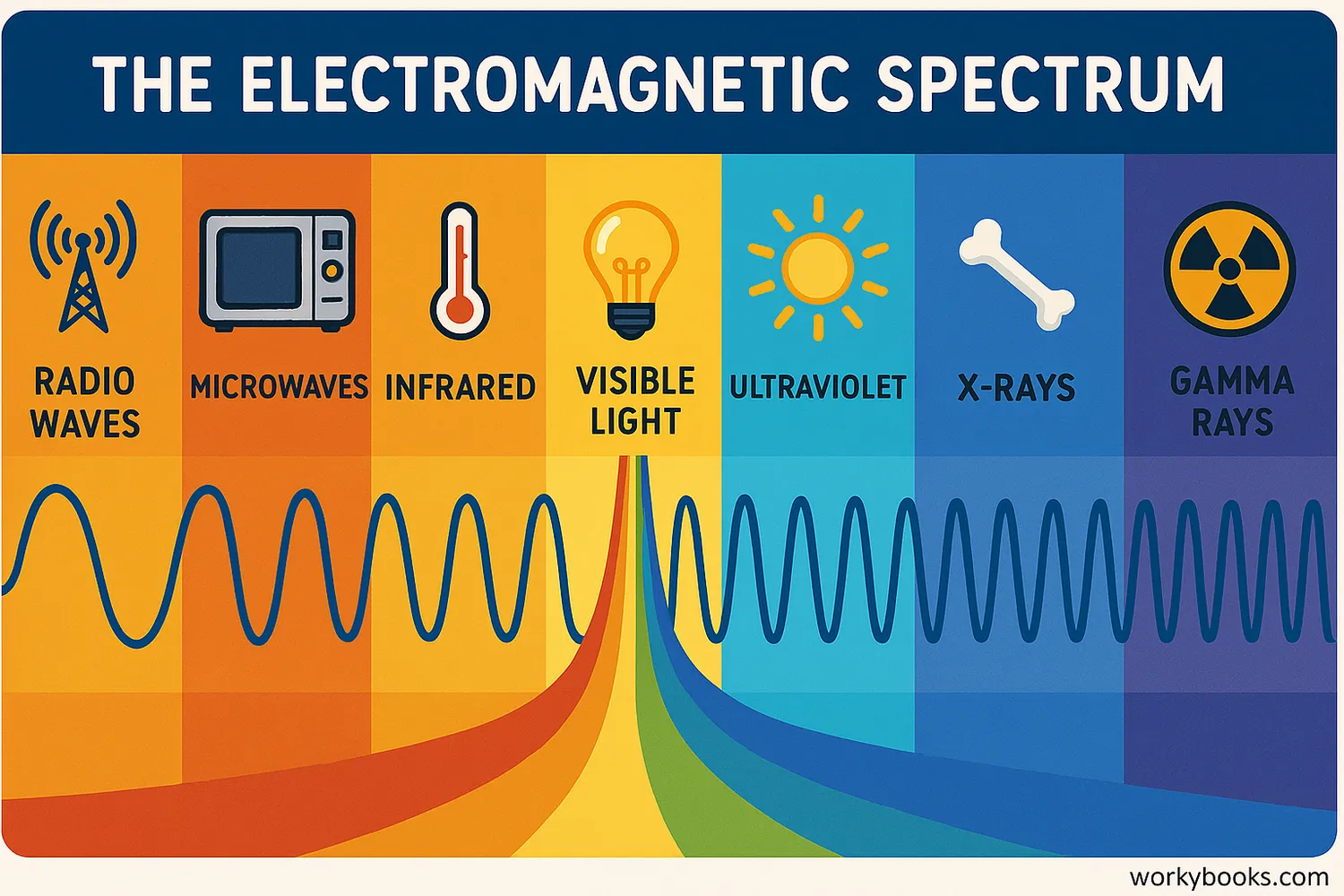
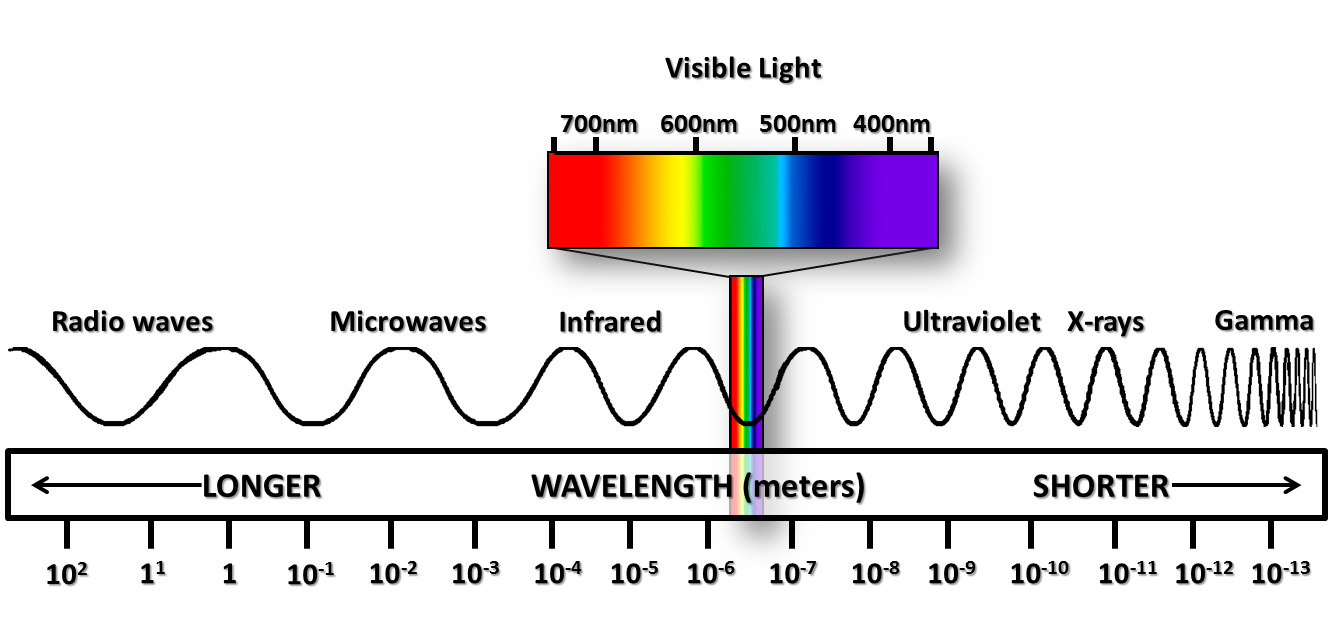
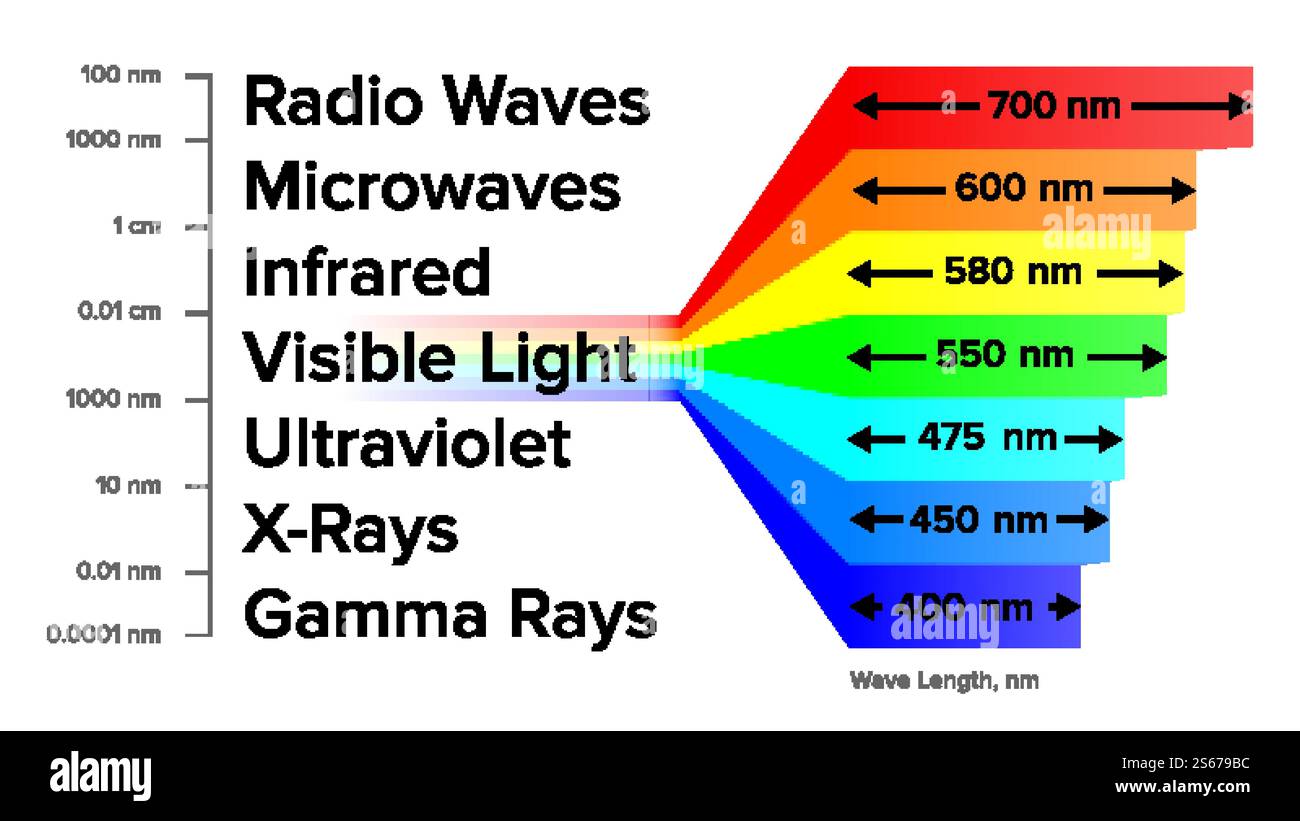
The electromagnetic spectrum is arranged by frequency or wavelength:
- Radio waves
- Microwaves
- Infrared
- Visible light
- Ultraviolet
- X-rays
- Gamma rays
As you move from radio waves toward gamma rays:
- Wavelength becomes shorter.
- Frequency becomes higher.
- Photon energy becomes greater.
Microwaves are often treated as a high-frequency part of the radio-wave region. Infrared lies between microwaves and visible light.
The boundary between microwaves and infrared is not perfectly fixed. Some engineering references define microwaves as extending up to 300 GHz, which corresponds to a wavelength of about 1 millimeter. Other references use “microwave” more broadly for some millimeter-wave bands. This difference changes the labels at the border, not the main comparison.
Across their usual ranges, microwaves have longer wavelengths than infrared radiation.

Why wavelength matters
Wavelength helps explain how radiation behaves, but it does not tell the whole story by itself.
A longer wavelength generally means that a wave can interact with larger structures or pass through some materials more easily. Microwaves can travel through clouds and some building materials, which makes them useful for radar, wireless communication, and satellite links.
Infrared radiation has shorter wavelengths. Many infrared wavelengths are absorbed strongly by molecules near a material’s surface. This is why infrared is useful for heat sensing, thermal cameras, remote controls, and some types of heating.
However, neither statement is universal:
- Some materials block microwaves well.
- Some materials absorb microwaves strongly.
- Some infrared wavelengths can pass through thin materials.
- Some materials reflect infrared instead of absorbing it.
The result depends on the wavelength, material, thickness, moisture level, surface condition, and angle of the radiation.


Wavelength, frequency, and photon energy
Photon energy follows this relationship:
[
E = hf
]
Where:
- (E) is photon energy
- (h) is Planck’s constant
- (f) is frequency
Since microwaves have lower frequencies than infrared, individual microwave photons have less energy than infrared photons.
This does not mean a microwave oven has no heating effect. A microwave oven produces a large amount of microwave power. The total energy delivered can be enough to heat food, even though each photon has low energy.

Microwaves versus infrared: a practical comparison
The following table shows the main differences.
| Feature | Microwaves | Infrared |
|---|---|---|
| Relative wavelength | Longer | Shorter |
| Relative frequency | Lower | Higher |
| Relative photon energy | Lower | Higher |
| Common range | About 1 mm to 1 m | About 700 nm to 1 mm |
| Common examples | Wi-Fi, radar, microwave ovens, satellite links | Heat radiation, thermal cameras, remote controls |
| Visible to the human eye? | No | No |
| Ionizing radiation? | No | No |
| Typical interaction | Can pass through or reflect from some materials | Often absorbed or emitted at surfaces |
| Common sensing use | Radar and wireless signals | Heat and temperature sensing |
Both types are non-ionizing radiation. That means their photons generally do not have enough energy to remove tightly bound electrons from atoms in the way that X-rays and gamma rays can.
Still, non-ionizing does not mean “cannot cause harm.” Strong microwave fields can heat tissue. Powerful infrared sources can burn skin or damage eyes. Exposure depends on power, distance, duration, frequency, and the equipment involved.

Are microwaves a type of infrared?
No. Microwaves and infrared are separate regions of the electromagnetic spectrum.
They are related because both are electromagnetic waves, but they have different usual wavelength and frequency ranges. Infrared has a shorter wavelength and higher frequency than microwaves.
The confusion often comes from the broad transition between the two regions. At the boundary near 1 millimeter, one source may use the term “millimeter wave,” another may call it a microwave, and another may discuss it as far-infrared radiation.
The label is less important than the measured wavelength or frequency. If you need to identify a signal, check its actual frequency and wavelength rather than relying only on its name.
Do microwaves travel faster than infrared?
No. In a vacuum, microwaves and infrared radiation travel at the same speed: approximately 299,792,458 meters per second.


In air, their speeds are very close to that value. In glass, water, plastic, or another material, both can slow down by different amounts depending on the material and frequency.
Microwaves do not travel faster because they have longer wavelengths. Their wavelength is longer because their frequency is lower while their travel speed remains nearly the same.
A useful comparison is ocean waves. Two waves can move across the same surface at a similar speed while having different distances between their crests. Electromagnetic waves work differently in detail, but the comparison helps show why speed alone does not determine wavelength.

Do microwaves have more energy than infrared?
For individual photons, no. Infrared photons have more energy than microwave photons because infrared has a higher frequency.
The energy of one photon is small for both types of radiation. The heating effect of a device depends on the total energy delivered, not only the energy of each photon.
For example:
- A microwave oven delivers substantial power to food.
- A low-power infrared remote sends a very small amount of energy.
- A powerful infrared lamp can still produce intense heat.
This is why it is inaccurate to say that all infrared is more dangerous than all microwaves, or that all microwaves are weaker than all infrared sources. The source power and exposure conditions matter.
Why does a microwave oven heat food while infrared heats surfaces?
Microwave ovens use electromagnetic fields that can transfer energy into certain molecules and materials throughout part of the food. Water, fats, and dissolved ions affect how strongly food absorbs microwave energy.
The heating is not always perfectly even. Food shape, moisture distribution, container design, and the oven’s field pattern can create hot and cold spots. This is why standing time and stirring can help distribute heat.
Infrared heating usually transfers energy at the exposed surface first. The surface can then conduct heat inward. Some infrared wavelengths may penetrate a short distance, but infrared heating is commonly associated with surface heating.
Neither method guarantees uniform heating. The result depends on the material and the exact wavelength or frequency used.

How to calculate which wave has the longer wavelength
You can compare two electromagnetic waves with the wavelength formula:
[
\lambda = \frac{c}{f}
]
Use:
- (c = 3.00 \times 10^8) meters per second in a vacuum
- (f) as the frequency in hertz
Example: microwave signal
Suppose a wireless signal has a frequency of 5 GHz:
[
\lambda = \frac{3.00 \times 10^8}{5.00 \times 10^9}
]
[
\lambda = 0.060\text{ m}
]
The wavelength is 6 centimeters.
Example: infrared signal
Suppose an infrared signal has a frequency of 300 THz:
[
\lambda = \frac{3.00 \times 10^8}{3.00 \times 10^{14}}
]
[
\lambda = 1.0 \times 10^{-6}\text{ m}
]
The wavelength is 1 micrometer, or 1,000 nanometers.
The microwave wavelength in this example is much longer than the infrared wavelength.

Common mistakes about microwave and infrared wavelengths
Mistake 1: Confusing heat with infrared only
Objects at ordinary temperatures emit thermal infrared radiation. This is why infrared is often called “heat radiation.”
But microwaves can also heat materials. Heating depends on energy absorption, not on whether the radiation is infrared.
Mistake 2: Assuming longer wavelength means stronger radiation
Wavelength does not measure the total strength of a signal. A long-wavelength microwave beam can carry more total power than a weak infrared signal.
Power, exposure time, distance, and beam direction must be considered separately.
Mistake 3: Treating the spectrum boundaries as exact
Scientific categories are useful, but the boundaries between radio waves, microwaves, infrared, and other regions can vary by field.
The central rule remains stable: microwaves normally have longer wavelengths than infrared.
Mistake 4: Assuming non-ionizing means risk-free
Microwave and infrared radiation are non-ionizing, but high exposure levels can still cause heating and injury. Follow equipment instructions, avoid damaged shielding, and do not bypass safety interlocks.
For unusual industrial, medical, laboratory, or high-power equipment, use the manufacturer’s safety instructions and applicable workplace guidance.
Frequently asked questions
Which has the higher frequency, microwaves or infrared?
Infrared has the higher frequency. Because wavelength and frequency are inversely related, infrared has a shorter wavelength than microwaves.
Which has more energy, microwaves or infrared?
Individual infrared photons have more energy than microwave photons because infrared has a higher frequency. Total exposure energy depends on the source power and exposure time.
Are microwaves and infrared visible?
No. Human eyes cannot normally see microwaves or infrared radiation. Visible light has a shorter wavelength than infrared and occupies a different region of the electromagnetic spectrum.
Can infrared pass through walls better than microwaves?
Usually, microwaves are more useful for passing through some walls and obstacles. However, the result depends on the material, thickness, moisture, frequency, and construction. Metal can strongly reflect or block many microwave signals.
Are microwaves and infrared ionizing radiation?
No. Both are generally classified as non-ionizing radiation. High-power sources can still heat tissue or cause burns, so non-ionizing does not mean completely harmless.
Key takeaways
- Microwaves have longer wavelengths than infrared.
- Microwaves usually range from about 1 millimeter to 1 meter.
- Infrared usually ranges from about 700 nanometers to 1 millimeter.
- Infrared has a higher frequency and greater energy per photon.
- Both are electromagnetic and non-ionizing forms of radiation.
- Their practical behavior depends on frequency, power, material, distance, and exposure time.
Conclusion
Microwaves have the longer wavelength. The reason is that microwaves have lower frequencies than infrared radiation, while both travel at nearly the same speed in a vacuum.
This relationship explains many practical differences. Microwaves support radar, wireless communication, satellite links, and microwave cooking. Infrared is widely used for thermal imaging, remote controls, heat sensing, and surface heating.
When comparing any two electromagnetic waves, use the same basic test: compare their frequencies or calculate their wavelengths with (\lambda = c/f). The lower-frequency wave will have the longer wavelength.
Sources and further reading
- NASA Science: The Electromagnetic Spectrum
- NASA Science: Infrared Waves
- Federal Communications Commission: Radio Spectrum
- National Institute of Standards and Technology: The International System of Units

Appliance Review Expert
Lucas Ramirez is a trusted voice at HomeFixGrid.com, known for his clear, practical, and creatively written guides that simplify appliance care for everyday homeowners. With a strong focus on hands-on testing and real-world problem-solving, Lucas brings expert insight into appliance reviews and troubleshooting techniques. Her work empowers readers to confidently maintain, repair, and choose the right appliances for their homes.