How To Set Power Level On GE Microwave: Easy Guide
Introduction
On most GE microwaves sold in the United States, you can set the power level by pressing Time Cook, entering the cooking time, pressing Power Level, choosing a level from 1 to 10, and then pressing Start. Some GE models use a Microwave, Cook Time, or dedicated number-pad function instead, so the exact button names may differ.
A lower power level does not always mean less total cooking time. It means the microwave uses full power in shorter bursts, with pauses between them. This helps food cook more gently and can improve results when you are defrosting meat, melting chocolate, reheating leftovers, or cooking delicate foods.

What Does the Power Level Mean on a GE Microwave?
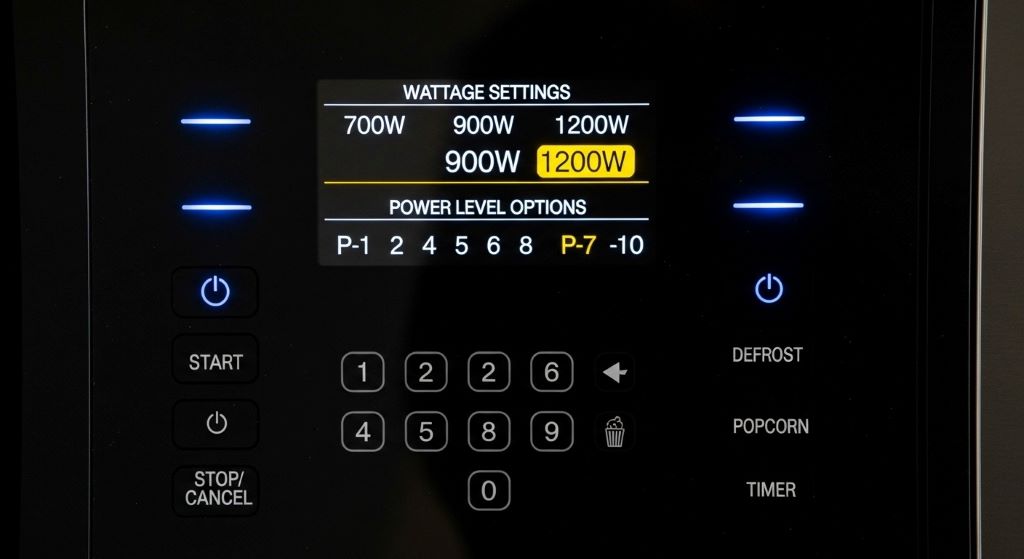
The power level controls how often the microwave produces energy during the cooking cycle. It does not usually change the microwave’s maximum wattage.


For example, a setting of Power Level 10 generally delivers full microwave power. A setting of Power Level 5 usually runs at about 50% power by cycling on and off during the selected time.
| GE power level | General use |
|---|---|
| 10 | Boiling water, cooking vegetables, heating liquids |
| 8–9 | Reheating dense foods and cooking most everyday meals |
| 6–7 | Cooking poultry, casseroles, and foods that may dry out |
| 5 | Gentle cooking, reheating leftovers, and simmering |
| 3–4 | Defrosting and softening foods |
| 1–2 | Keeping food warm or softening delicate items |
These are practical guidelines, not exact recipes. A microwave’s wattage, cavity size, food amount, container shape, and starting temperature all affect the result.
A lower power level also gives heat more time to spread through the food. This can reduce a common microwave problem: a hot outside with a cold center.

How to Set the Power Level on a GE Microwave
Follow these steps if your GE microwave has Time Cook and Power Level buttons.
-
Place the food in a microwave-safe container.
Remove metal trim, foil, twist ties, and metal utensils. Cover the food loosely if needed. -
Press
Time Cook.
On some GE models, this button may be labeled Cook Time, Microwave, or something similar. -
Enter the cooking time.
For example, enter200for 2 minutes, or follow your model’s display format. -
Press
Power Level.
The display may showPL10,P10, or a similar power setting. -
Enter the desired power level.
Press a number from1through10. For 50% power, press5. -
Press
StartorEnter/Start.
The microwave will run at the selected level for the time you entered.


Example: Set a GE microwave to 50% power
To cook food for 4 minutes at half power:
- Press Time Cook.
- Enter
4:00. - Press Power Level.
- Press
5. - Press Start.
The microwave may sound different during this cycle. That is normal. At a lower setting, the magnetron may turn on and off rather than run continuously.
How to Use Power Level on GE Models With a Number pad
some GE microwaves let you set the power level after entering the time, while others use a different sequence.
A common alternative is:
- Press Cook Time.
- Enter the cooking time.
- Press Power Level.
- Enter the level, such as
5. - Press Start.
On some models, you may need to press Power Level first, choose the level, and then enter the cooking time. If the first sequence does not work, check the control panel labels and the owner’s manual for your exact model.
The model number is often found:
- Inside the microwave door
- On the inside wall of the oven cavity
- On the front or side of the control panel
- On the back or side of an over-the-range model
Use the model number on the official GE Appliances support page to find the correct manual.

How to Change the Power Level During Cooking
Many GE microwaves do not let you change the power level after the cycle has already started. You may need to stop the microwave and program it again.
Try this method:
- Press Cancel/Off.
- Re-enter the cooking time.
- Press Power Level.
- Choose the new level.
- Press Start.
Some models support multi-stage cooking. This lets you program two different power levels in one cycle. For example, you might cook at high power first and then switch to a lower level.
A typical two-stage program may work like this:
- Press Time Cook.
- Enter the first cooking time.
- Press Power Level and enter the first level.
- Press Time Cook again.
- Enter the second cooking time.
- Press Power Level and enter the second level.
- Press Start.
The exact sequence varies by GE model. Do not assume that every GE microwave supports multi-stage cooking.
Which Power Level Should You Use?
Choose the setting based on the food and the result you want. The chart below gives a useful starting point.
| Task | Suggested level | Practical advice |
|---|---|---|
| Boil water | 10 | Use a large, microwave-safe container and watch for boil-over |
| Reheat soup | 7–10 | Stir once or twice and allow a short standing time |
| Reheat rice or pasta | 6–8 | Add a small amount of water and cover loosely |
| Reheat meat | 5–7 | Lower power helps reduce dry edges |
| Cook vegetables | 8–10 | Add a little water and cover with a vented lid |
| Melt butter | 3–5 | Use short bursts and stir between them |
| Melt chocolate | 2–4 | Heat in short intervals; stir often |
| Soften cream cheese | 2–3 | Use brief intervals to avoid melting |
| Defrost food | 3–4 | Turn and separate pieces during the cycle |
| Keep food warm | 1–2 | Check often so the food does not dry out |
These settings are starting points. Follow the package directions when they provide a microwave power level or wattage.


Adjusting for microwave wattage
Cooking directions often assume a specific oven wattage, such as 1,000 watts. If your GE microwave has a different wattage, cooking time may change.
A rough adjustment can be estimated with this formula:
Adjusted time = package time × stated wattage ÷ your microwave’s wattage
For example, if a package gives 4 minutes for a 1,000-watt microwave and your oven is 1,200 watts:
4 × 1,000 ÷ 1,200 = about 3 minutes 20 seconds
This is only an estimate. Start with the shorter time, stir or rotate the food, and add time in small steps.

How to Use Lower Power for Better Results
Lower power works best when the food needs gentle, even heating rather than intense surface heat.
Reheating leftovers
Use medium power, often around 5 or 6, for dense foods such as meatloaf, rice, pasta, and casseroles. Cover the dish loosely and stir or rotate it halfway through heating.
Let the food stand for one or two minutes after the microwave stops. The heat can continue moving toward the center during this time.
Defrosting meat
Use the microwave’s Defrost function when available. If you set the power level manually, choose about 3 or 4.
Stop often to turn the food and separate pieces. Cook the food right after microwave defrosting because some areas may begin to warm during the process.
Melting chocolate
Use Power Level 2 or 3. Heat the chocolate in short intervals, such as 15 to 30 seconds, and stir each time.
Chocolate can hold its shape even when it is already soft inside. Stirring helps reveal its true temperature and reduces the risk of scorching.
Cooking eggs and delicate foods
Use a lower setting and short cooking periods. Pierce egg yolks, potatoes, and similar foods before cooking so steam can escape.


Never microwave an egg in its shell. It can burst from built-up steam.
What to Do if the Power Level Will Not Change
If your GE microwave stays at high power, check the programming steps first. Many control panels require you to press Power Level after entering the cooking time.
Try these checks in order:
- Cancel the current cycle.
- Press Time Cook or Cook Time.
- Enter the time.
- Press Power Level.
- Enter a number from 1 to 10.
- Press Start.
If the display shows a power level but the food still seems to cook at full power, listen during operation. Lower settings may create pauses or changes in the operating sound.
Also check the following:
- The control lock may be active.
- The microwave may be in a preset program.
- The model may use a different button sequence.
- The keypad may not be registering a button press.
- The microwave may need to be unplugged briefly and reset.
- The unit may have a control-board or magnetron fault.
Do not remove the microwave’s outer cabinet to inspect it. Microwave ovens contain high-voltage parts that can remain dangerous even after the appliance is unplugged. If the controls fail, contact GE Appliances support or a qualified appliance technician.

Common Mistakes When Setting a GE Microwave Power Level
Pressing a number before pressing Power Level
Entering 5 does not always select 50% power. On many GE models, you must press Power Level first or immediately after entering the cooking time.
Assuming Power Level 5 means five minutes
Power level and cooking time are separate settings. Power Level 5 means roughly half power. It does not mean the microwave will run for five minutes.
Using low power for every food
A low setting is not always better. Water and many vegetables often need high power. Lower settings work best when you want gentle heating or more even results.
Covering food tightly
Steam must escape. Use a vented cover, a microwave-safe lid set loosely in place, or a microwave-safe paper towel. Do not seal a container unless it is designed for microwave pressure release.
Using metal or unsafe containers
Do not use metal pans, aluminum foil unless the manual specifically permits a limited use, metal twist ties, or dishes with metallic decorations. Use containers marked microwave-safe.
Trusting the display instead of checking the food
Microwave heating varies. Stir the food, check the center, and use a food thermometer when temperature matters, especially for meat, poultry, eggs, and reheated leftovers.
Power Level Safety Tips
Follow the instructions for your exact GE model and the food manufacturer’s directions when available.
- Never operate the microwave when it is empty.
- Do not heat sealed jars, sealed containers, or whole eggs in their shells.
- Use care when heating water and other liquids. Superheated liquid can erupt when moved or disturbed.
- Let liquids stand briefly before removing them.
- Use oven mitts because containers can become hot.
- Stir food to spread heat and reduce cold spots.
- Do not use the microwave if the door, hinges, latch, or door seal is damaged.
- Stop the oven if you see sparks, smoke, or unusual arcing.
- Do not attempt high-voltage repairs yourself.
For food safety, use a food thermometer when the food must reach a specific internal temperature. The U.S. Department of Agriculture provides current guidance on safe cooking and reheating temperatures at FoodSafety.gov.
Quick Troubleshooting Table
| Problem | Likely reason | What to try |
|---|---|---|
| The microwave always runs at full power | The power level was not entered correctly | Cancel and reprogram using Time Cook, Power Level, number, Start |
| The food is hot outside but cold inside | The power is too high or the food was not stirred | Use a lower level, stir, rotate, and allow standing time |
| The microwave will not start | Door is not fully closed or controls are locked | Close the door firmly and check the control lock |
| The display shows an error | Model-specific fault or control issue | Record the code and check the owner’s manual |
| Food takes much longer than expected | Low power, low wattage, frozen food, or a large portion | Check the power setting, wattage, portion size, and food temperature |
| There are sparks | Metal, foil, or damaged interior is present | Stop the oven and remove unsafe materials; discontinue use if damage remains |
| The keypad does not respond | Control lock, power issue, or failed keypad | Check the lock, reset the unit, and contact service if needed |
Frequently Asked Questions
Is Power Level 5 the same as 50% power on a GE microwave?
Usually, yes. Power Level 5 generally means the microwave produces energy during about half of the cooking cycle. The exact control method can vary by model, so the owner’s manual remains the best source for model-specific details.
Why does my GE microwave pause on a lower power setting?
The microwave may be cycling its energy on and off. This is normal for many models. The pauses help create a lower average power level.
Can I use Power Level 5 to defrost meat?
You can, but Power Level 3 or 4 is usually a better starting point. A lower setting helps reduce the chance that the edges begin cooking while the center remains frozen.
Why is my GE microwave not showing a power level?
Some models show the setting briefly and then return to the cooking time. Other models display codes such as PL5 or P5. If the microwave does not respond to the Power Level button, check the model’s manual and make sure the control lock is off.
Do I need to change the power level when reheating leftovers?
Not always. High power works for many foods, but medium power can produce more even results for dense meals, meat, rice, pasta, and casseroles. Stir the food and let it stand before eating.
Conclusion
To set the power level on most GE microwaves, press Time Cook or Cook Time, enter the cooking time, press Power Level, choose a number from 1 to 10, and press Start. Use high power for fast heating and boiling, and lower power for defrosting, melting, reheating dense food, and cooking delicate items.
If the sequence does not work, find the model number inside the door or on the appliance and consult the matching GE manual. Start with short cooking times, stir the food, and never ignore sparks, damaged doors, or unsafe containers.

Appliance Review Expert
Lucas Ramirez is a trusted voice at HomeFixGrid.com, known for his clear, practical, and creatively written guides that simplify appliance care for everyday homeowners. With a strong focus on hands-on testing and real-world problem-solving, Lucas brings expert insight into appliance reviews and troubleshooting techniques. Her work empowers readers to confidently maintain, repair, and choose the right appliances for their homes.