How Long Does A Mattress Last: Signs It Needs Replacing
Most mattresses last about 7 to 10 years. Some may need replacement sooner, while well-made mattresses with light use can last longer.
The right answer depends on the mattress type, materials, sleeper weight, use, care, and signs of wear. A guest-room mattress may last more than 10 years because it gets less use. A low-cost foam mattress used every night may wear out sooner.
For people in the United States, the best replacement rule is simple: replace your mattress when it no longer supports comfortable, restful sleep—not only when it reaches a certain age.
This guide explains the typical life of each mattress type, the warning signs to watch for, how to make a mattress last longer, and how to dispose of an old mattress in the U.S.


Average Mattress Lifespan by Type
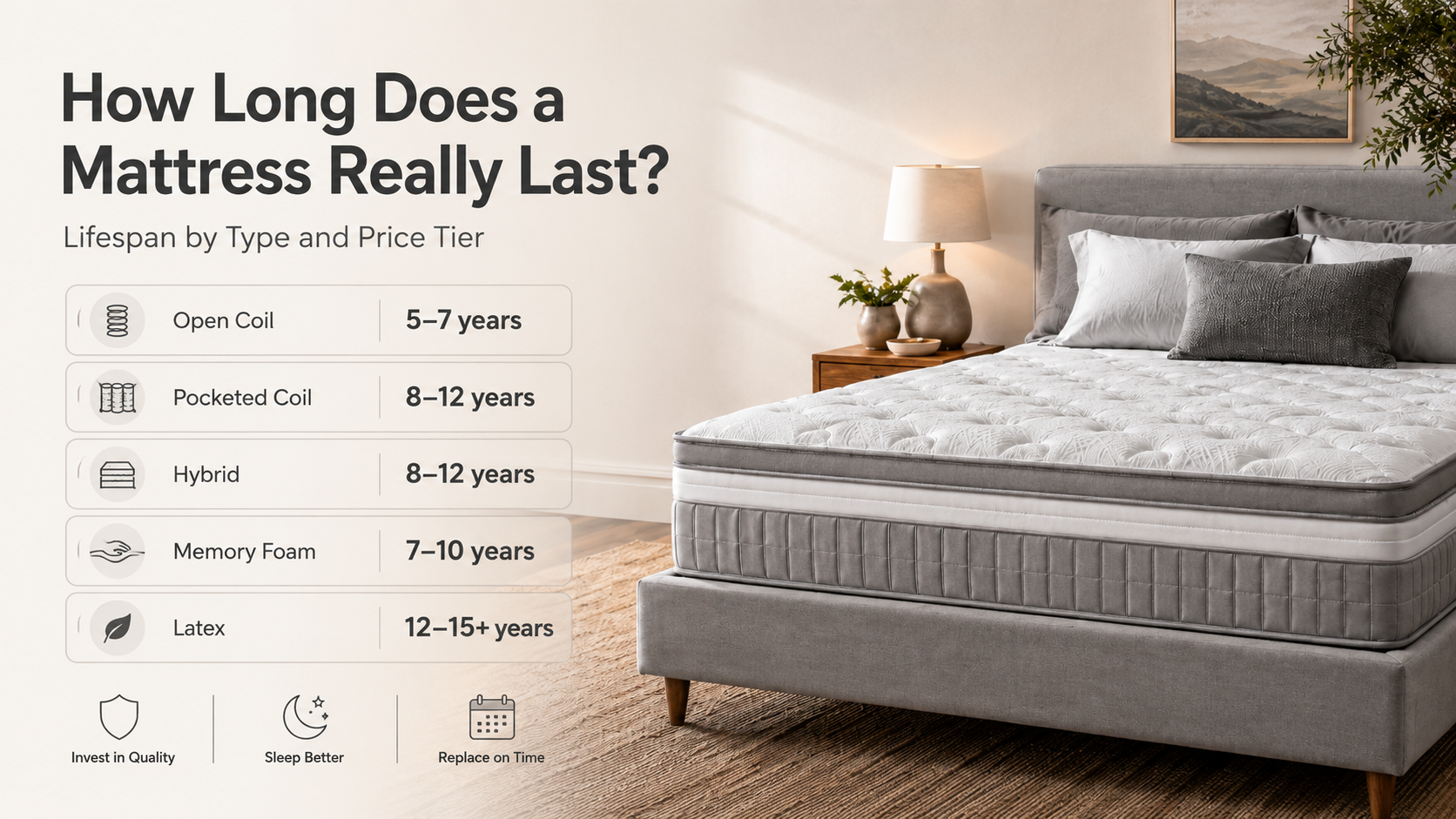
Mattress lifespan varies by construction. The table below gives practical estimates for a mattress used every night by one or two adults.
| Mattress type | Typical lifespan | What usually limits its life |
|---|---|---|
| Innerspring | 6–8 years | Sagging coils, weak edges, body impressions |
| Foam | 6–10 years | Softening, permanent dents, loss of support |
| Memory foam | 7–10 years | Compression, heat retention, loss of pressure relief |
| Latex | 10–15 years | Material breakdown, surface wear, foundation problems |
| Hybrid | 7–10 years | Foam wear or coil fatigue |
| Air bed | 8–10 years | Pump, valve, chamber, or remote problems |
| Adjustable bed base | 7–10 years | Motor, wiring, remote, or frame failure |
These are estimates, not guarantees. A mattress with strong materials and good support may last longer. A mattress used by heavier sleepers, couples, or people who sit on the edge often may show wear sooner.
A warranty also does not prove that a mattress will feel comfortable for its entire warranty period. A warranty mainly covers certain defects under specific rules. It may not cover normal softening, comfort changes, stains, or a small body impression.
Why mattress types age differently
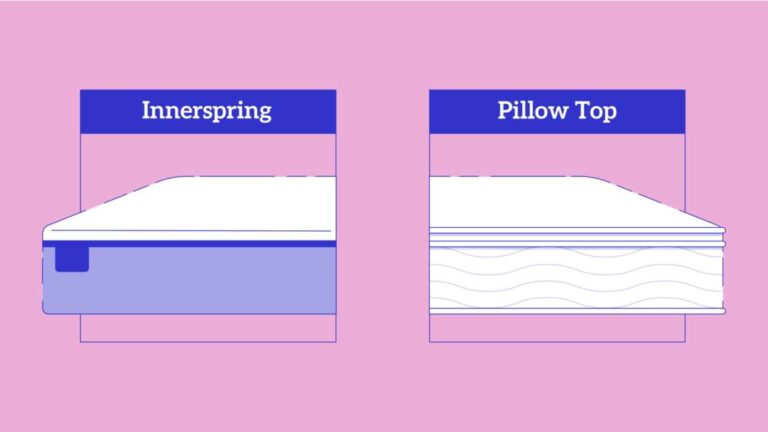
Innerspring mattresses rely on metal coils. The coils may remain intact for years, but the foam, fiber, and fabric above them can soften first. Lower coil counts do not automatically mean poor quality, since coil shape, wire thickness, and overall design also matter.
Foam mattresses often lose firmness before they show visible damage. Heat, body weight, and repeated compression can make the sleep surface feel uneven. High-density foam generally resists early wear better than very low-density foam, but density alone does not predict the full life of a mattress.
Latex mattresses often last the longest. Natural or blended latex can resist deep impressions, though the cover, comfort layers, and support base may still wear out. “Latex” is not one single material, so construction and quality still matter.
Hybrid mattresses combine foam with coils. Their lifespan depends on both parts. The foam may soften while the coils still work, or the support core may weaken while the surface looks acceptable.

Signs Your Mattress Needs Replacing
The clearest sign is a repeated loss of comfort or support. If you sleep better in another bed, wake with new aches, or feel as if you are sinking into a hole, the mattress may have reached the end of its useful life.
Check these signs:


- A visible dip, ridge, or sag in the sleep surface
- Pain or stiffness that improves after you get out of bed
- More tossing and turning than usual
- Waking when your partner moves
- A noisy or unstable surface
- Broken, bent, or exposed coils
- Foam that feels lumpy, crumbly, or uneven
- A damaged cover that exposes internal materials
- A persistent odor that does not fade after cleaning and airing
- Allergy symptoms that seem worse in bed
- A base or frame that no longer supports the mattress
A small body impression is not always a defect. Many foams soften slightly with use. The important question is whether the change affects sleep or support.
Use a simple floor test
If you suspect sagging, place the mattress on a firm, flat surface for a short test, following the maker’s instructions. Do not use the floor for long periods because poor airflow can trap moisture and encourage mold.
If the mattress feels much better on a firm surface, the problem may be the bed frame, slats, box spring, or foundation. If it still feels uneven, the mattress itself may be worn.
Do not use this test as a permanent fix. A mattress needs the correct support system for ventilation, stability, and warranty requirements.
A useful comfort check
Ask yourself:
- Do I wake with pain or stiffness most mornings?
- Does the mattress sag or feel uneven?
- Do I sleep better somewhere else?
- Has the mattress become too soft, too firm, or too hot?
- Have my body, sleep position, or health needs changed?
- Is the mattress older than the period when its materials usually perform well?
One “yes” does not prove that you need a new mattress. Several “yes” answers point to a replacement decision.

What Affects How Long a Mattress Lasts?
The same mattress can last different lengths of time in different homes. These factors matter most.
Body weight and sleep position
A mattress carries force every night. A heavier sleeper may create more compression, especially in the hips and shoulders. Couples also place more total load on the surface than one person.
Side sleepers often wear the comfort layers faster because the shoulders and hips press into the same areas. Stomach and back sleepers may notice loss of support when the center of the mattress softens.
This does not mean a certain body type should use a particular mattress. It means the mattress must provide enough support for the people using it.
Mattress quality and material density
Material quality affects durability, but labels can be vague. Terms such as “premium,” “luxury,” and “orthopedic” do not tell you how long a mattress will last.
For foam, density is useful information because denser foam usually contains more material per cubic foot. However, it does not describe every layer or predict comfort for every sleeper.
For coils, look beyond the number of coils. Wire thickness, coil design, edge support, padding, and assembly all affect performance.
Foundation and frame support
A good mattress can wear out early on a weak base. A frame that bends, missing slats, or wide gaps between slats can cause uneven support.


Check the mattress maker’s support rules before changing the base. Some mattresses require a solid platform. Others permit slats only when the slats meet a stated spacing limit.
A center support beam may be needed for larger U.S. bed sizes, such as queen, king, and California king. The exact requirement depends on the frame and mattress.
Climate and moisture
Heat and humidity can affect comfort and materials. Moisture from sweat, spills, high humidity, or poor airflow may lead to odor or mold.
Use a washable protector that allows airflow. Keep the room reasonably dry. Do not seal a damp mattress in plastic for storage.
Frequency of use
A main bedroom mattress receives far more wear than a guest mattress. A guest mattress may last longer, but age can still matter if the foam has degraded or the cover has become contaminated.
A mattress in a vacation home may also age without constant use, especially in a hot or humid space.

How to Make a Mattress Last Longer
You can slow wear, but you cannot stop normal aging. These steps help protect the mattress and maintain its support.
1. Use the correct foundation
Confirm that the base matches the mattress. Follow the manufacturer’s instructions for slat spacing, center support, and weight limits.
Do not place a mattress on a damaged box spring or a frame that bows in the center. Repair or replace the base before blaming the mattress for uneven support.
2. Add a waterproof, breathable protector
A protector helps shield the mattress from sweat, spills, skin oils, and stains. It can also make cleaning easier.
Choose a protector that fits the mattress depth. A loose protector can bunch up and affect comfort. A plastic cover that traps heat may also make sleep less comfortable.
3. Rotate it when allowed
Many modern mattresses should not be flipped because they have a specific top and bottom. Rotating the mattress from head to foot may help spread wear, but only if the manufacturer allows it.
Do not flip a one-sided mattress. Do not rotate a mattress with built-in features, handles, or zoning unless the instructions permit it.
4. Clean it gently
Wash sheets and the protector as directed. Vacuum the mattress surface with an upholstery attachment when needed.


Avoid soaking the mattress. Water can move deep into foam and padding, where it dries slowly. Do not use harsh chemicals unless the manufacturer approves them.
5. Keep pets from damaging the surface
Pet claws, accidents, and repeated jumping can shorten mattress life. A washable protector adds a useful barrier, but it may not prevent all damage.
6. Avoid standing or jumping on the bed
A mattress spreads weight across its support system. Concentrated force from standing or jumping can damage foam, coils, seams, or the foundation.

Mattress Warranty vs. Expected Lifespan
A mattress warranty and a mattress lifespan are not the same thing.
The expected lifespan is the period when a mattress may still provide acceptable comfort and support. The warranty period is the time when the manufacturer may repair or replace the mattress if a covered defect occurs.
A warranty may cover:
- Broken or bent coils
- Split or damaged seams
- A body impression deeper than the stated limit
- Structural defects in the mattress
A warranty may not cover:
- Normal softening
- A change in comfort preference
- Stains or liquid damage
- Burns, cuts, or physical abuse
- Damage from an incorrect foundation
- Transportation costs
- A body impression below the warranty threshold
Warranty terms differ by brand and model. Read the current warranty document for the exact mattress. Keep the receipt, model name, purchase date, and photos of any suspected defect.
If you make a claim, describe the problem clearly. A photo of a sagging mattress may help, but the manufacturer may require a measurement or inspection.
The Federal Trade Commission advises consumers to understand warranty terms and the company’s responsibilities before relying on warranty protection. A long warranty is not proof that the mattress will remain comfortable for that entire time.
Should You Replace a Mattress After 7 or 8 Years?
Not automatically. Seven or eight years is a useful review point, not a compulsory replacement date.
Replace the mattress when age combines with a meaningful problem, such as:
- Loss of support
- Ongoing discomfort
- Visible damage
- Poor sleep despite healthy sleep habits
- Hygiene concerns that cleaning cannot solve
- A change in your needs that the mattress cannot meet
A mattress that is eight years old and still comfortable may not need immediate replacement. A mattress that is four years old but badly sagging may need replacement now.
Before buying a new one, check three things:
- The mattress: Look for sagging, lumps, damage, odors, and loss of support.
- The foundation: Check for broken slats, loose parts, or a bowed frame.
- Your sleep needs: Consider changes in weight, sleep position, pain, temperature comfort, or sharing the bed.
If the foundation is the problem, replacing only the base may help. If the mattress is worn, a new foundation alone will not restore its original feel.

How Much Longer Will a Mattress Last?
You cannot calculate an exact date, but you can make a reasonable estimate.
Use this simple method:
Estimated remaining life = expected service range − years of regular use
For example, this is a hypothetical estimate:
- A hybrid mattress may have a useful range of 7 to 10 years.
- It has been used every night for 6 years.
- It shows mild softening but no major sagging.
- Its estimated remaining useful period may be roughly 1 to 4 years, depending on comfort and support.
This is not a warranty calculation. It is a decision aid.
Reduce the estimate when several risk factors are present:
- Two adults use the mattress every night
- The sleepers place high pressure on one area
- The mattress has low-quality or very soft comfort layers
- The base provides poor support
- The mattress has been exposed to moisture
- The surface already shows permanent impressions
Increase the estimate when:
- The mattress is used rarely
- It has a durable construction
- It has a strong, correct foundation
- It has been protected from spills and moisture
- It still feels even and supportive
The final test is sleep quality. If the mattress causes discomfort or poor sleep, a theoretical remaining lifespan has little practical value.

How to Dispose of an Old Mattress in the U.S.
Do not leave a mattress at the curb unless your local rules allow it. Many U.S. cities require special pickup, a drop-off appointment, or a disposal fee.
Start with these options:
- Contact your city or county waste department.
- Ask whether the local landfill or transfer station accepts mattresses.
- Check whether a recycling program operates in your state.
- Ask the retailer whether it offers removal with a new mattress delivery.
- Donate the mattress only if it is clean, undamaged, and accepted by the organization.
The Mattress Recycling Council operates state programs in several parts of the United States, including California, Connecticut, and Rhode Island. Rules and fees vary by location, so check the current program information before transport.
Do not donate a mattress with bed bugs, mold, major stains, strong odors, broken parts, or structural damage. Donation centers set their own rules, and many cannot accept used mattresses.
Wrap the mattress only as required by the disposal service. Keep it dry during transport. If you suspect bed bugs, seal and handle the mattress according to local pest-control guidance rather than passing it to another household.

Common Mattress Replacement Mistakes
Replacing by age alone
Age is a clue, not a diagnosis. A mattress can fail early or remain useful beyond the typical range.
Blaming the mattress for every ache
Pain can have many causes. A worn mattress may contribute to discomfort, but it cannot explain every symptom. Seek medical advice for severe, persistent, or worsening pain.
Buying a topper instead of replacing a failed mattress
A topper can change surface comfort. It cannot repair broken coils, deep sagging, a weak foundation, or damaged foam. It may be a short-term option when the support core still works.
Ignoring the bed frame
A weak frame can create dips and noise. Check the base before spending money on a new mattress.
Trusting the warranty length
A 10-year warranty does not mean the mattress will feel new for 10 years. Read the covered defects, exclusions, support rules, and claim process.
Keeping a damaged mattress because it was expensive
Past cost should not control a health and comfort decision. If the mattress is unsupportive, contaminated, or unsafe to use, replacing it may be the better choice.

Key Takeaways
- Most mattresses last about 7 to 10 years.
- Latex mattresses often last longer, while low-cost or heavily used mattresses may wear out sooner.
- Replace a mattress when it causes poor sleep, loses support, sags, or shows serious damage.
- Check the foundation before replacing the mattress.
- A warranty covers stated defects, not guaranteed comfort for the full warranty term.
- Use a breathable protector, the correct base, gentle cleaning, and proper care to extend mattress life.
- Check local U.S. rules before donating, recycling, or disposing of a mattress.
FAQs
Can a mattress last 20 years?
Some high-quality latex mattresses may remain usable for 15 years or more, but 20 years is uncommon for a mattress used every night. Even when the core remains intact, the cover, comfort layers, and support feel may change.
How often should you replace a memory foam mattress?
Many memory foam mattresses last about 7 to 10 years. Replace one sooner if it develops deep impressions, feels uneven, traps uncomfortable heat, or no longer relieves pressure.
Does flipping a mattress make it last longer?
Only if the mattress is designed for flipping. Many current mattresses have one sleeping side. Rotating may help some models, but follow the manufacturer’s instructions.
Can a mattress topper fix a sagging mattress?
A topper may hide a mild comfort problem for a short time. It cannot restore a sagging support core or repair broken coils. Deep sagging usually means the mattress or foundation needs replacement.
How do I know whether the mattress or foundation is the problem?
Inspect the frame, slats, center support, and box spring for bending or damage. If the mattress feels better on a properly supported, firm surface during a short test, the foundation may be the cause. Follow the mattress maker’s instructions and avoid long-term floor use.
Is it safe to sleep on a 15-year-old mattress?
Age alone does not make a mattress unsafe, but a 15-year-old mattress deserves a careful check. Replace it if it has mold, pests, exposed materials, structural damage, deep sagging, or poor support.
Conclusion
A mattress usually lasts 7 to 10 years, but the best replacement time depends on its condition and your sleep.
Inspect the surface, test the foundation, review your comfort, and check the warranty before deciding. If the mattress is clean, even, and supportive, it may still be useful. If it causes pain, poor sleep, or clear physical problems, its useful life may be over—even if it is relatively new.

Appliance Review Expert
Lucas Ramirez is a trusted voice at HomeFixGrid.com, known for his clear, practical, and creatively written guides that simplify appliance care for everyday homeowners. With a strong focus on hands-on testing and real-world problem-solving, Lucas brings expert insight into appliance reviews and troubleshooting techniques. Her work empowers readers to confidently maintain, repair, and choose the right appliances for their homes.