Is Memory Foam Or Hybrid Mattress Better: Find Out
For most people in the United States, a hybrid mattress is better if you want strong support, easier movement, and better airflow. Memory foam is better if you want deep pressure relief, quiet sleep, and very little motion transfer.
Neither type is best for every sleeper. Your body weight, sleep position, pain concerns, room temperature, budget, and preference for a firm or soft feel all matter. The best choice is the mattress that keeps your spine level and lets you sleep without frequent pressure or heat discomfort.
Key Takeaways
- Choose memory foam for pressure relief, motion isolation, and a quiet sleep surface.
- Choose a hybrid mattress for stronger edge support, more bounce, and easier movement.
- Hot sleepers often prefer hybrids, though foam type and mattress cover also affect temperature.
- Side sleepers often like memory foam or a softer hybrid.
- Stomach sleepers usually need a firmer hybrid or firm foam mattress.
- A medium-firm feel may help some adults with low back pain, but personal fit matters.
- Mattress trials are useful because online descriptions cannot show how a bed feels to your body.
What Is the Difference Between Memory Foam and a Hybrid Mattress?
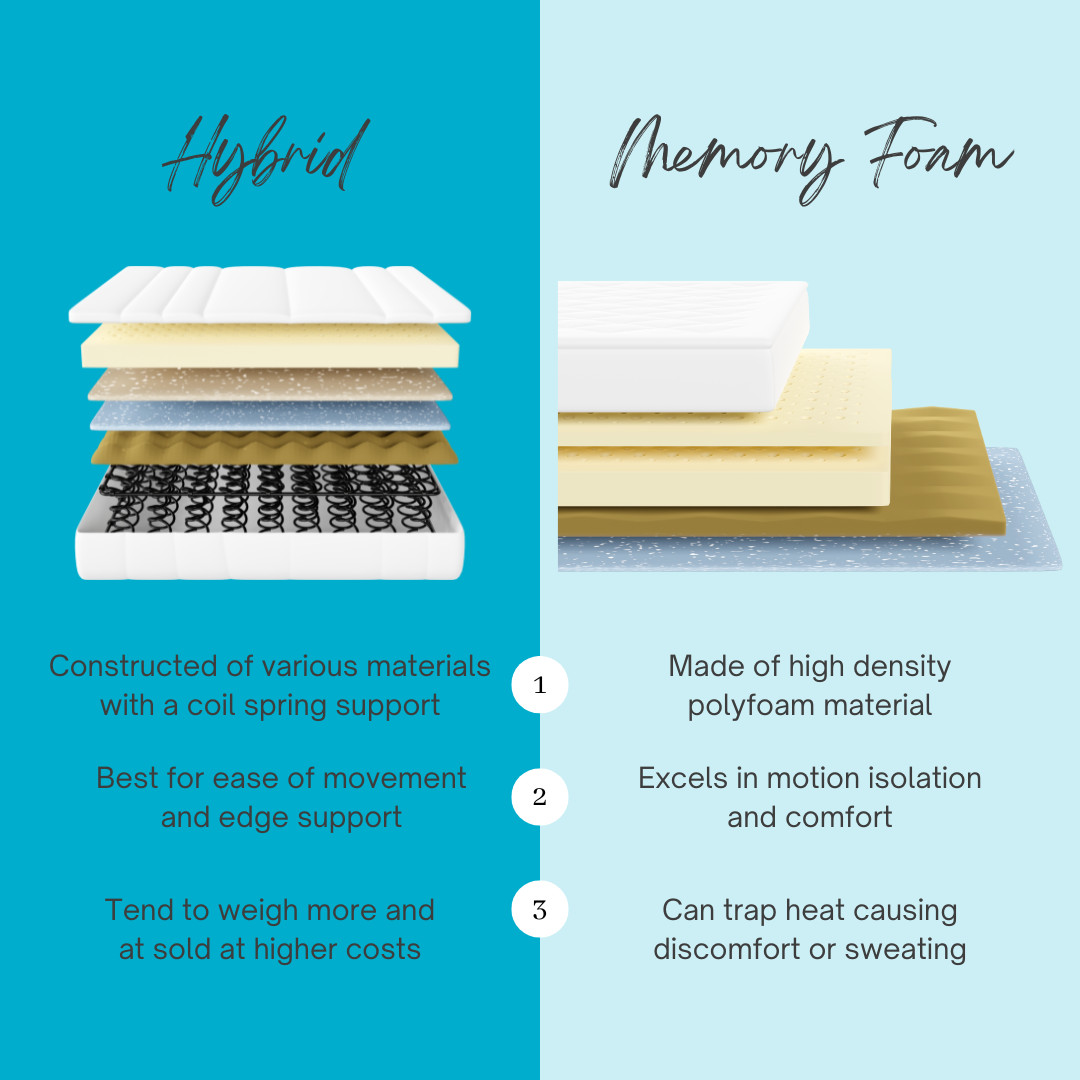
Memory foam mattresses use foam as the main support system. Hybrid mattresses combine foam comfort layers with a pocketed coil support core.
Memory foam mattress
Memory foam is a type of viscoelastic foam. It softens under body heat and pressure. As you lie down, it slowly molds around your shoulders, hips, and other pressure points.
A typical memory foam mattress may include:
- A soft quilted cover
- One or more comfort layers
- A thicker memory foam or polyfoam layer
- A dense foam support base
Some all-foam mattresses use memory foam only in the upper layers. Others use different foam types for comfort and support. Therefore, the label “memory foam” does not tell you the full feel of the mattress.
Hybrid mattress
A hybrid mattress combines foam with steel coils. Most modern hybrids use individually wrapped pocketed coils. These coils compress more independently than old-style connected coils.
A typical hybrid may include:
- A fabric or quilted cover
- Memory foam, latex, or polyfoam comfort layers
- A transition layer
- Pocketed coils
- A foam border around the coil unit
The coils add lift and support. The foam adds cushioning. This combination gives a hybrid a more buoyant feel than most all-foam mattresses.

Memory Foam vs. Hybrid: Side-by-Side Comparison
The table below compares the common traits of each mattress type. The exact result can change with firmness, foam density, coil design, and body size.
| Feature | Memory foam | Hybrid mattress |
|---|---|---|
| Pressure relief | Usually very good | Good to very good |
| Motion isolation | Usually excellent | Good, but varies |
| Ease of movement | Lower | Higher |
| Edge support | Fair to good | Usually good to very good |
| Bounce | Low | moderate to high |
| Airflow | Fair to limited | Usually better |
| Noise | Nearly silent | Usually quiet, but coils may make noise over time |
| Body contouring | Deep and close | Moderate to deep |
| Feel | Hugging and slow-moving | Lifted, responsive, or gently cushioned |
| Weight | Often lighter | Often heavier |
| Best for | Side sleepers and couples who value isolation | Combination sleepers and people who want support |
These are broad patterns, not guarantees. A firm memory foam mattress may feel cooler and easier to move on than a soft model. A hybrid with thick memory foam may feel warmer and less responsive than a latex hybrid.
Which Is Better for Different Sleep Positions?
Your sleep position is one of the strongest clues when choosing between memory foam and a hybrid mattress.
Side sleepers
Memory foam often works well for side sleepers because it can cushion the shoulders and hips. This may reduce pressure when the mattress has enough room to let those areas sink.
A softer hybrid can also work well. Its coils may stop the body from sinking too far. This can help side sleepers who want pressure relief but dislike the trapped feeling of foam.
Look for:
- A comfort layer that cushions the shoulder and hip
- A surface that keeps the waist supported
- A medium-soft to medium-firm feel, depending on body size
- A wide enough mattress to avoid pushing against the edge
Very firm mattresses may create pressure at the shoulder. Very soft mattresses may let the hips sink too far.
Back sleepers
Both mattress types can suit back sleepers. The main goal is balanced support beneath the lower back and hips.
A medium-firm memory foam mattress may provide close support. A hybrid may feel more supportive if you prefer a lifted surface and stronger pushback.
Look for:
- Even support under the lumbar area
- Enough cushioning for the shoulders and hips
- No visible dip beneath the pelvis
- A firmness that lets you rise and turn without strain
A mattress that feels comfortable for five minutes may still allow poor alignment after several hours. Use the full trial period when possible.
Stomach sleepers
Stomach sleepers often need a firmer surface. A mattress that is too soft may allow the abdomen and hips to sink. That can place the lower back in an uncomfortable position.
A firm hybrid is often a practical choice because its coil unit can provide strong upward support. A firm all-foam mattress can also work, especially for lighter adults.
Look for:
- Firm support beneath the hips
- Limited sinking around the midsection
- Enough comfort to prevent pressure on the ribs and chest
- Strong edge support if you sleep near the side
Combination sleepers
Combination sleepers change positions during the night. A hybrid is often easier to move on because the coils push back quickly. Memory foam can still work, but a responsive foam design may be more suitable than a very slow, deep model.

Which Mattress Is Better for Back Pain?
Neither memory foam nor hybrid mattresses can guarantee relief from back pain. The better option is the one that supports neutral spinal alignment and does not create pressure.
A randomized trial published in The Lancet found that people with chronic, nonspecific low back pain reported better outcomes on medium-firm mattresses than on firm mattresses. The study compared firmness, not memory foam against hybrids. It does not prove that one mattress material treats back pain.
For back comfort, focus on:
- Spinal alignment: Your hips should not sink far below your shoulders.
- Pressure relief: Your shoulders and hips should not feel jammed against the surface.
- Movement: You should be able to turn without fighting the mattress.
- Personal firmness: Your ideal firmness depends partly on body weight and sleep position.
Memory foam may help people who need close cushioning around the hips and shoulders. A hybrid may suit people who need more lift, stronger edge support, or easier movement.
Seek medical advice if back pain follows an injury, causes weakness or numbness, spreads down a leg, or lasts despite basic self-care. A mattress is not a substitute for diagnosis or treatment.

Which Mattress Sleeps Cooler?
A hybrid mattress usually has an airflow advantage because air can move through the coil section. Memory foam can retain more heat, especially when it is thick, soft, and closely contouring.
Still, the coil unit is only one part of temperature control. Heat depends on:
- Foam density and thickness
- Mattress firmness
- Cover fabric
- Bedroom temperature
- Sheets and blankets
- Body size
- How deeply you sink into the mattress
Some memory foam mattresses use open-cell foam, gel, phase-change fabric, or ventilation channels. These features may change the feel, but marketing terms do not guarantee that a mattress will sleep cool.
If you sleep hot, consider a hybrid with:
- A thinner comfort layer
- A breathable cover
- Responsive foam or latex
- A coil core with room for airflow
Also check your bedding. A thick comforter or heat-trapping sheet set can make a cool mattress feel warm.
Which Mattress Is Better for Couples?
Memory foam usually performs better for motion isolation. Its dense, conforming surface absorbs more movement when one person turns or gets out of bed.
A hybrid can also isolate motion well, especially when it uses pocketed coils and generous foam layers. However, the coil system may transmit more movement than an all-foam design. A highly responsive hybrid may also make movement more noticeable.
Choose memory foam if:
- One partner wakes easily
- One person moves often
- You want a quiet, still surface
- You do not need much bounce
Choose a hybrid if:
- Both partners want easier movement
- You need stronger edge support
- You share a smaller bed
- You prefer a more buoyant feel
Firm edges matter for couples because they preserve usable sleeping space. A mattress with weak edges can make both sleepers feel pushed toward the center.

Which Mattress Lasts Longer?
A quality hybrid may have a durability advantage because its coil system supplies durable support. However, construction quality matters more than the word “hybrid” alone.
Foam can soften or develop body impressions over time. Coils can also lose tension, and the foam above them may wear before the springs do. The following factors affect mattress life:
- Foam density
- Total material thickness
- Sleeper weight
- Nightly use
- Bed frame support
- Rotation instructions
- Heat and humidity
- Manufacturing quality
Do not judge durability by the warranty alone. A warranty may cover a visible defect but exclude normal softening, comfort changes, or damage from an unsuitable foundation. Read the warranty and return terms before buying.
A properly supported mattress can last longer than one placed on a weak or widely spaced frame. Follow the mattress maker’s foundation requirements.
Which Mattress Is Better for Sex?
A hybrid mattress usually offers more bounce and makes movement easier. Its coil system gives the surface a springier feel.
Memory foam provides more traction and less bounce. Some couples like that stable feel, while others find it harder to change positions.
For this use, compare:
- Bounce
- Edge support
- Noise
- Ease of movement
- Surface stability
A hybrid is often the more versatile choice. A responsive latex or foam hybrid may offer movement without the strong bounce of some coil designs.
How Firm Should Your Mattress Be?
Firmness is personal, but body weight changes how a mattress feels.
A heavier sleeper may feel a mattress as softer because the body compresses the comfort layers more deeply. A lighter sleeper may feel the same mattress as firmer because less of the body sinks into it.
Use this starting guide:
| Sleeper need | Useful starting point |
|---|---|
| Side sleeping with shoulder or hip pressure | Medium-soft to medium |
| Back sleeping with balanced support | Medium to medium-firm |
| Stomach sleeping | Medium-firm to firm |
| Heavier body weight | Strong support with enough surface cushioning |
| Lighter body weight | Softer comfort layer may be needed |
| Frequent position changes | Responsive hybrid or responsive foam |
These are starting points, not medical rules. A mattress can feel firm at first and soften after several minutes. Test it while lying in your usual position.
Common Mistakes When Choosing Between Foam and Hybrid
Choosing by material name alone
“Memory foam” and “hybrid” describe broad categories. They do not reveal firmness, foam density, coil count, edge design, or comfort-layer thickness.
Read the full construction details when available.
Buying the softest mattress for pressure relief
Softness can reduce pressure at first. Too much softness can allow the hips to sink and make movement harder.
Pressure relief and support must work together.
Ignoring body size
A mattress may feel firm to one sleeper and soft to another. Reviews from people with different body types may not predict your experience.
Forgetting the foundation
A compatible foundation helps the mattress perform as designed. An unsuitable frame may cause sagging, poor support, or warranty problems.
Treating cooling claims as proof
Gel, copper, and open-cell foam may affect heat management, but no feature guarantees cool sleep. The whole mattress and your bedding system matter.
Returning a mattress too soon
New mattresses can feel different from the bed you replace. Follow the company’s break-in and return rules. If you have serious pain or poor alignment, do not force yourself to keep using a mattress that feels unsafe or clearly unsuitable.

A Simple Decision Guide
Choose memory foam when most of these statements fit you:
- You sleep on your side.
- You want deep cushioning.
- You share a bed with a restless partner.
- You dislike bounce.
- You want a nearly silent mattress.
- You prefer a close, body-hugging feel.
Choose a hybrid mattress when most of these statements fit you:
- You sleep hot.
- You change positions often.
- You want stronger edge support.
- You prefer a lifted, responsive feel.
- You need support for a larger body size.
- You dislike the feeling of sinking into foam.
- You want a mattress that is easier to move on.
If your needs are split, consider a medium-firm hybrid with a moderate foam layer. It often provides a middle ground between pressure relief, airflow, support, and movement.
How to Test a Mattress at Home
Use the trial period as a structured test rather than judging the mattress after one night.
- Place the mattress on the required foundation.
- Use your normal pillow and bedding.
- Sleep in your usual positions.
- Check whether your shoulders and hips feel pressured.
- Notice whether your lower back feels strained.
- Check if you wake from heat or partner movement.
- Try getting in and out near the edge.
- Keep the mattress only if your sleep improves and your body feels supported.
A successful fit usually means you wake with less stiffness, stay asleep more easily, and can change positions without discomfort. If pain, numbness, or severe pressure continues, stop treating the mattress as a health solution and consult a qualified clinician.

Frequently Asked Questions
Is a hybrid mattress better than memory foam for side sleepers?
Not always. Memory foam may give better pressure relief at the shoulder and hip. A softer hybrid can work well when you want that cushioning with more lift and airflow.
Do hybrid mattresses sag less than memory foam mattresses?
They may, but construction and material quality are more important than the category name. A weak hybrid can sag, and a well-made foam mattress can perform well for years.
Is memory foam better for people with allergies?
Neither type is automatically allergy-proof. Use a washable, protective cover and keep the sleep area clean. Check the materials and care instructions if you have a known sensitivity.
Can a hybrid mattress be as quiet as memory foam?
Often, yes. Pocketed coils are usually quieter than older connected-coil systems. Noise can develop from the coils, frame, or foundation, so the entire bed setup matters.
Are memory foam mattresses safe?
Memory foam is widely used in residential mattresses. Some new mattresses may have an odor when unpacked. Ventilate the room and follow the manufacturer’s instructions. If an odor causes breathing problems or irritation, leave the area and seek medical guidance.
Final Verdict: Memory Foam or Hybrid?
Memory foam is better for deep pressure relief, motion isolation, and a quiet sleep surface. A hybrid mattress is better for airflow, edge support, bounce, and easier movement.
For many U.S. shoppers, a medium-firm hybrid is the safer all-around starting point. For side sleepers who value a close, cushioned feel or couples who are highly sensitive to movement, memory foam may be the better match.
Before you buy, compare firmness, comfort-layer thickness, foundation rules, trial length, return costs, and warranty limits. Then choose based on how your body sleeps—not only on the mattress label.

Appliance Review Expert
Lucas Ramirez is a trusted voice at HomeFixGrid.com, known for his clear, practical, and creatively written guides that simplify appliance care for everyday homeowners. With a strong focus on hands-on testing and real-world problem-solving, Lucas brings expert insight into appliance reviews and troubleshooting techniques. Her work empowers readers to confidently maintain, repair, and choose the right appliances for their homes.