What Are The Dimensions Of A Single Mattress: Size Guide
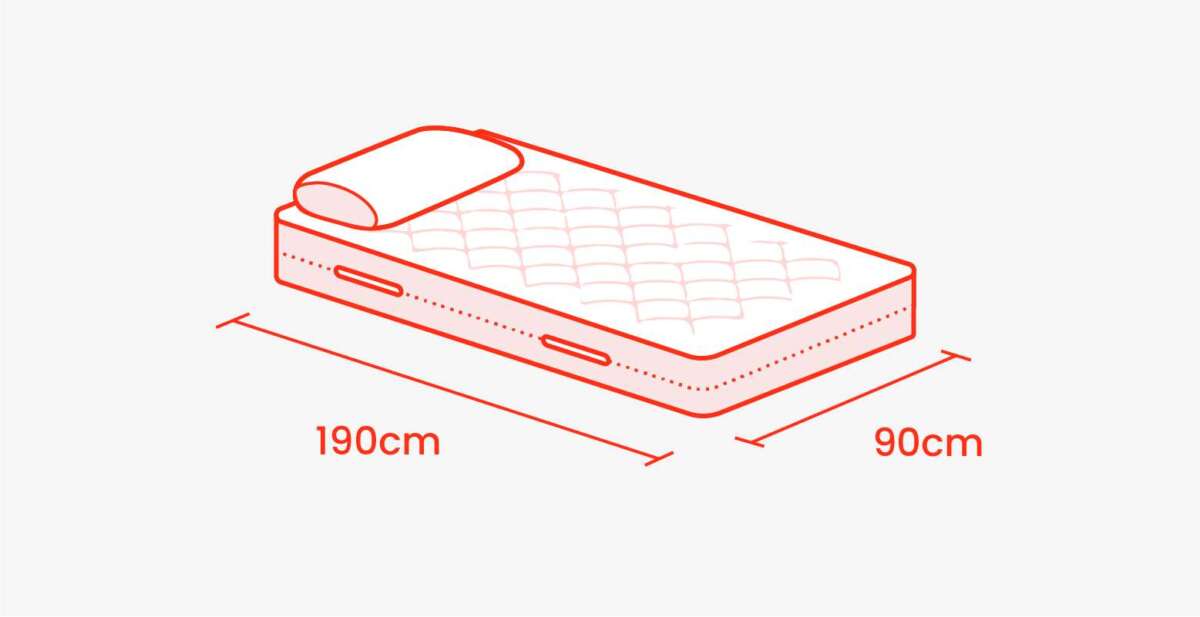
In the United States, a single mattress usually means a Twin mattress. A standard Twin mattress measures 38 inches wide by 75 inches long—about 3 feet 2 inches by 6 feet 3 inches.
Some brands list small differences in width, length, or thickness. Always check the product specifications before buying a mattress, bed frame, sheets, or a box spring.
Quick answer: standard single mattress size in the USA
A standard U.S. single mattress, also called a Twin mattress, has these dimensions:
| Measurement | Inches | Feet |
|---|---|---|
| Width | 38 inches | 3 feet 2 inches |
| Length | 75 inches | 6 feet 3 inches |
| Surface area | 2,850 square inches | About 19.8 square feet |
The standard Twin mattress is the smallest common adult mattress size in the United States. It is often used in children’s rooms, guest rooms, dorms, bunk beds, studio apartments, and other small spaces.
A Twin mattress is designed for one person. It can work well for a child or shorter adult, but many taller sleepers may find its 75-inch length too short.

What is a single mattress called in the United States?
In the U.S., “single mattress” is not usually the main retail name. The common term is Twin mattress.
The terms generally refer to the same basic size:
- Single mattress
- Twin mattress
- Standard Twin mattress
- Twin bed mattress
A Twin mattress is different from a Twin XL mattress. A Twin XL has the same width but adds 5 inches of length.
| Mattress type | Width | Length | Best known use |
|---|---|---|---|
| Standard Twin | 38 inches | 75 inches | Children, guest rooms, small rooms |
| Twin XL | 38 inches | 80 inches | College dorms and taller sleepers |
| Full/Double | 54 inches | 75 inches | One adult who wants more room |
Some manufacturers round measurements. For example, a mattress may be listed as 39 by 75 inches even though it is intended for a standard Twin frame. The product label and the manufacturer’s detailed size chart should take priority.

How thick is a single or Twin mattress?
The width and length of a Twin mattress are fairly consistent, but thickness is not standardized in the same way.
A Twin mattress may be:
- 5 to 8 inches thick: Often used for children, bunk beds, trundle beds, or temporary sleeping areas
- 8 to 12 inches thick: Common for foam, hybrid, and innerspring mattresses
- 12 to 16 inches thick: Usually made with thicker comfort layers or a taller coil and foam design
A thicker mattress is not automatically better. Its height affects bed access, sheet fit, guardrail clearance, and the overall height of a bunk or platform bed.
Before buying a thick mattress, check the bed’s maximum mattress height. This matters most for bunk beds and raised beds. A mattress that is too thick can reduce the space between the mattress and the upper guardrail.

How much room does a Twin mattress need?
The mattress itself needs a floor area of about 38 by 75 inches. The room needs more space because the bed frame, headboard, footboard, bedding, and walking paths add to the total footprint.
For planning purposes:
- Mattress footprint: about 3 feet 2 inches by 6 feet 3 inches
- Common frame footprint: often slightly larger than the mattress
- Room around the bed: depends on doors, drawers, closets, windows, and walking paths
A practical layout should leave enough room to get into bed, change sheets, open drawers, and move around the room. The exact clearance depends on the room and furniture, so there is no single required distance for every bedroom.
Measure the full frame, not only the mattress. A headboard or footboard can add several inches to the overall length. Side rails can also make the bed wider than the mattress.

Will a standard Twin mattress fit a single bed frame?
A standard Twin mattress should fit a frame made for a standard U.S. Twin mattress, but small gaps or tight spots can occur.
Check these measurements before buying:
- Measure the inside width of the frame.
- Measure the inside length of the frame.
- Check whether the frame is labeled Twin or Twin XL.
- Confirm the frame supports the mattress type and weight.
- Look for manufacturer instructions about platform spacing and support.
A frame that is much larger than the mattress can allow the mattress to shift. A frame that is too small can compress the mattress edges or make installation difficult.
Do not assume that every “single” frame uses U.S. Twin dimensions. Imported furniture may use a different regional size. Measure the actual inside area whenever possible.

Twin vs. Twin XL: what is the difference?
The key difference is length. A Twin XL is 38 inches wide and 80 inches long, while a standard Twin is 38 inches wide and 75 inches long.
That extra 5 inches can make a noticeable difference for taller sleepers. A person near or above 6 feet tall may have less room on a standard Twin, especially if they sleep fully stretched out.
| Feature | Twin | Twin XL |
|---|---|---|
| Width | 38 inches | 38 inches |
| Length | 75 inches | 80 inches |
| Surface area | About 19.8 square feet | About 21.1 square feet |
| Common setting | Children’s rooms, guest rooms | Dorm rooms, adult bedrooms |
| Sheet fit | Twin sheets | Twin XL sheets |
Twin and Twin XL bedding are not interchangeable in length. Twin sheets may not cover a Twin XL mattress properly, while Twin XL fitted sheets can be too loose on a standard Twin mattress.
The same rule applies to bed frames, mattress protectors, box springs, and foundations: match the exact size.

How does a Twin compare with other U.S. mattress sizes?
A Twin is the narrowest standard U.S. mattress size. The next common size is a Full, also called a Double.
| Mattress size | Width | Length | Typical capacity |
|---|---|---|---|
| Twin | 38 inches | 75 inches | One person |
| Twin XL | 38 inches | 80 inches | One person |
| Full/Double | 54 inches | 75 inches | One person; sometimes two |
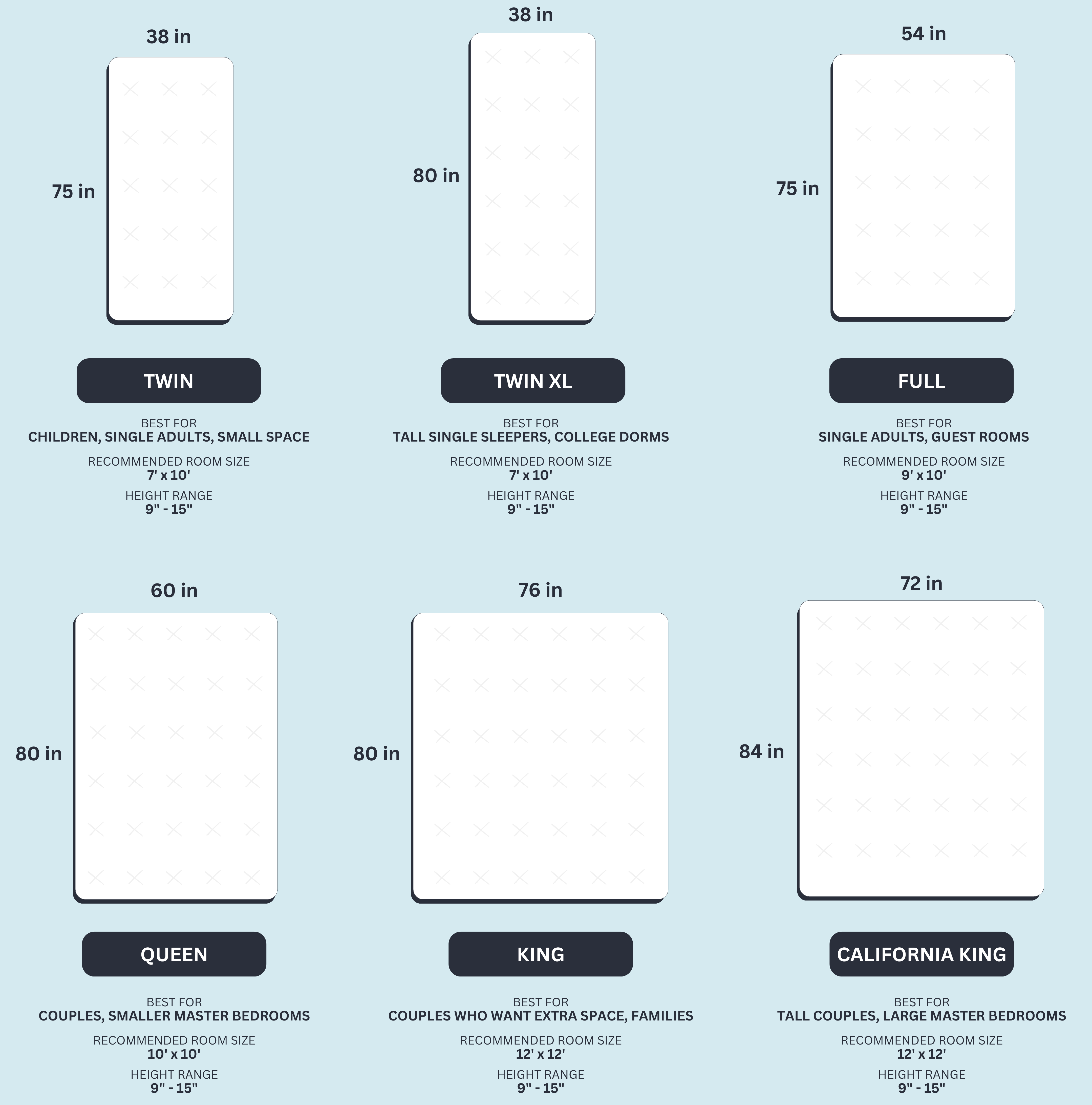
| Queen | 60 inches | 80 inches | One or two people |
| King | 76 inches | 80 inches | Two people |
| California King | 72 inches | 84 inches | Two people who need extra length |
A Twin gives up sleeping space in exchange for a smaller footprint and lower bedding cost. A Full provides 16 more inches of width than a Twin but keeps the same 75-inch length.
A Queen is both wider and longer than a Twin. It may be more comfortable for most adults, but it needs more floor space and usually costs more.

Is a Twin mattress suitable for adults?
A Twin mattress can suit an adult if the sleeper is comfortable with its 38-inch width and 75-inch length.
It may work well for:
- A shorter adult
- A guest room used occasionally
- A narrow bedroom
- A temporary sleeping arrangement
- A daybed or trundle
- A budget-conscious setup
- A room with limited floor space
A Twin may feel restrictive for an adult who moves a lot during sleep or shares the bed. The 75-inch length can also leave taller sleepers with little room at the foot of the bed.
For an adult who wants the same narrow width but more legroom, a Twin XL is usually the more suitable option. The frame and bedding must also be Twin XL size.
Can two Twin mattresses make a king bed?
Two standard Twin mattresses placed side by side measure 76 inches wide by 75 inches long. A standard King mattress measures 76 inches wide by 80 inches long.
Therefore, two Twin mattresses are the same width as a King but 5 inches shorter. Two Twin XL mattresses measure 76 by 80 inches, which matches the surface dimensions of a standard King.
This setup can be useful for couples who want separate mattresses or different firmness levels. However, the mattresses need proper support, and a gap may form between them unless the base is designed for the arrangement.
Use King-size bedding for two Twin XL mattresses side by side. Standard Twin mattresses will need bedding that matches their shorter length, or they may require a custom arrangement.

How to measure a single mattress correctly
Measure the mattress when it is not compressed by tight bedding.
- Remove the sheets and mattress protector.
- Measure from one side edge to the other for the width.
- Measure from the head edge to the foot edge for the length.
- Measure the height from the bottom surface to the highest point.
- Record the measurements in inches.
- Compare them with the frame and bedding specifications.
Do not press down on a pillow-top or quilted surface while measuring its height. Compression can make the mattress appear thinner than it is.
Mattress dimensions may vary slightly because of materials, cover construction, tufting, and manufacturing tolerances. A small difference does not always mean the mattress is the wrong size, but a major difference may affect frame fit and sheet fit.
What size sheets fit a single mattress?
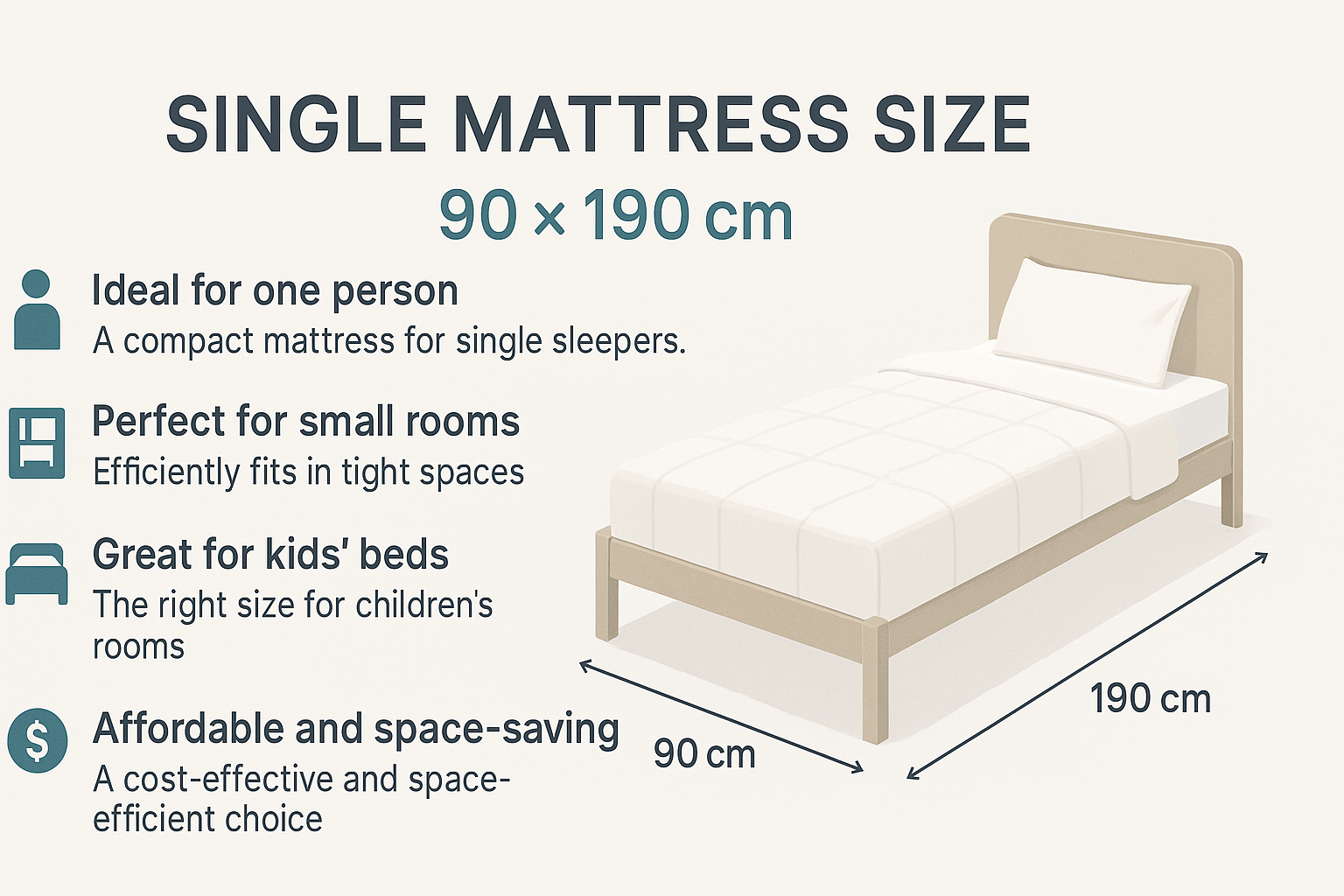
Standard Twin sheets are made for a standard Twin mattress. The fitted sheet must match both the mattress size and its depth.
For example, a fitted sheet labeled “Twin” may fit a standard Twin mattress that is:
- 38 by 75 inches
- 8 inches thick
- 10 inches thick
- 12 inches thick
The sheet’s listed pocket depth should be equal to or slightly greater than the mattress height. If the mattress has a thick topper, measure the mattress and topper together.
Use Twin XL sheets for a Twin XL mattress. Regular Twin sheets are 5 inches shorter and may pull loose from the corners.
Flat sheets are more forgiving than fitted sheets, but the mattress length still affects how well the sheet covers the bed.

Common mistakes when buying a single mattress
The most common mistake is treating “single,” “Twin,” and “Twin XL” as interchangeable terms. In U.S. stores, a single mattress usually means Twin, but Twin XL is a separate size.
Other mistakes include:
- Buying Twin XL bedding for a standard Twin mattress
- Measuring the old mattress instead of the bed frame
- Ignoring mattress thickness
- Forgetting the height of a mattress topper
- Placing a thick mattress on a bunk bed without checking guardrail clearance
- Assuming an imported “single” bed uses U.S. Twin dimensions
- Measuring the room but not the doorways and stairways
- Choosing a mattress that is too short for the sleeper
Check the mattress, frame, foundation, protector, and sheets as one complete system. Each part should use the same size label and compatible dimensions.

Frequently asked questions
Is a single mattress the same as a Twin mattress?
In the United States, a single mattress generally refers to a standard Twin mattress. The usual size is 38 by 75 inches. Because “single” can mean different dimensions in other countries, confirm the measurements before ordering imported furniture or bedding.
Is a Twin mattress big enough for one person?
A Twin mattress is designed for one person. It can be suitable for a child, shorter adult, guest, or sleeper with limited space. Taller adults or people who want more room may prefer a Twin XL or Full mattress.
Is a Twin mattress the same size as a Full mattress?
No. A Twin mattress is 38 by 75 inches. A Full mattress is 54 by 75 inches. Both have the same standard length, but a Full mattress is 16 inches wider.
Can a Twin mattress fit in a Twin XL frame?
Usually, no. A Twin XL frame is 5 inches longer than a standard Twin frame. A standard Twin mattress may leave an unwanted gap at the head or foot. Use a frame that matches the mattress size.
What is the smallest standard mattress size in the USA?
A standard Twin is the smallest widely available U.S. mattress size for children and adults. Specialty crib, toddler, cot, and RV mattresses may be smaller, but they use different size systems and should not be treated as standard Twin mattresses.
How wide is a single bed in feet?
A standard U.S. Twin mattress is 38 inches wide, which equals 3 feet 2 inches. The complete bed frame may be wider because of its rails, upholstery, or headboard.
Conclusion
A standard single mattress in the United States is usually a Twin mattress measuring 38 inches wide by 75 inches long. It is made for one sleeper and works well in small bedrooms, children’s rooms, guest rooms, dorm-style spaces, and bunk beds.
Choose a Twin XL if you need the same width with an extra 5 inches of length. Before buying, measure the mattress, frame, bedding, room, and entry route. The size label helps, but the manufacturer’s actual measurements are the safest final check.

Appliance Review Expert
Lucas Ramirez is a trusted voice at HomeFixGrid.com, known for his clear, practical, and creatively written guides that simplify appliance care for everyday homeowners. With a strong focus on hands-on testing and real-world problem-solving, Lucas brings expert insight into appliance reviews and troubleshooting techniques. Her work empowers readers to confidently maintain, repair, and choose the right appliances for their homes.