How Cold Does The Fridge Need To Be: Ideal Temp Guide
Your refrigerator should be 40°F (4°C) or colder. For a useful target, set it near 37°F (3°C). This gives the fridge room to warm slightly when you open the door without passing the food-safety limit.
Keep the freezer at 0°F (-18°C). Use a separate appliance thermometer to check both sections because the number on the fridge dial may not show the actual temperature inside.
The U.S. Department of Agriculture (USDA) and the U.S. Food and Drug Administration (FDA) advise keeping perishable food at 40°F or below. Food kept above that point for too long can enter the range where harmful bacteria grow quickly.


What Temperature Should a Refrigerator Be?
A refrigerator should stay between 33°F and 40°F, with 37°F as a practical everyday setting.
Temperatures below 32°F can freeze some foods, especially items near the back wall or cold-air vents. Temperatures above 40°F can reduce the safe storage time of meat, seafood, eggs, dairy products, cooked food, and leftovers.
Use this simple guide:
| Appliance area | Recommended temperature |
|---|---|
| Refrigerator | 37°F target |
| Maximum safe refrigerator temperature | 40°F |
| Freezer | 0°F |
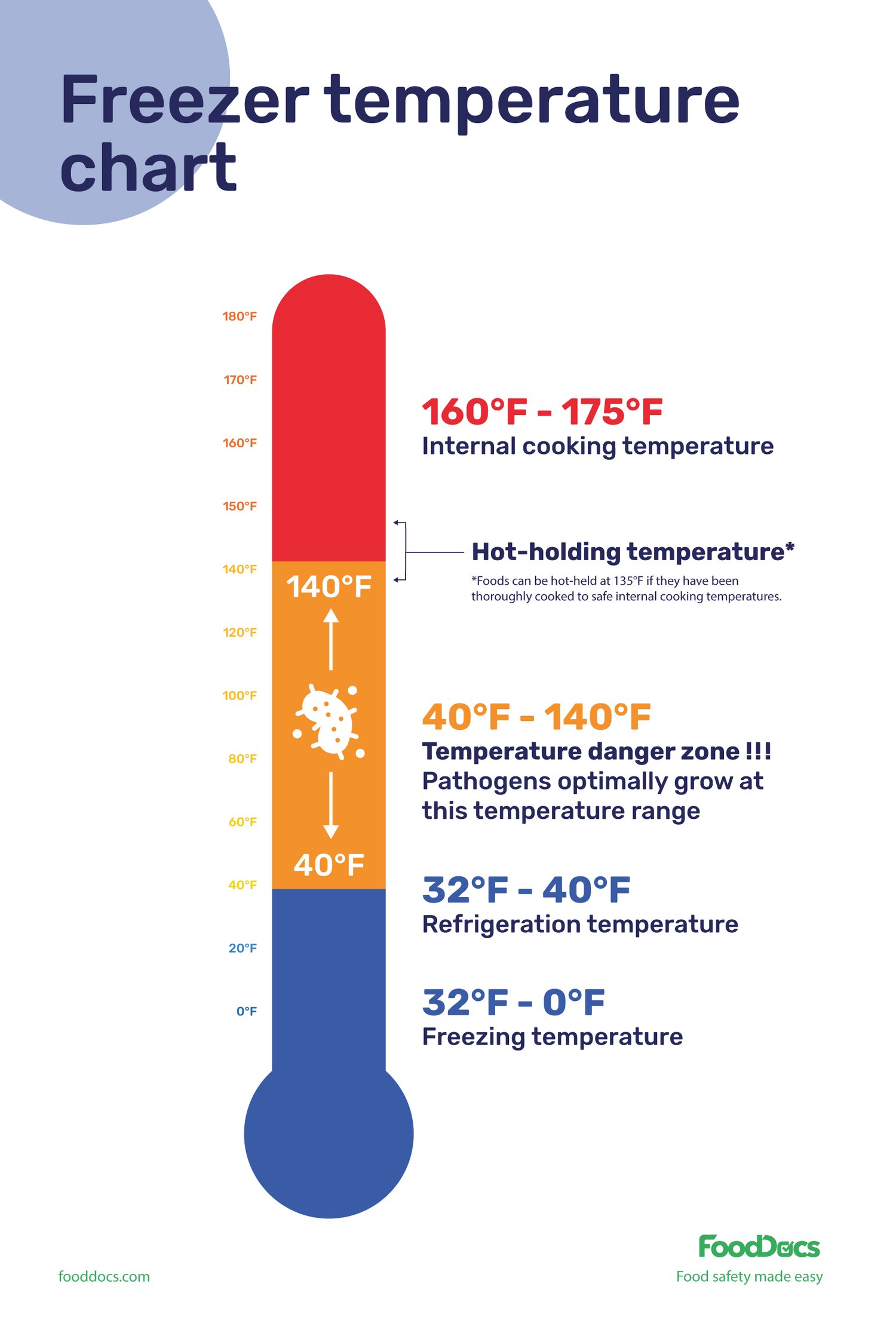
| Food safety danger zone | 40°F to 140°F |
The “danger zone” is the temperature range in which many bacteria can grow rapidly. The USDA explains that perishable food should not remain in this range for more than 2 hours, or more than 1 hour when the temperature is above 90°F.
The 37°F target is not a legal requirement or a guarantee that food will last for a certain number of days. It is a practical setting that helps keep most of the refrigerator safely cold without freezing common foods.

Why 40°F Is the Safe Upper Limit
A cold refrigerator slows bacterial growth, but it does not stop it completely. That is why cold storage does not replace safe cooking, prompt refrigeration, or proper food handling.
Many harmful bacteria grow more quickly as food warms. Keeping the refrigerator at or below 40°F slows this process and helps preserve food quality. It also reduces the chance that a brief temperature rise will make food unsafe.
A refrigerator may warm above its set point when you:
- Open the door often
- Load it with warm food
- Leave the door open
- Have a blocked air vent
- Pack it too tightly
- Experience a power outage
- Have a worn door seal
- Use a faulty thermostat or cooling system
The refrigerator’s average temperature matters more than a single reading. A fridge that briefly reaches 41°F while the door is open is different from one that stays at 45°F for several hours.


How to Check Your Fridge Temperature
Use a refrigerator thermometer rather than relying only on the control dial or the appliance display.
Follow these steps:
-
Place the thermometer in the center of the refrigerator.
Keep it on a shelf, not in the door and not directly against the back wall. -
Leave it in place for several hours.
An overnight check gives the thermometer time to reflect the normal temperature. -
Read the result before opening the door.
Opening the door lets warm air in and can change the reading. -
Check more than one area if needed.
Place the thermometer near the front, back, and lower shelves to look for cold or warm spots. -
Adjust the control in small steps.
Wait several hours before checking again. Many refrigerators need time to respond.
The door shelves are often warmer than the main shelves because they are exposed to room air each time the door opens. Store milk, eggs, meat, and other highly perishable foods in the main compartment instead of the door.
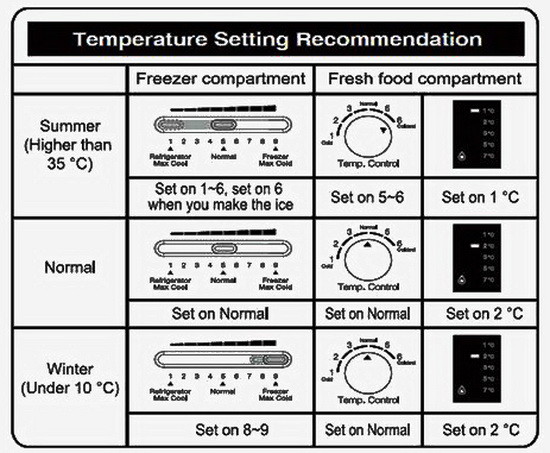
A refrigerator thermometer is inexpensive, but it can provide more useful information than a dial marked from “1” to “5.” Those dial numbers usually show cooling intensity, not degrees Fahrenheit.
Where to Store Food Inside the Refrigerator
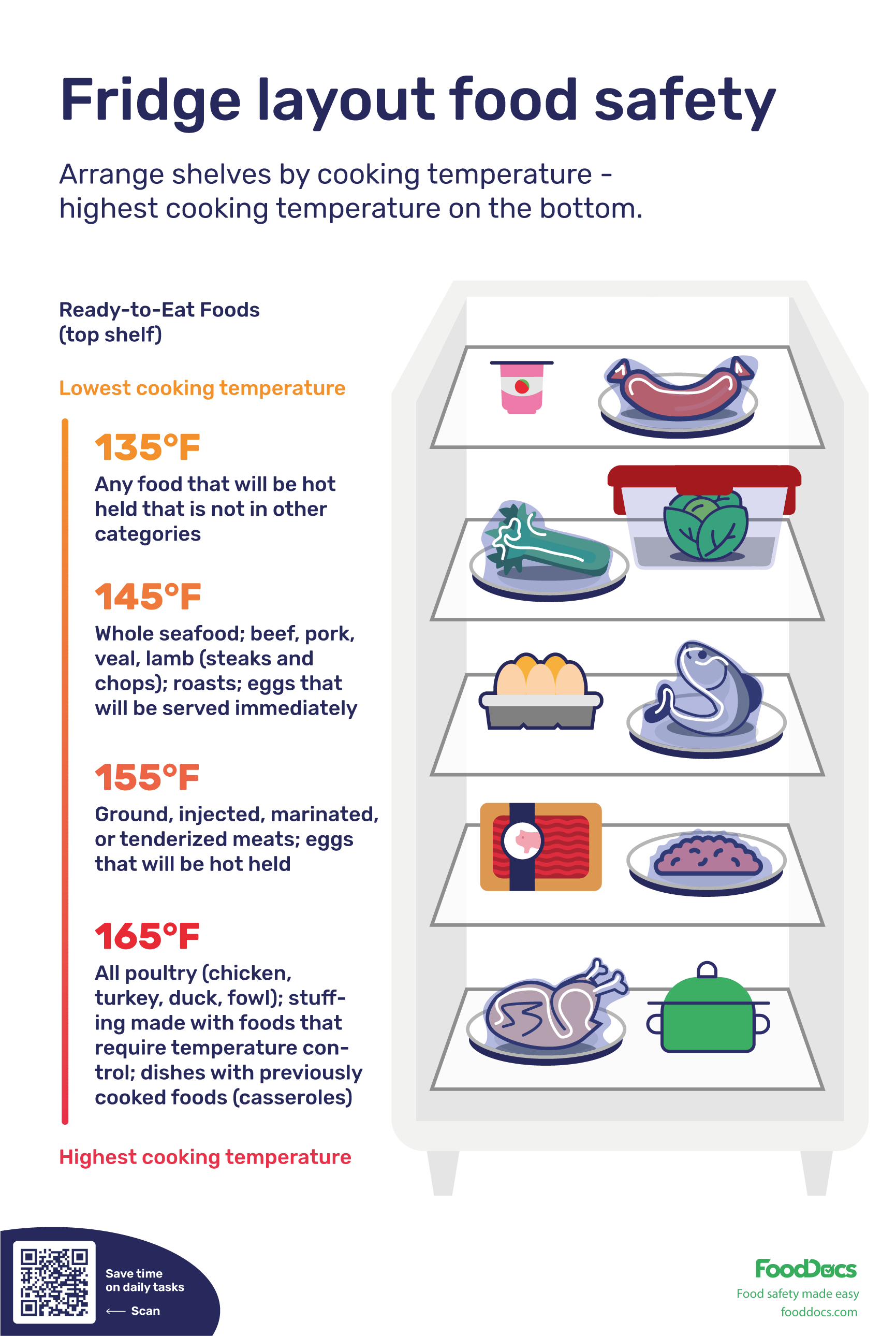
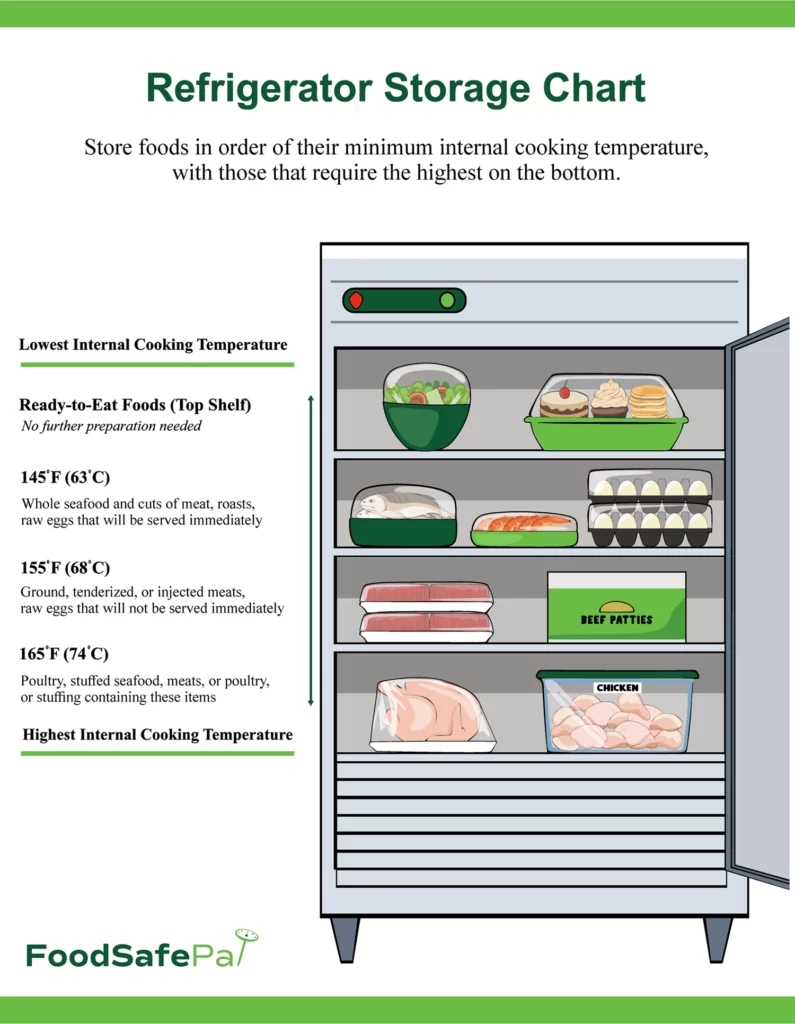
The coldest spot is not always the best spot for every food. Good placement helps maintain steady temperatures and prevents leaks from raw foods.
Upper shelves
Use the upper shelves for:
- Ready-to-eat food
- Leftovers
- Yogurt and other dairy products
- Drinks
- Sealed containers
Lower shelves
The lower shelves are often colder. Use them for:
- Raw meat
- Poultry
- Seafood
- Foods that need extra protection from leaks
Keep raw meat in a sealed container or leak-proof bag. Place it below ready-to-eat food so juices cannot drip onto food that will not be cooked.
Crisper drawers
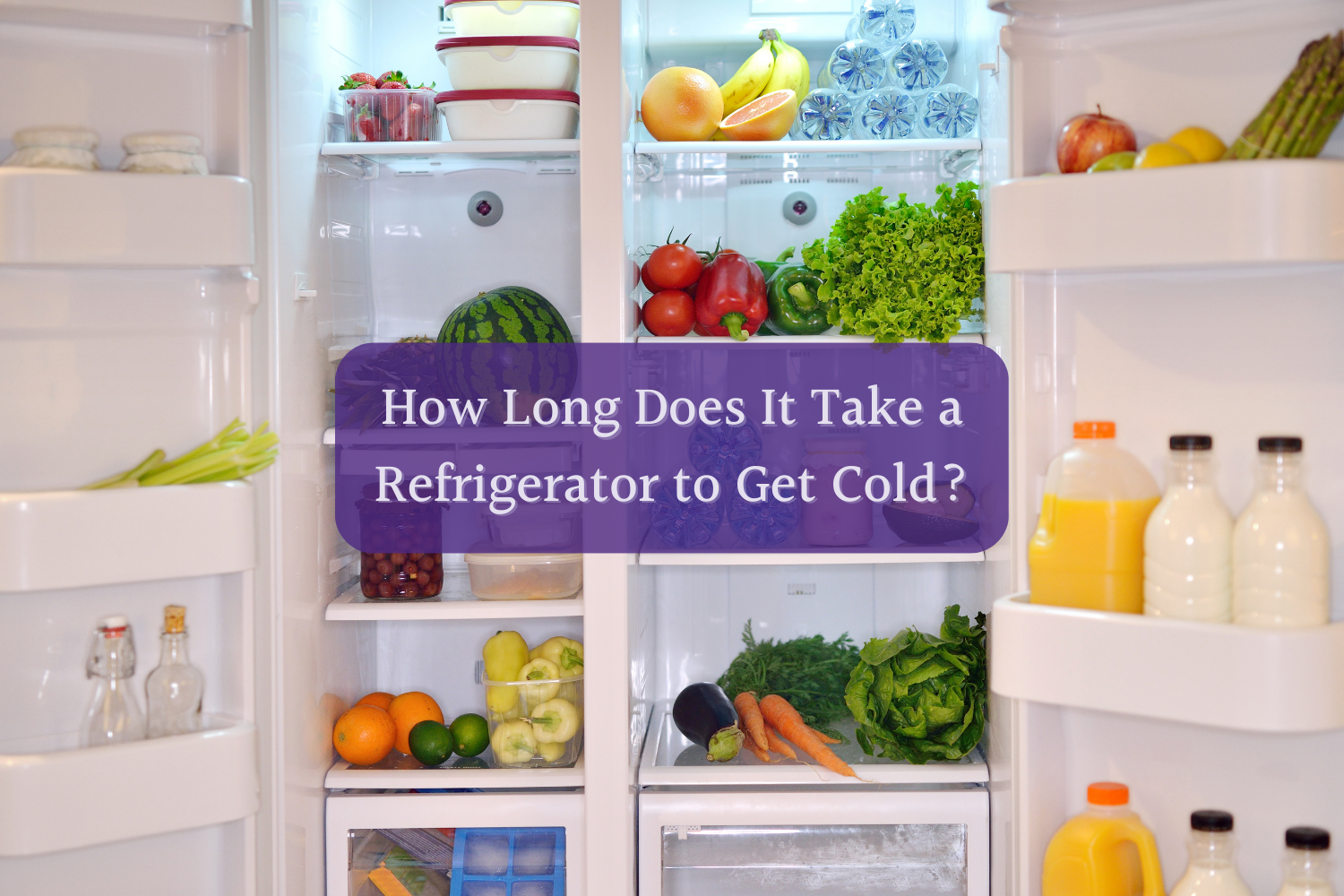
Use crisper drawers for fruits and vegetables. Some drawers let you control humidity, which can help produce stay fresh longer.


Refrigerator door
The door is usually the warmest part of the refrigerator. Use it for items that are less sensitive to small temperature changes, such as:
- Condiments
- Pickles
- Juice
- Bottled water
- Commercially packaged sauces
Do not use the door as the main storage place for raw meat, milk, eggs, or other highly perishable foods.

How Full Should a Refrigerator Be?
A refrigerator should be full enough to hold a stable temperature but not so full that air cannot move.
Cold air needs space to circulate around food. Overpacking the shelves can create warm pockets, especially near air vents. An almost empty refrigerator may also lose cold air quickly when the door opens.
Follow these habits:
- Keep air vents clear.
- Leave a little space between containers.
- Do not push food against the rear wall.
- Cool large amounts of food in shallow containers.
- Avoid placing hot food directly beside delicate items.
- Check that the door closes fully.
You can place hot food in the refrigerator rather than leaving it on the counter for hours. Divide large portions into shallow containers so they cool more quickly and evenly.
What to Do If the Fridge Is Too Warm
If your refrigerator reads above 40°F, check the simple causes first.
1. Check the thermometer
Make sure the thermometer is accurate and placed in the center of the refrigerator. A reading taken in the door may not represent the temperature of the food-storage area.
2. Check the control setting
Move the setting colder by a small amount. Do not assume a higher number means a colder temperature because control systems vary by model.
3. Inspect the door seal
Close the door on a sheet of paper. If the paper slides out with little resistance, the gasket may not seal well. Clean the seal and check for cracks, gaps, or food debris.
4. Look for blocked vents
Food containers can block cold-air vents. Move them away and allow air to circulate.
5. Consider the room temperature
A refrigerator may struggle in a very hot garage, near a stove, or in direct sunlight. Check the owner’s manual for the appliance’s approved room-temperature range.
6. Wait after loading food
A large grocery load can temporarily raise the internal temperature. Keep the door closed and check again after several hours.


7. Call for service when the problem continues
If the refrigerator remains above 40°F, makes unusual sounds, leaks, or runs constantly, contact the manufacturer or a qualified appliance technician. Do not remove sealed panels or work on electrical or refrigerant parts yourself.
What about the food?
Use time and temperature together. If perishable food has stayed above 40°F for more than 2 hours, the safest choice is usually to discard it. When in doubt, do not taste the food to test whether it is safe. Harmful bacteria may not change the smell, appearance, or taste.
What to Do If the Fridge Is Too Cold
A refrigerator that stays below 32°F may freeze food even though the compartment is not meant to be a freezer.
Check these common causes:
- The temperature control is set too cold.
- Food is touching the back wall.
- Food is blocking a sensor or vent.
- The refrigerator is nearly empty.
- A thermostat or damper is malfunctioning.
- The room is unusually cold.
- The door is not sealing correctly.
Move sensitive foods away from the back wall and air vents. Then raise the temperature setting slightly and check the appliance again after several hours.
If milk, produce, or other food keeps freezing after you adjust the setting, the appliance may need service. Repeated freezing can damage food quality and may signal a control problem.
How Long Can Food Stay in the Fridge?
A refrigerator at 40°F or below helps keep food safe, but each food has its own storage limit.
The USDA’s FoodKeeper tool provides storage guidance for common foods. As general examples:
- Most cooked leftovers: 3 to 4 days
- Raw ground meat: 1 to 2 days
- Raw poultry: 1 to 2 days
- Many fresh steaks, chops, and roasts: 3 to 5 days
- Opened lunch meat: often 3 to 5 days, depending on the product
- Eggs in the shell: several weeks when properly refrigerated
These time frames assume proper refrigeration and handling. Food can become unsafe sooner if it was warm before refrigeration, exposed to contamination, or stored in a refrigerator that ran above 40°F.
Write the date on leftovers and opened packages. When food looks questionable, remember that a normal smell is not proof of safety.

What Temperature Should a Fridge Be During a Power Outage?
Keep the refrigerator door closed during a power outage. An unopened refrigerator can usually keep food cold for about 4 hours, according to the USDA, although the exact time depends on the room temperature, how full the refrigerator is, and the appliance itself.
A full freezer can usually hold a safe temperature for about 48 hours if the door stays closed. A half-full freezer may hold for about 24 hours.
After the power returns:
- Check the refrigerator with an appliance thermometer.
- Check food temperature if you have a reliable thermometer.
- Discard perishable food that was above 40°F for more than 2 hours.
- Do not rely on smell or appearance alone.
- Never refreeze food that has completely thawed and stayed too warm.
Some food may still contain ice crystals and remain safe to refreeze, but quality can decline. For detailed outage guidance, use the USDA’s food safety information for power failures.

Common Refrigerator Temperature Mistakes
Avoiding a few common errors can make a major difference.
Trusting the dial
A dial setting is not the same as a temperature reading. Verify the actual temperature with a thermometer.
Storing milk in the door
The door often has greater temperature swings than the main compartment. Keep milk and similar foods on an interior shelf.
Packing food against the back wall
The back wall may be close to freezing. Food placed there can freeze even when the average refrigerator temperature is safe.
Leaving food out to cool for too long
Do not wait for a large pot of food to reach room temperature. Divide it into shallow containers and refrigerate it promptly.
Ignoring a warm reading
A refrigerator above 40°F is not automatically safe because the food still feels cool. Check how long the temperature stayed high and follow USDA guidance.
Using a smell test
Some dangerous bacteria produce no obvious odor. When time and temperature rules say food should be discarded, tasting or smelling it is not a reliable safety check.
Key Takeaways
- Set the refrigerator near 37°F.
- Keep it at 40°F or below.
- Set the freezer to 0°F.
- Use a separate appliance thermometer.
- Store perishable foods in the main compartment, not the door.
- Keep air vents clear.
- Refrigerate food promptly.
- Discard perishable food that stayed above 40°F too long.
- Do not use smell or appearance as the only safety test.
FAQs
Is 38°F a good temperature for a refrigerator?
Yes. 38°F is a safe and practical refrigerator temperature because it is below the 40°F upper limit while remaining above freezing.
Is 42°F too warm for a fridge?
Yes. 42°F is above the recommended maximum for refrigerator storage. A brief reading may not mean all food must be discarded, but a refrigerator that stays at 42°F needs attention.
Should I set my fridge to the coldest setting?
Usually, no. The coldest setting may freeze food and does not necessarily produce a stable, safe temperature. Set the appliance based on a thermometer reading instead.
Why is my refrigerator cold in some places and warm in others?
Air circulation, blocked vents, food placement, and door openings can create temperature differences. The door is often warmer, while the back wall may be colder. Keep the thermometer near the center and avoid placing food against vents or walls.
Can a refrigerator be too cold for food?
Yes. Temperatures near or below 32°F can freeze leafy greens, milk, fruit, and other foods. Freezing may damage texture even when the food remains safe to eat.
Conclusion
The best refrigerator temperature for most U.S. homes is about 37°F, and the refrigerator should never stay above 40°F. Keep the freezer at 0°F.
Check the temperature with an appliance thermometer, keep the door shelves for less perishable items, and leave room for cold air to circulate. If your fridge stays too warm or keeps freezing food after basic adjustments, have the appliance inspected.

Appliance Review Expert
Lucas Ramirez is a trusted voice at HomeFixGrid.com, known for his clear, practical, and creatively written guides that simplify appliance care for everyday homeowners. With a strong focus on hands-on testing and real-world problem-solving, Lucas brings expert insight into appliance reviews and troubleshooting techniques. Her work empowers readers to confidently maintain, repair, and choose the right appliances for their homes.