Can You Put Metal In A Convection Microwave: Safe Use Guide
Yes, you can often put metal in a convection microwave—but only under the right setting and only when the owner’s manual allows it.
In most US homes, a convection microwave has three cooking modes:
- Microwave mode: Uses microwave energy to heat food.
- Convection mode: Uses a heating element and fan, much like a small oven.
- Combination mode: Uses microwave energy and convection heat at the same time.
Metal cookware is usually fine in convection-only mode. It may also be allowed in combination mode if the manufacturer designed the appliance for it. In regular microwave mode, metal can cause sparks, arcing, fire, or damage to the oven.
The safest rule is simple: check your model’s manual before using metal. If the manual does not clearly approve it, use glass, ceramic, or another microwave-safe dish instead.

Why Metal Can Be Unsafe in Microwave Mode
Metal reflects microwave energy instead of allowing the food to absorb it. This can create an uneven electric field inside the oven.
The result may be:
- Sparks, also called arcing
- Scorch marks
- Damage to the oven’s interior
- Damage to the microwave generator
- A fire in rare cases
The risk is higher with metal that has:
- Sharp points or edges
- Thin strips
- Crumpled foil
- Loose pieces
- Contact with the oven wall
- A damaged or peeling surface
A smooth, thick metal pan is less likely to spark than a thin piece of foil. Still, “less likely” does not mean safe in every microwave. The oven design, cooking mode, pan shape, food load, and manual instructions all matter.
The US Food and Drug Administration explains that metal cookware can reflect microwave energy. It also advises users to follow the manufacturer’s instructions for safe operation.
Does all metal behave the same way?
No. A large, smooth metal pan and a crumpled sheet of foil do not behave in the same way.
A metal rack made for a specific convection microwave may have the correct shape, height, and finish. A random metal bowl or foil wrapper may not. The oven may also be designed with a rack that stays a set distance from the walls. That distance can reduce the chance of arcing.
This is why a metal rack supplied with the appliance is not proof that every metal item is safe.

When Metal Is Safe in a Convection Microwave
Metal is generally safe when the oven runs in convection-only mode, because this mode uses dry heat from an element and moving air. It does not use microwave energy.
In this setting, you can usually use oven-safe metal items such as:
- Aluminum baking pans
- Stainless steel baking pans
- Metal cake pans
- Metal roasting pans
- Oven-safe metal racks
The pan must still fit the appliance without touching the walls, ceiling, door, or heating element.
Convection microwaves differ by model. Some units allow metal only in convection mode. Others permit certain metal cookware during combination cooking. Some manuals tell users to remove the metal rack before using microwave mode.
Convection-only mode
In convection-only mode, the appliance works more like a small electric oven. Metal bakeware is often suitable.
Use the correct setting. Look for a control labeled:
- convection
– Bake - Roast
- Broil, if supported
Do not assume that a button labeled “convection” always means the microwave function is off. Read the control panel and manual.
Combination mode
Combination mode uses both microwave energy and convection heat. Metal use in this setting is model-specific.
Some manufacturers allow a supplied metal rack or certain metal pans. Other manufacturers limit the size, shape, or position of metal. The manual may also require the rack to sit in a specific support position.
For example, the manual may say to:
- Use only the supplied rack
- Keep the rack away from the oven walls
- Avoid metal containers with lids
- Remove the rack for microwave-only cooking
- Use only a certain combination setting
Follow the exact rule for your appliance. Do not transfer instructions from one brand or model to another.
Microwave-only mode
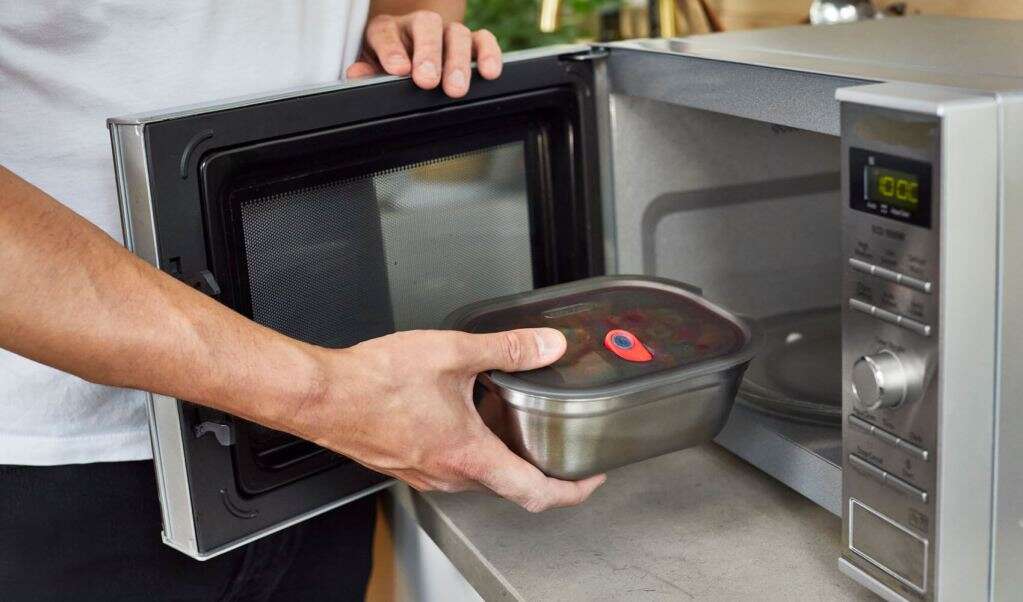
Avoid ordinary metal cookware in microwave-only mode unless your manual clearly says it is approved.
That includes metal:
- Pots
- Pans
- Bowls
- Travel mugs
- Utensils
- Twist ties
- Takeout containers
- Foil-lined packaging
A few appliances are designed to use special metal accessories. Those accessories are exceptions, not a general approval for metal cookware.

How to Check Whether Your Metal Pan Is Safe
Use this process before placing metal in a convection microwave.
1. Identify the cooking mode
Read the display or selected program. Confirm whether the oven is using:
- Microwave energy
- Convection heat
- Both functions
If you cannot tell, stop and check the manual.
2. Find the model number
The model number is often found:
- On the inside door frame
- On the back of the appliance
- On the side panel
- In the owner’s manual
- In the original purchase record
Search the manufacturer’s US support site for the exact model. A similar-looking appliance may have different rules.
3. Read the cookware section
Look for terms such as:
- Metal cookware
- Aluminum foil
- Metal rack
- Combination cooking
- Convection cooking
- Microwave-safe containers
- Utensils and materials
Use the manual’s instructions as the final authority for that model.
4. Inspect the pan
Do not use metal cookware that is:
- Bent
- Rusted
- Peeling
- Cracked at a coating
- Fitted with loose metal parts
- Too large for the cavity
Make sure the pan does not touch any part of the oven. Leave space around it when the manual calls for clearance.
5. Use the correct rack
If your convection microwave came with a metal rack, use that rack only as directed. Do not replace it with a rack from another appliance.
The supplied rack may be designed for a particular distance from the oven walls. Its feet may also prevent contact with the turntable or cavity floor.
6. Stop at the first sign of arcing
Stop the oven immediately if you see:
- Blue or yellow sparks
- Flashing
- Crackling
- Smoke
- A burning smell
- Scorch marks
- A sudden loud buzzing sound
If there is a fire, keep the door closed, turn off the appliance, and unplug it if you can do so safely. Do not use the oven again until you identify the cause and confirm that it is safe.

Metal Cookware: Quick Decision Table
This table gives a general guide. Your owner’s manual takes priority.
| Metal item | Microwave-only mode | Convection-only mode | Combination mode |
|---|---|---|---|
| Supplied metal rack | Manual required | Often allowed | Manual required |
| Smooth aluminum pan | Usually avoid | Often allowed | Manual required |
| Stainless steel pan | Usually avoid | Often allowed | Manual required |
| Small piece of foil | Only if manual allows | Usually allowed | Manual required |
| Crumpled foil | Avoid | Avoid if it may touch the element | Avoid |
| Metal twist tie | Avoid | Remove | Avoid |
| Metal takeout container | Avoid | Not recommended unless oven-safe | Avoid |
| Metal utensil | Avoid | Remove unless specifically needed and approved | Avoid |
| Metal cake pan | Usually avoid | Often allowed | Manual required |
The key distinction is not simply “metal or no metal.” The real question is:
Which material is being used, in which mode, inside which model of convection microwave?

Can You Use Aluminum Foil in a Convection Microwave?
You may be able to use aluminum foil in a convection microwave, but the answer depends on the mode and the manual.
In convection-only mode, foil may be used much like it is in a standard oven. Keep it away from the heating element and do not block the air vents.
In microwave or combination mode, foil can be risky. If the manual permits it, use only a small, smooth sheet. Never crumple foil or let it touch the oven walls, rack, ceiling, or door.
Avoid using foil to cover the entire dish. A full foil cover can block microwave energy and may create hot spots. It can also interfere with airflow during convection cooking.
Do not use foil to wrap food in a microwave unless the manual gives clear instructions. The safer choice is usually a microwave-safe glass or ceramic cover.
Can You Use a Metal Rack in a Convection Microwave?
A metal rack supplied with a convection microwave is often designed for that specific oven. It may be safe in convection mode and, in some models, in combination mode.
The rack is not automatically safe in every program. Remove it if the manual says to remove it during microwave-only cooking.
Before using the rack, check that:
- It is the original rack for the appliance.
- The rack is not bent or damaged.
- Its feet are attached and stable.
- It does not touch the cavity walls.
- Food or cookware does not extend into the oven wall.
- The selected cooking mode allows the rack.
Never place an unapproved cooling rack, grill grate, or metal shelf inside the appliance. Even if it fits, its shape may create an unsafe path for electrical arcing.

What Cookware Should You Use Instead?
When the manual does not approve metal, choose cookware made from a material marked for microwave use.
Common choices include:
- Microwave-safe glass
- Plain microwave-safe ceramic
- Microwave-safe stoneware
- Some microwave-safe plastic containers
Avoid dishes with metallic paint, gold trim, silver trim, or hidden metal decoration. A dish can look like ceramic while still containing a metal edge or glaze.
To check a dish, look for a microwave-safe label or symbol. If the label is missing, use a different container when possible. A material test can help, but it does not replace the manufacturer’s instructions.
The safest general-purpose choice is a plain glass or ceramic dish with no metal decoration.

Common Mistakes to Avoid
Mistake 1: Assuming “convection” makes every setting safe
A convection microwave is still a microwave. Combination and microwave-only settings may use microwave energy.
Always confirm the active mode.
Mistake 2: Copying advice from another microwave
Two ovens may look alike but have different cavity designs and safety rules. Use the manual for the exact model.
Mistake 3: Using foil because the piece is small
Small foil can still spark if it has a sharp edge, wrinkle, or contact with another metal surface.
Mistake 4: Letting a pan touch the wall
Metal that touches the oven wall is more likely to arc. A pan can shift while the turntable moves, so leave room around it.
Mistake 5: Using a metal container with a plastic lid
The lid may be unsafe at high convection heat. The container may also be unsafe in microwave mode. Check both parts and the selected setting.
Mistake 6: Continuing after sparks appear
Turn the appliance off at once. Do not keep cooking to see whether the sparks stop.
Mistake 7: Putting an empty metal pan in microwave mode
Food or liquid helps absorb microwave energy. An empty container can increase reflection and heating in unwanted areas. Never run the microwave empty.

What to Do If Metal Sparks in the Microwave
If metal sparks, stop the appliance immediately.
- Press Stop or Cancel.
- Keep the door closed if there is smoke or a flame.
- Unplug the appliance only if you can do so safely.
- Let the oven cool.
- Remove the metal after the arcing stops.
- Check for scorch marks, melted parts, or damage.
- Clean food residue from the cavity.
- Read the manual before using the oven again.
If the oven has visible damage, a burnt smell that remains, repeated arcing, or a failure to heat, stop using it. Contact the manufacturer or a qualified appliance repair professional.
Do not test the oven with more metal. A single spark may come from an unsafe item, but repeated sparks may point to a damaged rack, waveguide cover, cavity, or other component.

Frequently Asked Questions
Can I use a metal baking pan in a convection microwave?
Usually, yes, in convection-only mode if the pan is oven-safe and fits without touching the oven. In microwave-only or combination mode, use it only if the manual specifically allows it.
Can I use stainless steel in a convection microwave?
Stainless steel is commonly suitable for convection-only cooking. It is not automatically safe in microwave-only mode. Combination use depends on the appliance instructions.
Can I use aluminum pans in convection mode?
Often, yes. Convection mode uses dry heat, so an oven-safe aluminum pan may work. Keep the pan away from the heating element and follow the manual’s size and placement rules.
Why does the metal rack that came with my oven work?
The supplied rack may be shaped and positioned for that exact appliance. Its design does not mean that all metal racks or pans are safe.
Is it safe to use foil in a combination microwave?
Only when the manufacturer’s manual permits it. If allowed, use a smooth, limited amount of foil and keep it away from the oven walls and other metal parts.
Final Answer: Use the Manual and the Cooking Mode
You can put metal in a convection microwave when the appliance is in convection-only mode and the metal cookware is oven-safe. Metal may also be allowed in combination mode, but only when the manufacturer gives clear instructions.
For microwave-only cooking, avoid ordinary metal cookware, foil, utensils, and metal-lined containers unless the manual specifically approves them.
When in doubt, choose plain microwave-safe glass or ceramic. That simple choice avoids most metal-related risks and works for many microwave and combination cooking tasks.

Appliance Review Expert
Lucas Ramirez is a trusted voice at HomeFixGrid.com, known for his clear, practical, and creatively written guides that simplify appliance care for everyday homeowners. With a strong focus on hands-on testing and real-world problem-solving, Lucas brings expert insight into appliance reviews and troubleshooting techniques. Her work empowers readers to confidently maintain, repair, and choose the right appliances for their homes.