
Can You Put Toaster Oven On Top Of Microwave: Safe Tips
Usually, no. You should not place a toaster oven on top of a microwave unless both appliance manuals allow it and the setup meets all clearance, weight, heat, and ventilation rules. In many kitchens, this arrangement is unsafe because a toaster oven gives off strong heat, may block the microwave’s vents, and can make the microwave unstable.
For most homes in the United States, the safer choice is to place the appliances side by side on a firm, heat-resistant counter. If counter space is limited, use a properly rated shelf or appliance rack instead of stacking one appliance directly on the other.

Why stacking a toaster oven and microwave can be unsafe
A microwave and a toaster oven are both high-wattage appliances, but they produce and release heat in different ways. A toaster oven heats exposed elements and sends hot air into the space around it. A microwave may release heat through vents on its sides, back, top, or bottom.
Putting a toaster oven above a microwave can cause several problems:
- Blocked ventilation: The toaster oven may cover the microwave’s top vents.
- Excess heat: Heat from the toaster oven may enter the microwave’s controls or outer case.
- Fire risk: Nearby cabinets, paper, plastic, or other items may become too hot.
- Instability: Opening the toaster oven door or moving a heavy tray can make the stack shift.
- Surface damage: Heat can discolor, warp, or damage the microwave’s top.
- Electrical overload: Using both appliances on one circuit may trip a breaker or overheat a poor-quality power connection.
The main issue is not simply the weight of the toaster oven. The more important question is whether the microwave can safely support the heat, airflow needs, and movement of the appliance above it.
Check the manuals before placing anything on top
The manuals are the deciding source. Look for the sections titled Installation, Clearances, Ventilation, Countertop Use, Warnings, or Placement.
Check both manuals for these points:
- Does the microwave allow objects on top?
- Are there vents on the microwave’s top surface?
- Does the toaster oven require open space above, behind, or beside it?
- Does the toaster oven manual prohibit enclosed spaces or placement under cabinets?
- Is the microwave’s top rated to support the toaster oven’s weight?
- Does either manual require a minimum distance from walls or other appliances?
Do not assume that a flat metal top is designed to hold another appliance. A countertop microwave may look strong, but its top may be part of the ventilation and heat-control system.
Manufacturer instructions vary by model. For example, official installation information from Whirlpool, GE Appliances, and Panasonic should be checked for the exact model rather than a similar-looking appliance.
If the manual says “do not place objects on top,” treat that as a firm no. If the manual says nothing about supporting another appliance, do not interpret the silence as permission.
When can a toaster oven sit above a microwave?
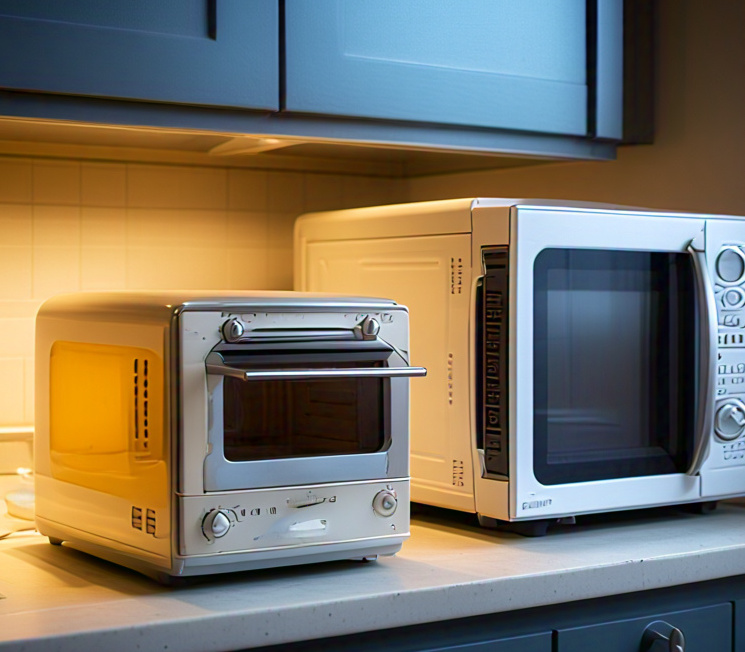
A toaster oven may be placed above a microwave only when the setup is specifically safe for both appliances. Every condition below should be satisfied:
- The microwave manual permits items on its top.
- The toaster oven manual permits the planned clearance and location.
- No microwave or toaster oven vent is blocked.
- The toaster oven has the required open space around it.
- The shelf or surface can safely carry the combined weight.
- The appliances sit level and cannot slide or tip.
- The toaster oven’s heat does not reach cabinets, walls, cords, or other materials.
- Each appliance can be unplugged without moving the other.
- The electrical circuit can handle the load.
- The arrangement does not place the toaster oven in a restricted enclosed space.
A manufacturer-approved stacking kit or purpose-built appliance shelf is safer than placing the toaster oven directly on the microwave. Such a shelf should be rated for the total weight and heat produced by the toaster oven. Decorative racks, lightweight rolling carts, and ordinary plastic shelving may not be suitable.
Even when a manual allows an appliance to sit above another, follow the required air gap. A toaster oven often needs open space around its sides and top because its outer case and exhaust area become hot during use.
A safer setup for small kitchens
The best arrangement is usually side by side on a clear counter. Leave the manufacturer’s required space around both appliances, and keep the toaster oven away from curtains, paper towels, wooden walls, and plastic containers.
If side-by-side placement is not possible, consider these options:
Use a heat-rated appliance shelf
Choose a shelf that:
- Lists a weight capacity higher than the combined appliance weight
- Uses heat-resistant materials
- Has a stable, wide base
- Does not block vents
- Prevents the toaster oven from sliding
- Leaves the required clearance above the toaster oven
Do not place the shelf directly over a sink, stove, or area where water may splash.
Place one appliance on a separate stand
A rolling kitchen cart or metal utility stand can provide safer separation. The stand must be stable and must not wobble when the toaster oven door opens.
Move one appliance to another counter
This is often the simplest solution. A toaster oven needs more open air than many people expect, especially when used for broiling, roasting, or high-temperature baking.
Use a built-in installation only when designed for it
Some microwaves and wall ovens are designed for cabinet installation. A regular countertop microwave or toaster oven is not automatically suitable for a cabinet opening. Do not install either appliance inside cabinetry unless the manufacturer gives instructions for that type of installation.

Electrical safety when using both appliances
A toaster oven and microwave can draw a large amount of power. In the United States, household outlets generally provide about 120 volts, but the actual current draw depends on each appliance’s wattage.
You can estimate current with this formula:
Current in amps = watts ÷ volts
For a hypothetical example:
- Microwave: 1,200 watts ÷ 120 volts = about 10 amps
- Toaster oven: 1,500 watts ÷ 120 volts = about 12.5 amps
- Combined estimated draw: about 22.5 amps
That total may exceed the capacity of a typical household circuit, especially if lights, a refrigerator, coffee maker, or other appliances share the same circuit. The label on the appliance may show input wattage, which is more useful for this estimate than the microwave’s advertised cooking output.
Follow these rules:
- Plug each appliance directly into a properly grounded wall outlet when possible.
- Do not use a power strip for a toaster oven.
- Avoid extension cords unless the appliance manual specifically permits one and the cord is correctly rated.
- Do not use a damaged, warm, loose, or discolored outlet.
- Stop using the setup if the breaker trips repeatedly.
- Ask a qualified electrician to check the circuit if you are unsure about its capacity.
A circuit breaker that trips is a warning, not an inconvenience to work around. Do not replace it with a larger breaker unless a qualified electrician confirms that the wiring and circuit are designed for it.
How to inspect your current setup
If the toaster oven is already on top of the microwave, turn both appliances off and check the arrangement before using them again.
1. Read both manuals
Find the exact model numbers. The model number is often printed on a label inside the microwave door, on the back of the appliance, or beneath the toaster oven.
2. Identify every vent
Look at the top, sides, rear, and underside of the microwave. Then check the toaster oven’s exhaust openings. Leave all vents open.
3. Check for heat damage
Look for:
- Brown, yellow, or melted plastic
- Warped surfaces
- Softened labels
- Discoloration on the microwave
- Hot cords or plugs
- Cabinet paint that is peeling or bubbling
Damage means the arrangement should not continue.
4. Test stability while the appliances are cold
Do not push hard, but check whether the toaster oven slides or rocks. Make sure opening its door does not pull the microwave forward.
5. Review the electrical connection
Confirm that cords are not pinched, stretched, or touching a hot surface. Do not connect both appliances through a single power strip.
6. Remove the upper appliance if any rule is unclear
If the manuals do not clearly allow the arrangement, separate the appliances. This is the safest response to uncertainty.
Signs of a safe setup include stable placement, clear vents, no heat damage, and compliance with both manuals. These signs do not replace the manufacturer’s instructions.

Common mistakes to avoid
Treating the microwave like a shelf
A flat surface does not mean a surface is designed to support another appliance. The microwave may need that area for cooling or airflow.
Using the toaster oven beneath a cabinet
A toaster oven can send hot air upward. It may damage the underside of a cabinet or heat items stored there. Follow the toaster oven’s required top clearance.
Covering vents with a tray or mat
A heat mat may protect a surface, but it can also trap heat or cover vents. Use one only if the appliance manufacturer allows it.
Running both appliances at once
Even if both plugs fit, the circuit may not safely support both appliances. Staggering use can reduce the load, but it does not fix blocked vents or an unstable stack.
Assuming “over-the-range” means “stackable”
An over-the-range microwave is designed for a specific installation above a cooktop and may use a dedicated ventilation system. That design does not mean a countertop microwave can support a toaster oven.
Ignoring heat from broiling
Broiling and high-temperature cooking usually produce more radiant heat than reheating. A setup that seems fine during short warming cycles may become unsafe during long, high-heat use.
Toaster oven on microwave: quick decision table
| Situation | Recommendation |
|---|---|
| The microwave has top vents | Do not place the toaster oven directly on top |
| The toaster oven needs open space above it | Do not use it beneath a cabinet or another appliance |
| Either manual forbids stacking | Do not stack them |
| The manuals do not mention stacking | Use a separate surface |
| A stable, heat-rated shelf is approved by both manuals | It may be acceptable with required clearances |
| The outlet, plug, or cord becomes hot | Stop using the setup and inspect the circuit |
| The toaster oven rocks when the door opens | Move it to a stable surface |
| The microwave top becomes hot or discolored | Stop stacking the appliances |
| Both appliances share a power strip | Unplug them and use proper wall outlets |
The safest default is simple: do not place a toaster oven directly on a microwave unless the exact manuals clearly permit it.
Frequently asked questions
Can a toaster oven damage a microwave?
Yes. Heat may damage the microwave’s outer case, controls, vents, wiring, or surface. The risk depends on the appliance design, cooking temperature, clearance, ventilation, and duration of use.
Can I put a microwave on top of a toaster oven?
This is usually not a good idea. The toaster oven needs clear space above it, and the microwave may block its heat exhaust. The microwave may also be too heavy for the toaster oven’s top. Check both manuals and use a separate, rated shelf instead.
Can I use a heat-resistant mat between the appliances?
A mat may protect against scratches or minor surface heat, but it does not solve blocked vents, poor clearance, excess weight, or electrical overload. Use one only when both manufacturers allow it.
Is it safe to run the toaster oven and microwave at the same time?
Only if the electrical circuit is rated for the combined load and both appliances have safe ventilation. Many kitchen circuits may not support two high-wattage appliances at once. Ask an electrician if the circuit capacity is unclear.
How much space should I leave around a toaster oven?
Use the exact clearance listed in the toaster oven manual. Requirements differ by model and cooking mode. Do not guess based on the size of another toaster oven.
What should I do if my kitchen has no counter space?
Use a stable, heat-rated appliance cart or shelf that does not block vents. You can also move one appliance to another suitable counter. If you plan a permanent cabinet installation, consult the appliance manufacturer and a qualified installer.
Final recommendation
For most U.S. kitchens, do not put a toaster oven directly on top of a microwave. Place the appliances side by side, or use a properly rated shelf that preserves ventilation, clearance, stability, and electrical safety.
Before using any stacked arrangement, check the exact manuals for both appliances. If either manual is unclear or the setup blocks a vent, creates heat damage, or makes the appliances unstable, separate them.

Appliance Review Expert
Lucas Ramirez is a trusted voice at HomeFixGrid.com, known for his clear, practical, and creatively written guides that simplify appliance care for everyday homeowners. With a strong focus on hands-on testing and real-world problem-solving, Lucas brings expert insight into appliance reviews and troubleshooting techniques. Her work empowers readers to confidently maintain, repair, and choose the right appliances for their homes.