How Is A Refrigerator Measured: Easy Sizing Guide
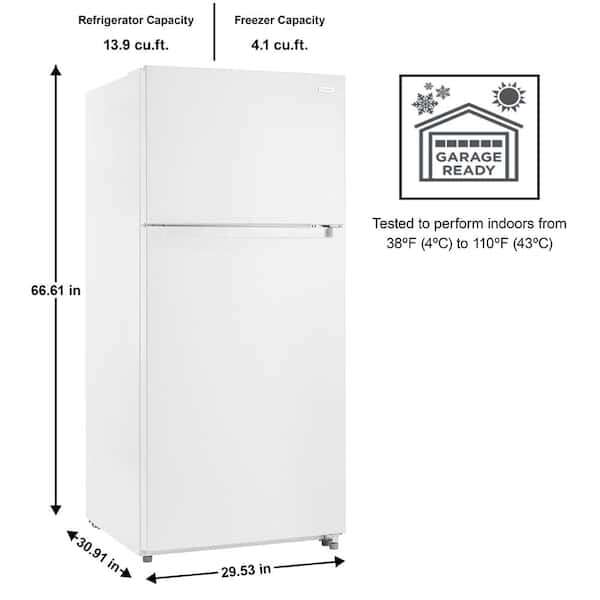
A refrigerator is measured by its height, width, depth, and interior capacity. In the United States, appliance dimensions are usually listed in inches, while storage space is listed in cubic feet.
To know whether a refrigerator will fit, measure both the open cabinet space and the path into your home. Check the refrigerator’s full dimensions, including doors, handles, hinges, and required air space. A unit that fits the opening may still fail to clear a doorway or open fully.
What Refrigerator Dimensions Mean
Refrigerator dimensions describe the outside size of the appliance. Product listings normally show these measurements:
- Height: The distance from the floor to the highest point.
- Width: The distance from the left side to the right side.
- Depth: The distance from the front to the back.
- Capacity: The usable storage volume inside, shown in cubic feet.
A listing may show dimensions in this order:
Height × Width × Depth
For example, a refrigerator listed as 70 inches H × 36 inches W × 34 inches D is about 70 inches tall, 36 inches wide, and 34 inches deep.
However, manufacturers do not always use the same order. Read the labels carefully. Look for “H,” “W,” and “D” instead of assuming that the first number is the height.
Product depth versus cabinet depth
A refrigerator can have more than one depth measurement:
- Depth without the door: Measures the main cabinet only.
- Depth with the door: Includes the closed door.
- Depth with handles: Includes the handles, which may extend farther.
- Depth with the door open: Shows the space needed for access and cleaning.
- Depth including hinges: Important when the hinges sit above or behind the door.
For installation, the largest relevant measurement matters. A refrigerator may be advertised as 30 inches deep, but its handles may extend to 32 inches or more.
Capacity is not the same as outside size
Refrigerator capacity describes the interior space. It includes the refrigerator compartment and freezer compartment, usually measured in cubic feet.
Two refrigerators with the same outside dimensions can have different capacities. Insulation, ice makers, water systems, shelves, drawers, and wall thickness all affect usable space.
A 25-cubic-foot refrigerator does not provide 25 cubic feet of open, empty shelf space. Shelves, bins, drawers, and ice equipment take up part of the interior.
How to Measure the Space for a Refrigerator
Measure the opening before you shop. Use a metal tape measure and record each measurement in inches.
1. Measure the opening width
Measure from one side of the opening to the other at:
- The top
- The middle
- The bottom
Write down the smallest width. Walls, cabinets, trim, and floors may not be perfectly straight.
For example:
| Location | Width |
|---|---|
| Top | 36 1/4 inches |
| Middle | 36 inches |
| Bottom | 35 7/8 inches |
The usable opening width is 35 7/8 inches, not 36 1/4 inches.
Do not rely on the width of the old refrigerator. The cabinet opening may be wider or narrower than the appliance.
2. Measure the opening height
Measure from the floor to the lowest part of the cabinet or trim above the refrigerator. Take the measurement at the:
- Left side
- Center
- Right side
Use the smallest result.
Check the floor, too. A raised section, uneven tile, or platform can reduce the actual height available.
If the refrigerator has a top hinge, the hinge may rise above the main cabinet. The product specification should state the height to the top of the hinge.
3. Measure the opening depth
Measure from the back wall to the front edge of the counter, cabinet, or surrounding trim.
Then check whether the wall has:
- A baseboard
- An outlet
- A water line
- A gas line
- A wall plate
- A recessed area
- Uneven trim
These items can reduce the usable depth.
Leave room for the power cord and water line. Do not force them behind the refrigerator. A pinched cord or crushed water tube can create a safety or service problem.
4. Check the required installation clearance
Refrigerators need space for air flow, door movement, leveling, and service. The required clearance varies by model.
Some units need space:
- Behind the cabinet
- Above the refrigerator
- Beside the doors
- Near the hinge
- At the bottom grille
Use the installation guide for the exact model. The manufacturer’s clearance rules take priority over a general measuring rule.
A refrigerator that fills the opening exactly may not install correctly. It may also be hard to level, clean, repair, or remove later.
5. Measure the floor and front edge
Check whether the floor is level from side to side and front to back. A refrigerator can appear to fit but lean if the floor slopes.
Also measure the distance from the back wall to the front of the opening. This helps you estimate how far the refrigerator will project into the room.
A standard-depth refrigerator often extends past the counter. That is normal for many models. A counter-depth model usually sits closer to the cabinet line, but its doors and handles still extend beyond the cabinet.
How to Measure an Existing Refrigerator
Measure the refrigerator itself when you need a replacement, want to compare models, or need to plan a move.
Measure the refrigerator’s height
Place the tape measure at the floor and measure to the highest point. Check whether the highest point is:
- The cabinet
- A hinge cover
- A control panel
- A decorative top
- A leveling foot
If the refrigerator has adjustable feet, measure the unit at its current setting. A replacement may need a different amount of adjustment.
Measure the refrigerator’s width
Measure across the widest fixed part of the refrigerator. Then measure the door and handle separately if they extend past the cabinet.
Record both:
- Cabinet width
- Overall width with doors or handles
This distinction helps when you compare a new appliance with the old one.
Measure the refrigerator’s depth
Measure from the back of the cabinet to the farthest front point. Take separate measurements for:
- Cabinet depth
- Door depth
- Handle depth
- Depth with the door open
If the refrigerator is still installed, do not push the tape behind it unless you can do so safely. Use the model number and installation manual when the rear measurement is difficult to reach.
Find the model number
The model number can provide more accurate dimensions than a tape measure. In many U.S. refrigerators, the label is inside:
- The fresh-food compartment
- The freezer compartment
- The side wall
- The ceiling near the front
- Behind a crisper drawer
Search the manufacturer’s support page for the exact model. Do not use a similar model’s dimensions. A small revision can change the height, hinge design, water connection, or door swing.
How to Measure the Delivery Path
A refrigerator can fit the kitchen and still fail to enter the home. Measure the full route before delivery.
Check these areas:
- The driveway or entry gate
- Exterior doors
- Interior doors
- Hallways
- Turns and corners
- Stairways
- Elevators
- The final opening
Measure the narrowest point of each doorway. Measure with the door open as far as it can go. Include the door frame, trim, handrails, and nearby walls.
Also measure the height and width of tight turns. A refrigerator may pass through a doorway when upright but fail when the delivery team must tilt or rotate it.
Account for packaging
A boxed refrigerator is larger than the bare appliance. Ask the retailer or delivery company for the packaged dimensions.
If the unit must be unboxed outside, confirm who will remove the packaging and whether doing so affects delivery service or damage claims.
Check door and hinge removal rules
Some refrigerators have removable doors. Others require a trained installer or specific tools. Removing a door can reduce the width needed to enter a home, but it does not always solve a height or turning problem.
Do not disconnect water lines or electrical parts unless the installation instructions allow it and the work can be done safely. Ask the delivery team or a qualified appliance professional when the path is tight.
How Much Clearance Does a Refrigerator Need?
The exact clearance comes from the installation manual. Still, shoppers should check four types of space before buying.
Air clearance
The refrigerator releases heat as it runs. It may need space around the top, back, or sides for proper air flow.
The required amount depends on the design. Some newer models have different vent locations than older units. Do not assume that a fixed gap applies to every refrigerator.
Door-swing clearance
Measure the space needed for the door to open. This includes clearance from:
- A wall
- A nearby cabinet
- An island
- A second appliance
- A counter edge
A French-door refrigerator may need less side-swing space than a single wide door. However, its doors still need room to open, and the drawers may need extra space in front.
Drawer clearance
Pull-out freezer drawers and crisper drawers need open floor space. Check whether a nearby island or table blocks them.
A refrigerator may fit against the wall but fail to let you remove a drawer. This matters for cleaning and for removing large food items.
Service clearance
Technicians may need access to the back, sides, or top. The installation guide may state a minimum service space.
Avoid sealing the refrigerator tightly into a cabinet unless the model is designed for built-in installation. Freestanding and built-in refrigerators are not interchangeable.
Standard-Depth and Counter-Depth Measurements
The main difference between standard-depth and counter-depth refrigerators is how far the cabinet extends into the room.
Standard-depth refrigerators
A standard-depth refrigerator usually has a deeper cabinet. It often offers more interior storage but may project well beyond standard kitchen counters.
Its total depth can increase when you add:
- Doors
- Handles
- Hinges
- Rear connections
Counter-depth refrigerators
A counter-depth refrigerator has a shallower cabinet. It is designed to sit closer to the front of the counters.
The term does not mean the entire appliance will be flush with the counter. Doors and handles usually extend beyond the cabinet line. Counter depth also varies by manufacturer.
Check the exact measurements for:
- Cabinet depth
- Door depth
- Handle depth
- Open-door depth
- Required rear clearance
Built-in refrigerators
Built-in refrigerators are made to fit a planned cabinet system. They may use different ventilation, trim, hinge, and installation requirements than freestanding models.
Do not replace a built-in unit with a freestanding refrigerator based only on width. The surrounding cabinets, electrical setup, ventilation, and door design may not match.
How to Calculate Refrigerator Capacity
Manufacturers list refrigerator capacity in cubic feet. The number is useful for comparison, but it does not tell you the exact amount of usable shelf space.
For a simple rectangular area, use:
Length × width × height = cubic inches
Then convert cubic inches to cubic feet:
Cubic inches ÷ 1,728 = cubic feet
There are 1,728 cubic inches in one cubic foot.
Example calculation
Suppose a simple storage compartment measures:
- 30 inches wide
- 20 inches deep
- 18 inches high
The calculation is:
30 × 20 × 18 = 10,800 cubic inches
10,800 ÷ 1,728 = 6.25 cubic feet
This is a basic estimate. A real refrigerator has curved walls, shelves, bins, lights, vents, and other parts. The manufacturer’s stated capacity is the better comparison number.
Compare usable layout, not only cubic feet
Capacity alone does not show how well a refrigerator will hold your food. Check the layout:
- Shelf width
- Shelf depth
- Door-bin size
- Drawer height
- Freezer space
- Ice-maker location
- Adjustable shelf positions
A tall, narrow refrigerator and a short, wide refrigerator may have similar capacity but feel very different in daily use.
Refrigerator Measurement Examples
Use the following examples as planning aids, not as universal size rules.
Example 1: A 36-inch opening
A kitchen opening measures:
- 35 7/8 inches at the narrowest width
- 70 1/2 inches at the lowest height
- 25 inches from the back wall to the counter edge
A suitable refrigerator must fit within those limits after the required installation clearances are added. A model listed as 36 inches wide may not fit, even if the nominal opening is called a 36-inch space.
Example 2: A counter-depth replacement
The opening is 24 inches deep, but the refrigerator’s installation guide requires 2 inches behind the cabinet. A model with a 24-inch cabinet depth may be too deep for that location.
The buyer must compare the cabinet depth plus required rear clearance, not just the advertised counter-depth label.
Example 3: A narrow doorway
The kitchen opening is wide enough, but the hallway doorway measures only 33 inches. The refrigerator is 35 inches wide with both doors attached.
The delivery plan may require door removal, a different angle, or a different refrigerator. The kitchen opening alone does not answer the delivery question.
A Refrigerator Measurement Checklist
Before ordering, record these measurements:
| Measurement | Your result |
|---|---|
| Opening width at top | |
| Opening width at middle | |
| Opening width at bottom | |
| Opening height at left | |
| Opening height at center | |
| Opening height at right | |
| Opening depth | |
| Height to the top of the hinge | |
| Door-swing space | |
| Drawer-opening space | |
| Narrowest exterior doorway | |
| Narrowest interior doorway | |
| Tightest hallway or turn | |
| Stairway or elevator limits |
Then compare your results with the manufacturer’s specification sheet. Look for separate values for:
- Height with hinge
- Height without hinge
- Width with doors
- Width without doors
- Depth with handles
- Depth without handles
- Depth with door open
- Required installation clearance
Keep the model number, installation guide, and delivery measurements together. Product pages sometimes show rounded dimensions, while installation documents show the details needed for a safe fit.
Common Refrigerator Measuring Mistakes
Measuring only the old appliance
The old refrigerator may be smaller than the available opening. Measure the opening itself and compare it with the new model’s exact specifications.
Using the advertised width as the real width
A model described as “36 inches wide” may have a listed width of 35 5/8 inches, 36 inches, or another value. Use the manufacturer’s technical dimensions.
Ignoring handles
Handles can add several inches to the front projection. They also affect turns and nearby cabinets.
Forgetting the hinge
The hinge may be the highest part of the refrigerator. Measure to the top of the hinge, not only to the cabinet roof.
Measuring only the kitchen
The refrigerator must travel through the home. Measure doors, hallways, turns, stairs, and elevators before delivery.
Treating counter depth as a fixed size
Counter depth is a product category, not one universal measurement. Compare the actual cabinet and total depth.
Leaving no room for air flow
A tight fit can interfere with ventilation, leveling, door movement, and service. Follow the model-specific installation guide.
Assuming a door can be removed
Some doors can be removed, but the process varies. Confirm the instructions before planning a delivery around door removal.
What to Do If the Refrigerator Does Not Fit
Stop before forcing the appliance into place. Check which measurement caused the problem.
- Too wide: Recheck the narrowest opening and look for trim or molding that can be safely removed.
- Too tall: Check the hinge height, floor level, and cabinet clearance.
- Too deep: Compare cabinet depth, handle depth, and required rear space.
- Door will not open: Check hinge-side clearance and the door-swing diagram.
- Drawers will not pull out: Measure the space in front of the refrigerator.
- Cannot enter the home: Recheck the delivery path and ask whether the doors may be removed.
- Power or water connection is blocked: Follow the installation guide or contact a qualified installer.
Do not alter cabinets, walls, wiring, plumbing, or structural parts without the right skill and permission. A licensed professional may be needed for electrical or plumbing changes.
Frequently Asked Questions
Is a refrigerator measured with the doors open?
Usually, the listed refrigerator dimensions refer to the unit with the doors closed. Product specifications may also list separate door-open measurements. Use the open-door dimensions to check walls, counters, islands, and drawer access.
Should I measure height with the refrigerator’s wheels or leveling feet?
Measure the unit as it will be installed. Include the highest point, such as a hinge cover, and account for the adjustment range shown in the installation guide.
Does refrigerator depth include the handles?
Not always. Manufacturers may list cabinet depth, depth with the door, and depth with handles as separate measurements. Check the labels carefully.
How much space should be behind a refrigerator?
The correct amount depends on the model. Use the manufacturer’s installation instructions rather than a general estimate. The required space may support air flow and provide room for the power cord and water line.
Is refrigerator capacity measured in cubic feet?
Yes. U.S. refrigerator capacity is generally listed in cubic feet. It represents interior volume, but the layout and fixed parts affect the storage space you can use.
Final Measurement Rule
Measure the opening, refrigerator, and delivery path. Use the smallest opening measurement, include hinges and handles, allow the required clearance, and verify every number against the model’s installation guide.
Before you order, write down the exact model number and compare its technical specification sheet with your measurements. That simple check can prevent delivery delays, cabinet damage, and an appliance that cannot open or be serviced properly.
Sources for further verification
- ENERGY STAR: Refrigerators
- U.S. Department of Energy: Refrigerators and Freezers
- Whirlpool: Refrigerator Installation and Measuring Guidance

Appliance Review Expert
Lucas Ramirez is a trusted voice at HomeFixGrid.com, known for his clear, practical, and creatively written guides that simplify appliance care for everyday homeowners. With a strong focus on hands-on testing and real-world problem-solving, Lucas brings expert insight into appliance reviews and troubleshooting techniques. Her work empowers readers to confidently maintain, repair, and choose the right appliances for their homes.