How Big Is A Fridge: Standard Sizes Explained
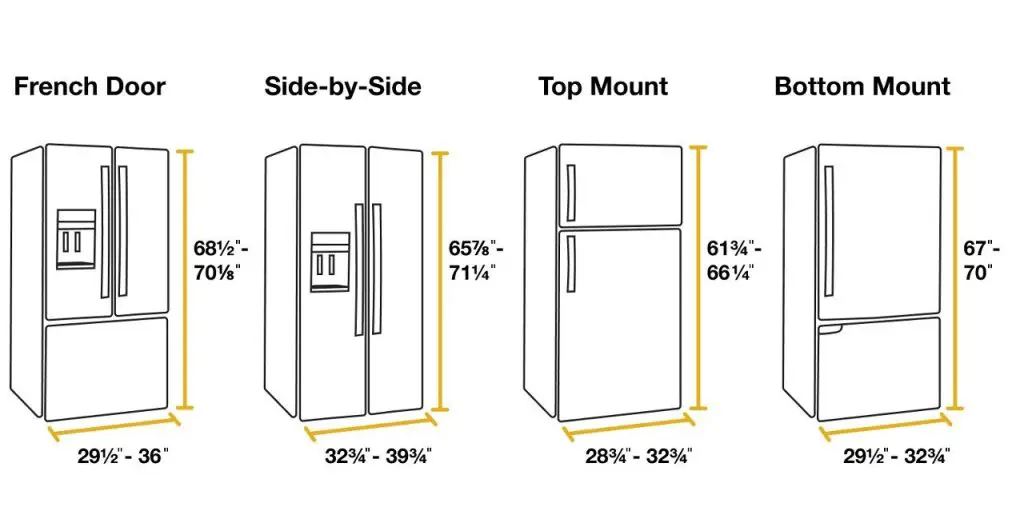
In the United States, most full-size refrigerators are about 28 to 36 inches wide, 30 to 36 inches deep, and 67 to 70 inches tall. Their storage capacity usually falls between 18 and 28 cubic feet.
The exact size depends on the refrigerator type. A compact fridge may be less than 20 inches wide, while a large French-door model can be 36 inches wide and hold more than 30 cubic feet. Before you buy, measure the kitchen opening, the delivery path, and the space needed to open the doors.
Quick Answer: Typical Refrigerator Sizes in the US
Here are common size ranges for full-size refrigerators sold in the United States:
| Refrigerator type | Typical width | Typical depth | Typical height | Common capacity |
|---|---|---|---|---|
| Top-freezer | 28–32 in. | 30–34 in. | ีน61–67 in. | 14–22 cu. ft. |
| Bottom-freezer | 29–33 in. | 30–34 in. | 67–70 in. | 18–25 cu. ft. |
| Side-by-side | 32–36 in. | 29–32 in. | 66–71 in. | 20–28 cu. ft. |
| French-door | 29–36 in. | 30–36 in. | 67–70 in. | 20–30+ cu. ft. |
| Column refrigerator | 18–36 in. per unit | 24–27 in. | 80–84 in. | Varies widely |
| Apartment-size | 24–30 in. | 26–31 in. | 60–68 in. | 10–18 cu. ft. |
| Compact or mini fridge | 18–24 in. | 18–24 in. | 19–36 in. | 1.7–6 cu. ft. |
These are planning ranges, not fixed US standards. Check the manufacturer’s specification sheet for the exact model. Hinges, handles, doors, leveling feet, water lines, and required air gaps can change the space the fridge needs.


A refrigerator’s listed capacity is measured in cubic feet. One cubic foot equals 1,728 cubic inches. For example, a refrigerator listed as 20 cubic feet has about 34,560 cubic inches of total interior volume, although shelves, drawers, and ice makers reduce the open space you can use.

How Wide Is a Standard Refrigerator?
A standard refrigerator in a US kitchen is often 30, 33, or 36 inches wide. The most common width depends on the refrigerator style and the cabinet opening.
Common refrigerator widths
- Top-freezer models: often 28 to 32 inches wide
- Bottom-freezer models: often 29 to 33 inches wide
- French-door models: often 30 to 36 inches wide
- Side-by-side models: often 32 to 36 inches wide
- Built-in models: often 36 inches wide, but some are narrower
- Compact models: often 18 to 24 inches wide
A “36-inch refrigerator” does not always measure exactly 36 inches. Many models are slightly narrower so they can fit into a nominal 36-inch cabinet opening. Others may need extra clearance at the sides for the doors or hinges.
For example, a refrigerator listed as 35⅝ inches wide may fit a 36-inch opening, but only if the opening is truly wide enough and the installation guide allows it. Old cabinets may not be square, so measure the opening at the top, middle, and bottom.
Refrigerator width versus cabinet width
Kitchen openings are often described by their nominal size:
- A 30-inch opening may accept a refrigerator about 29½ to 30 inches wide.
- A 33-inch opening may accept a refrigerator about 32 to 33 inches wide.
- A 36-inch opening may accept a refrigerator about 35 to 36 inches wide.
Do not rely on the nominal label alone. The manufacturer may require side clearance for heat release, door swing, or leveling.

How Deep Is a Refrigerator?
Most full-size refrigerators are about 30 to 36 inches deep, including or excluding different parts depending on how the manufacturer reports the measurement.
This distinction matters. A specification sheet may list:
- Cabinet depth: The depth of the refrigerator body, usually excluding handles and sometimes excluding the doors.
- Depth with doors: The cabinet plus the closed doors.
- Depth with handles: The farthest point at the front.
- Depth with the door open: The space needed to access shelves and drawers.
A regular-depth refrigerator may extend several inches beyond standard kitchen cabinets. A counter-depth refrigerator is designed to sit closer to the cabinet fronts.


Regular-depth versus counter-depth refrigerators
| Refrigerator style | Typical body depth | Practical result |
|---|---|---|
| Regular-depth | About 30–36 in. | More interior space, but it may project past the counters |
| Counter-depth | About 24–30 in. | A more flush look, but usually less storage |
| Built-in | About 24–25 in. body depth | Fits cabinetry closely and often needs special installation |
Counter-depth does not mean the refrigerator will be exactly as deep as the counter. The doors and handles may still extend beyond the countertop.
A counter-depth model can be useful in a narrow kitchen or walkway. A regular-depth model may be better when storage matters more than a flush appearance.
How Tall Is a Refrigerator?
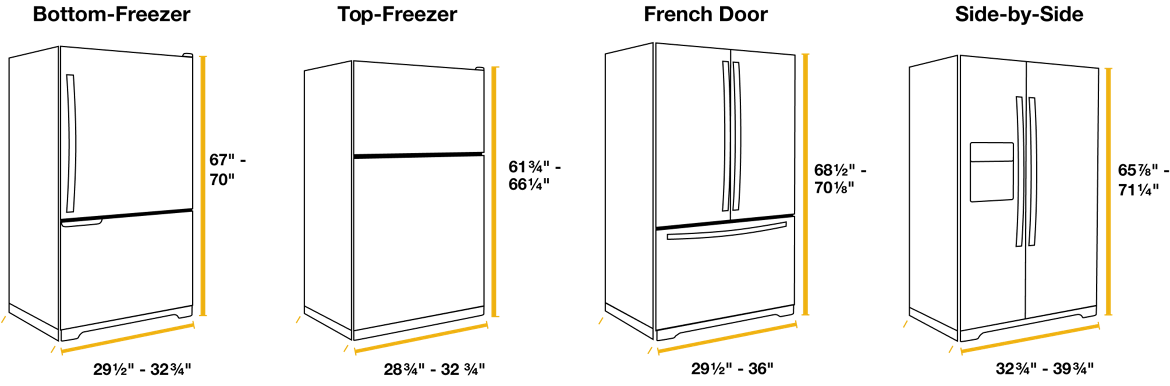
Most full-size refrigerators are about 67 to 70 inches tall, but some models are shorter or taller.
Typical height ranges include:
- Top-freezer: 61 to 67 inches
- Bottom-freezer: 67 to 70 inches
- French-door: 67 to 70 inches
- Side-by-side: 66 to 71 inches
- Built-in columns: about 80 to 84 inches
- Compact fridges: about 19 to 36 inches
The listed height may include the leveling legs. It may not include the hinge cover or the extra space required above the refrigerator.
If your refrigerator sits under cabinets, measure from the floor to the lowest point of the cabinet. Then compare that measurement with the model’s maximum height, not just the nominal height.
Leave the amount of top clearance required in the installation instructions. Some refrigerators need space above them for ventilation or for the doors to open fully.

How Much Does a Refrigerator Hold?
A typical US household refrigerator holds 18 to 28 cubic feet. The right capacity depends more on household size and shopping habits than on kitchen size alone.
A useful starting estimate is:
- 1 person: 8–12 cubic feet
- 2 people: 12–18 cubic feet
- 3 to 4 people: 18–24 cubic feet
- 5 or more people: 24–30+ cubic feet
These figures are planning estimates, not rules. A person who buys fresh food several times a week may need less space than a person who shops once every two weeks.
A freezer-heavy household may also need more total capacity. Families who freeze meat, prepared meals, or bulk foods may prefer a larger freezer or a separate chest freezer.
Refrigerator capacity is not the same as usable space
The advertised cubic-foot number usually covers the refrigerator and freezer compartments together. It may include spaces occupied by:
- Shelves
- Drawers
- Door bins
- Ice makers
- Water filters
- Interior walls
- Cooling equipment
Two refrigerators with the same listed capacity can feel very different inside. A side-by-side model may offer less room for wide items because the refrigerator and freezer sections are narrow. A French-door model often provides wider shelves but may have a smaller freezer section.


Refrigerator Size by Type
The refrigerator style changes both its outside dimensions and its usable layout.
Top-freezer refrigerators
Top-freezer refrigerators place the freezer above the fresh-food section. They are often among the narrowest and least expensive full-size options.
Typical dimensions are:
- Width: 28–32 inches
- Depth: 30–34 inches
- Height: 61–67 inches
- Capacity: 14–22 cubic feet
This style can work well in older homes, apartments, and kitchens with limited height. The freezer is easy to reach, but the lower refrigerator section may require more bending.
Bottom-freezer refrigerators
Bottom-freezer models place the freezer below the refrigerator compartment.
Typical dimensions are:
- Width: 29–33 inches
- Depth: 30–34 inches
- Height: 67–70 inches
- Capacity: 18–25 cubic feet
The refrigerator section sits at a convenient height. However, the freezer drawer may need more floor clearance when opened.
French-door refrigerators
French-door refrigerators have two upper refrigerator doors and a lower freezer drawer. Some include a middle drawer for drinks or fresh food.
Typical dimensions are:
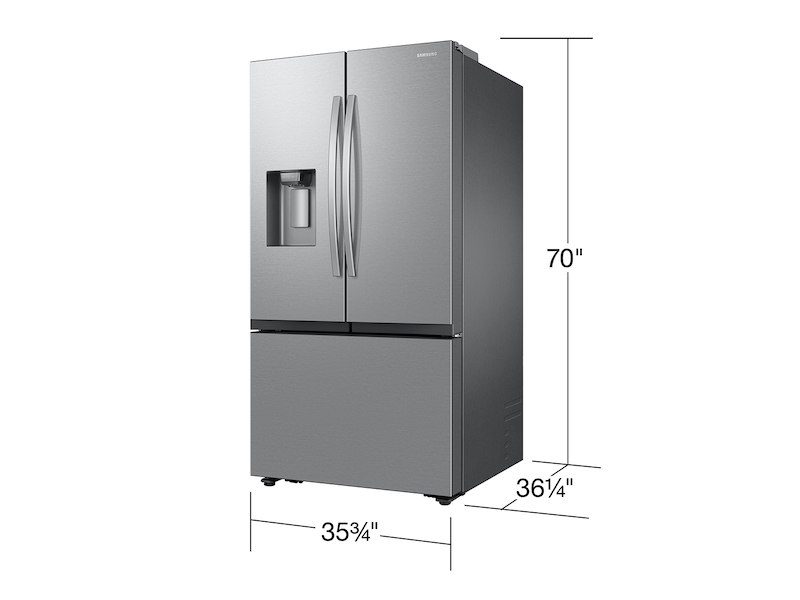
- Width: 30–36 inches
- Depth: 30–36 inches
- Height: 67–70 inches
- Capacity: 20–30+ cubic feet
The split doors need less swing space than one wide door. Still, drawers and doors may need room to open fully, especially near a wall.
Side-by-side refrigerators
Side-by-side models place the freezer and refrigerator next to each other.
Typical dimensions are:
- Width: 32–36 inches
- Depth: 29–32 inches
- Height: 66–71 inches
- Capacity: 20–28 cubic feet
They work well when door swing space is limited. Their narrow vertical compartments can make it harder to store wide trays, pizza boxes, or large platters.
Compact refrigerators
Compact refrigerators are common in dorm rooms, offices, garages, guest rooms, and small apartments.


Typical dimensions are:
- Width: 18–24 inches
- Depth: 18–24 inches
- Height: 19–36 inches
- Capacity: 1.7–6 cubic feet
Some compact models have a small freezer box. That freezer may not hold food at the same temperature or volume as a full-size freezer, so check the product specifications.

How to Measure for a New Refrigerator
Measure the opening, the delivery route, and the operating space before ordering.
1. Measure the cabinet opening
Measure:
- Width at the top, middle, and bottom
- Height on the left, center, and right
- Depth from the back wall to the front edge of the counter or cabinet
Use the smallest measurement. A wall or cabinet that is slightly out of square can prevent the refrigerator from fitting.
2. Measure the delivery path
Check every point between the entrance and the kitchen:
- Driveway and front door
- Hallways
- Turns
- Stairways
- Interior doors
- Pantry or kitchen entry
- The final refrigerator opening
Measure the narrowest point. Also check ceiling height where the refrigerator must be tilted.
3. Check door and drawer clearance
The refrigerator must have room to:
- Open both doors
- Pull out freezer drawers
- Remove shelves and bins
- Reach the water filter
- Clean behind the unit
- Move air around the cabinet
A refrigerator may fit the opening but still fail if a wall blocks the door from opening far enough.
4. Read the installation guide
The product page may show headline dimensions, but the installation guide usually provides the more useful details. Look for:
- Required side clearance
- Required top clearance
- Rear clearance
- Water-line space
- Electrical outlet location
- Door-swing limits
- Hinge clearance
- Whether the doors can be removed for delivery
5. Compare the model’s maximum dimensions
Use the largest stated measurement. If the specification says “height to top of hinge,” use that number when checking the cabinet opening.
Do not assume the delivery team will remove doors or handles unless the retailer confirms it. If removal is required, ask whether the warranty or installation service covers that work.

How Much Space Should You Leave Around a Refrigerator?
The required clearance depends on the model. Many refrigerators need a small amount of space at the sides, top, and rear, but the exact amount can vary.
Use the manufacturer’s installation instructions first. General planning rules may help during early kitchen design, but they should not replace the model’s requirements.
Clearance serves several purposes:
- It allows warm air to leave the cabinet.
- It gives the compressor and cooling system room to operate.
- It allows the doors to open.
- It makes leveling possible.
- It provides room for service and cleaning.
Too little clearance can create installation problems. It may also prevent the doors from sealing correctly or make the refrigerator difficult to remove later.
Avoid pushing a refrigerator tightly against a wall unless the instructions allow it. A wall can block a door, damage the handle, or prevent a drawer from extending.

What Size Refrigerator Do You Need?
Choose capacity and dimensions together. A large refrigerator is not useful if it blocks a walkway or cannot open fully.
Use this simple decision process:
- Measure the opening. Find the maximum width, height, and depth available.
- Check the delivery route. Confirm that the boxed or unboxed refrigerator can reach the kitchen.
- Choose a refrigerator style. Consider door swing, freezer access, and shelf width.
- Estimate storage needs. Use household size and shopping habits as a starting point.
- Check the actual interior layout. Look at shelf width, drawer space, and freezer volume.
- Confirm clearance. Include handles, hinges, doors, and drawers.
- Review the installation guide. Verify power, water, ventilation, and leveling requirements.
Example: choosing for a family of four
Suppose a family of four has a 36-inch-wide opening, 70 inches of height, and enough depth for a regular-depth model. A refrigerator between 20 and 25 cubic feet may provide a practical starting range.
If the family buys large trays or wide pizza boxes, a French-door layout may be more useful than a side-by-side layout. If the kitchen has a narrow walkway, counter-depth construction may reduce the projection into the room.
This is a hypothetical example. The final choice still depends on the exact opening and the manufacturer’s clearance rules.

Common Refrigerator-Sizing Mistakes
The most common mistake is measuring only the cabinet opening. A refrigerator also needs space for delivery, doors, drawers, ventilation, and service.
Watch for these problems:
- Measuring width in one place only: Use the narrowest width.
- Ignoring handles: Check the full front-to-back depth.
- Forgetting the hinge: The hinge cover may be the highest point.
- Overlooking the door swing: A nearby wall can stop the door.
- Assuming counter-depth means flush: Doors and handles still project.
- Using total capacity as usable shelf space: Ice makers and drawers take room.
- Ignoring the freezer layout: Narrow freezer compartments may not fit large items.
- Skipping the delivery route: A fridge can fit the kitchen but fail at a hallway turn.
- Leaving no service space: Future repairs may require access behind or beside the unit.
- Blocking ventilation: Follow the required clearances in the installation guide.
Safety note for installation
A refrigerator uses a grounded electrical connection and should be installed according to the manufacturer’s instructions and local electrical rules. Models with ice makers or water dispensers also need a suitable water connection.
Do not use an extension cord unless the manufacturer specifically permits it. If the outlet, circuit, water line, or cabinet opening is unsuitable, ask a qualified installer or electrician for help.
Refrigerator Dimensions in Inches and Centimeters
US product listings use inches and cubic feet. These approximate conversions can help when comparing international measurements:
| US measurement | Approximate metric equivalent |
|---|---|
| 24 in. | 61 cm |
| 30 in. | 76 cm |
| 33 in. | 84 cm |
| 36 in. | 91 cm |
| 60 in. | 152 cm |
| 67 in. | 170 cm |
| 70 in. | 178 cm |
| 1 cubic foot | 28.3 liters |
For example, a 36-inch-wide refrigerator is about 91 centimeters wide. A 20-cubic-foot refrigerator has about 566 liters of total stated volume.
These conversions are rounded. Use the original manufacturer’s measurements when checking fit.

Key Takeaways
- Most full-size US refrigerators are 28–36 inches wide.
- Typical height is 67–70 inches, though top-freezer models can be shorter.
- Typical depth is 30–36 inches for regular-depth models.
- Counter-depth refrigerators are usually shallower but may offer less capacity.
- Common full-size capacity is 18–28 cubic feet.
- Measure the opening, delivery route, door swing, and required clearance.
- Always use the exact model’s installation guide before ordering.
FAQs About Refrigerator Size
How wide is a standard refrigerator?
A standard full-size refrigerator is often 30 to 36 inches wide. Top-freezer models may be narrower, commonly around 28 to 32 inches. Always check the exact listed width and the required side clearance.
How deep is a refrigerator with the doors open?
The total space needed with the doors open varies by model and door angle. It can be much deeper than the closed refrigerator, especially for French-door models and freezer drawers. Check the manufacturer’s door-open dimensions before placing the refrigerator near a wall or island.
Is a 30-inch refrigerator big enough for a family?
A 30-inch refrigerator can be large enough for a small or medium household, especially when it offers about 18 to 22 cubic feet of capacity. A larger household or a family that shops in bulk may need more capacity.
What is the difference between counter-depth and standard-depth?
A counter-depth refrigerator has a shallower cabinet and usually sits closer to the counter front. A standard-depth refrigerator projects farther into the room but often provides more storage. Handles and doors can extend beyond the cabinet in either style.
How much clearance does a refrigerator need?
The required clearance depends on the model. Check the installation guide for top, side, and rear spacing. The refrigerator also needs enough room for its doors, drawers, leveling, ventilation, and future service.
Can a refrigerator be wider than the cabinet opening?
No. The refrigerator body must fit within the usable opening, and it may need additional space for hinges or door movement. A model that is even slightly too wide may not fit or may prevent the doors from opening correctly.
Conclusion: Finding the Right Refrigerator Size
For most US kitchens, begin by looking at refrigerators about 30 to 36 inches wide, 67 to 70 inches tall, and 30 to 36 inches deep. Then narrow the choice by capacity, door style, and available clearance.
The safest next step is to measure the opening at several points and compare those measurements with the exact manufacturer installation guide. Include the delivery path and door-swing space before you place the order.
Sources
- ENERGY STAR: Refrigerators and Freezers
- U.S. Department of Energy: Refrigerators and Freezers
- Whirlpool: Refrigerator Buying Guide
- GE Appliances: Refrigerator Buying Guide
- Samsung US: Refrigerator Buying Guide

Appliance Review Expert
Lucas Ramirez is a trusted voice at HomeFixGrid.com, known for his clear, practical, and creatively written guides that simplify appliance care for everyday homeowners. With a strong focus on hands-on testing and real-world problem-solving, Lucas brings expert insight into appliance reviews and troubleshooting techniques. Her work empowers readers to confidently maintain, repair, and choose the right appliances for their homes.