Can A Refrigerator Be Moved On Its Side: Moving Tips
Yes, a refrigerator can sometimes be moved on its side, but keeping it upright is safer. Laying a refrigerator down can let compressor oil move into the refrigerant lines. It can also stress the doors, shelves, tubing, and sealed cooling system.
For a move across town in the United States, transport the refrigerator upright whenever possible. If you must place it on its side, check the owner’s manual first, secure it well, and leave it upright for several hours before turning it on.

The short answer: Can you lay a refrigerator on its side?
You can move some refrigerators on their side for a short trip, but it should be a last resort. The safest position is upright, with the refrigerator strapped to an appliance dolly or kept vertical in a moving truck.


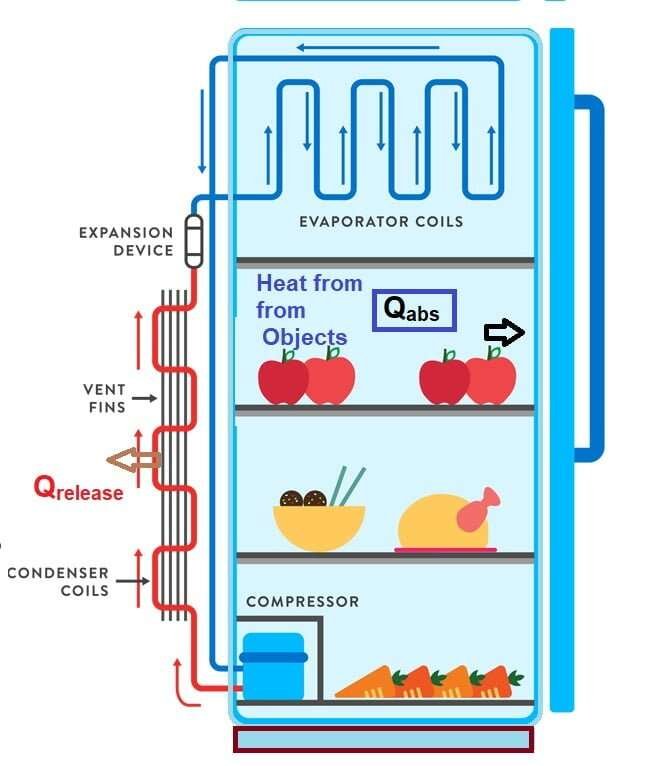
The main concern is the compressor. This motor and pump sit near the bottom of the refrigerator. It contains oil that helps lubricate its moving parts. When the refrigerator lies down, that oil may flow into the refrigerant lines or other parts of the cooling system.
If you plug in the refrigerator right away, the compressor may run with too little oil. In some cases, this can cause poor cooling or compressor damage.
Manufacturers do not all give the same waiting time. Whirlpool, GE Appliances, and Samsung guidance can vary by model and transport position. For that reason, the owner’s manual for your exact refrigerator is the best source.
As a general safety rule:
- Move the refrigerator upright when possible.
- If it must lie on its side, use the side approved in the manual.
- Keep it on its side for the shortest time possible.
- Stand it upright before plugging it in.
- Wait for the time stated by the manufacturer.
- If no time is listed, waiting at least 4 hours is a cautious minimum; 12 to 24 hours is safer for a refrigerator that spent a long time on its side.
The longer and farther the refrigerator travels on its side, the more time it may need to settle upright.
Why moving a refrigerator on its side can cause problems
A refrigerator is not just a large box with a motor. It contains a sealed cooling system, electrical parts, water lines, insulation, shelves, and doors that are designed to stay in a normal upright position.
Compressor oil can move
The compressor holds lubricating oil. That oil normally stays in the bottom of the compressor. Tilting the refrigerator can allow some oil to move into the suction or discharge line.
The oil may drain back after the refrigerator stands upright. However, that process takes time. Starting the compressor too soon can make it work under poor lubrication.
Refrigerant lines can become stressed
Copper or aluminum refrigerant lines run between the compressor, condenser, evaporator, and other parts. A hard tilt, drop, or sudden shift can bend or crack a line.
A damaged line may cause:
- A gradual loss of cooling
- Hissing or clicking sounds
- Oil marks near the back or bottom
- A refrigerator that runs but does not get cold
- A compressor that runs almost constantly
a sealed-system repair often requires a trained appliance technician. It is not a simple do-it-yourself repair.


Doors and shelves can shift
The refrigerator door is heavy. When the unit is on its side, the door can pull against its hinges and seals. Loose shelves, bins, ice makers, and drawers can also slide or break.
Glass shelves are especially vulnerable. Remove them if the manual permits, wrap them separately, and do not leave loose items inside the cabinet.
Water can reach electrical parts
Modern refrigerators may have:
- Ice makers
- Water dispensers
- Internal water tanks
- Filters
- Electronic control boards
- Condensation drains
Water can move into places where it does not belong during transport. Disconnect the water supply and let the unit dry before reconnecting power.

When should you keep a refrigerator upright?
Keep the refrigerator upright when the manufacturer says not to lay it down or when the design makes side transport risky.
An upright move is the better choice for:
- French-door refrigerators
- Built-in refrigerators
- Column refrigerators
- Large commercial-style models
- Refrigerators with an external water tank
- Models with delicate door displays
- Units that have already been damaged
- Refrigerators that must travel for many hours
A standard top-freezer or small apartment refrigerator may be easier to move on its side, but the owner’s manual still controls the decision.
Some refrigerators have a compressor layout or door design that limits which side is safe. Do not assume that the left side and right side are equal. If you cannot find the manual, search the manufacturer’s US support site using the model number from the label inside the cabinet or near the door frame.
How to move a refrigerator safely on its side
If an upright move is not possible, prepare the refrigerator before tipping it. Do not rush this part. Most damage happens when people move a refrigerator with loose shelves, an attached water line, or an unsecured door.
1. Check the owner’s manual
Look for instructions under headings such as:
- Moving or transporting the refrigerator
- Installation
- Storage
- Tipping
- Relocation
- Refrigerator care
Follow the exact instructions for your model. Some manuals say to keep the unit upright. Others identify an approved side and give a wait time before operation.
If the manual is unavailable, contact the manufacturer with the model number. Do not rely only on advice for a similar-looking refrigerator.
2. Empty and defrost the refrigerator
Remove all food, ice, water, and removable shelves. Defrost the freezer if frost or ice is present.
Wipe up water inside the cabinet. A wet refrigerator can leak during the move and can make the floor or ramp slippery.


Do not chip away ice with a knife or sharp tool. You could puncture the liner or a hidden cooling tube.
3. Disconnect utilities
Unplug the refrigerator before moving it. If it has an ice maker or water dispenser, close the home’s water shutoff valve.
Disconnect the water line according to the installation instructions. Drain or cap the line so it does not drip into the moving vehicle.
Never pull the refrigerator by its power cord or water tube.
4. Protect the doors and cabinet
Close the doors and secure them with soft straps or strong moving tape. Do not put tape directly on painted surfaces if it may leave residue.
Protect the exterior with moving blankets. Do not wrap the refrigerator so tightly that air cannot move around it while it is waiting to be plugged in.
Avoid using the doors, handles, or water dispenser as lifting points.
5. Remove or secure loose parts
Remove glass shelves, door bins, drawers, and loose ice containers. Wrap each item and mark where it belongs.
If a part cannot be removed, secure it with padding. Do not use hard objects that may scratch the interior.
6. Use the correct moving equipment
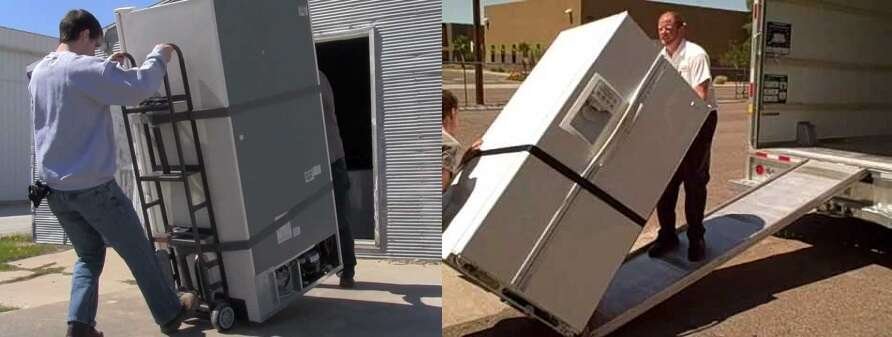
Use an appliance dolly with straps. A standard two-wheel hand truck may not support a tall, heavy refrigerator safely.
Have at least two adults help guide the refrigerator. For a large French-door or built-in model, more help or professional movers may be needed.
Protect stairs, corners, door frames, and flooring. A refrigerator can weigh several hundred pounds, especially when it has thick insulation, water systems, or multiple doors.
7. Tip the refrigerator onto the approved side
Tip it slowly. Keep the door hinges and back components from striking the floor.
Do not lay a refrigerator on its front or back unless the manufacturer specifically permits that position. The back may contain exposed coils, tubing, or other parts that can be crushed.
Use thick moving blankets under the cabinet. Keep the unit stable and prevent it from rolling or sliding.


8. Secure it inside the vehicle
Place the refrigerator on its side only if there is no safer option. Strap it to the vehicle or wall so it cannot shift during braking or turns.
Do not place heavy items on top of it. Avoid leaving it in direct heat for a long period, especially if the vehicle is not climate controlled.
An upright refrigerator should also be strapped. Upright transport does not remove the risk of tipping.

How long should a refrigerator sit before you plug it in?
The refrigerator should sit upright before you plug it in. The exact waiting period depends on the model and how it was transported.
Use this as a practical guide, not a replacement for the manual:
| Transport position | Suggested minimum before power | Safer approach |
|---|---|---|
| Upright the entire move | Follow the manual; often a short wait | Let it stand for 1–2 hours if it was tilted |
| Tilted briefly on a dolly | Several hours | Wait 4 hours |
| On its side for a short trip | At least several hours | Wait 12 hours |
| On its side for many hours or overnight | Manufacturer guidance is essential | Wait 24 hours if the manual gives no shorter period |
| Unknown position or heavy tipping | Do not guess | Contact the manufacturer |
The reason for the wait is simple: gravity gives compressor oil time to drain back to its normal location.
Do not use a timer alone if the refrigerator was dropped, hit, or left in extreme heat. Physical damage can cause problems that waiting will not fix.
What if you already plugged it in?
If you plugged in the refrigerator immediately after moving it on its side, unplug it. Stand it upright and let it rest for the time recommended by the manufacturer.
After the wait, reconnect power and listen for unusual sounds. A brief hum or a few clicks may be normal. Loud knocking, repeated clicking, burning smells, or a compressor that will not start are warning signs.
Do not keep restarting the refrigerator if the circuit breaker trips or the power cord becomes hot. Arrange service from a qualified appliance technician.
How to tell whether the refrigerator was damaged
A refrigerator may not cool at once after transport. The freezer can take several hours to reach its normal temperature, especially if the cabinet is warm and full of food.
Watch for these warning signs:
- The compressor runs but the cabinet stays warm.
- The freezer does not begin to freeze after several hours.
- The refrigerator makes loud knocking or grinding sounds.
- The compressor repeatedly clicks on and off.
- You see oil, water, or an unusual residue near the back.
- The cabinet rocks or a door no longer seals.
- The display or interior lights do not work.
- The circuit breaker trips.
- The refrigerator smells like burnt plastic or wiring.
Keep the doors closed while it cools. Frequent opening adds heat and makes diagnosis harder.
A new refrigerator may need many hours to reach stable temperatures. Use an appliance thermometer if you need to confirm cooling. The FDA recommends keeping a refrigerator at or below 40°F and a freezer at 0°F for food safety. Do not use food as the test for whether the refrigerator works.
If perishable food has stayed above safe temperatures for too long, discard it rather than trying to cool it again.
Can you move a refrigerator on its side in a car or SUV?
A small refrigerator may fit in a vehicle on its side, but the vehicle must provide a flat, stable surface and enough room to secure the unit.
Before loading it, check:
- The tailgate or hatch can support the refrigerator’s size.
- The doors will not press against the roof or interior trim.
- The refrigerator will not slide during braking.
- The vehicle has enough ventilation and weather protection.
- The unit can be unloaded without dropping it.
Do not place a full-size refrigerator loosely in an SUV. Sudden braking can turn a heavy appliance into a dangerous projectile.
For a full-size model, a rental box truck with a loading ramp and appliance dolly is usually safer than a passenger vehicle. Keep the refrigerator upright in the truck when possible.
Does a refrigerator need to be empty before moving?
Yes. Remove food, ice, water, shelves, drawers, and other loose items before moving it.
A full refrigerator is much heavier. Its contents can also shift and break shelves or door bins. Water and melted ice can leak into electrical areas or damage flooring.
You may leave fixed parts in place if the manual allows it and they are firmly supported. When in doubt, remove the part and pack it separately.
Can you plug in a refrigerator after transporting it upright?
Usually, yes, but do not ignore the manufacturer’s instructions. Even an upright refrigerator may have been tilted while going through a doorway, climbing stairs, or loading into a truck.
If it remained upright and was handled gently, the wait may be short. Many people still let it stand for one or two hours before turning it on.
Once powered, give the refrigerator time to cool before loading it with food. Follow the owner’s manual for ice maker startup and water-line connection.
Can you move a refrigerator on its side for a few minutes?
A short period on its side is less risky than a long trip, but it is not risk-free. The refrigerator can still suffer from a damaged door, bent tubing, or shifted compressor oil.
If the refrigerator was briefly tipped to pass through a doorway, return it upright and let it settle before plugging it in. If it was fully laid down, use the longer waiting guidance unless the manual states otherwise.
Common mistakes to avoid
Avoid these errors when moving a refrigerator:
-
Plugging it in as soon as it arrives
Waiting helps compressor oil return to its proper place. -
Using the wrong side
The manufacturer may approve only one side for transport. -
Laying it on the back
This can damage coils, tubing, or rear components. -
Leaving shelves and bins inside
Loose parts can break or damage the liner. -
Pulling on the doors or handle
Doors and hinges are not designed to move the full weight of the appliance. -
Moving it without straps
A refrigerator can tip even when it seems stable. -
Reconnecting water too soon
Check for leaks after restoring power and water. -
Assuming it is broken before it has cooled
Give the unit several hours, then check temperatures with a thermometer. -
Using an extension cord
Follow the manufacturer’s electrical instructions. A refrigerator should normally connect to a properly grounded outlet, not an overloaded power strip.

Upright transport versus side transport
Use this comparison to choose the safer plan:
| Option | Main benefit | Main risk | Best use |
|---|---|---|---|
| Upright on an appliance dolly | Lowest risk to the sealed system | Requires more clearance and control | Preferred method |
| Upright in a moving truck | Keeps the normal operating position | Can tip if not strapped | Best for long moves |
| On the approved side | May fit through tight spaces | Oil movement and cabinet damage | Short moves when upright transport is impossible |
| On the back | May appear stable | Can damage rear components and tubing | Avoid unless the manual permits it |
| On the front | Protects some rear parts but stresses doors and controls | Door and display damage | Avoid unless specifically approved |
The key trade-off is convenience versus risk. Laying the refrigerator down may make loading easier, but it increases the chance of damage and adds a required waiting period.
Key takeaways
- Yes, a refrigerator can sometimes be moved on its side.
- Upright transport is safer and should be the first choice.
- Check the exact owner’s manual before tipping the refrigerator.
- Remove food, shelves, ice, and water before the move.
- Secure the doors and use an appliance dolly with straps.
- Never plug it in immediately after side transport.
- Let it stand upright for the manufacturer’s stated time.
- If no guidance is available, waiting 12 to 24 hours after a long side trip is a cautious approach.
- Stop and seek service if the refrigerator leaks, trips a breaker, makes harsh noises, or fails to cool.
Frequently asked questions
Can laying a refrigerator on its side ruin it?
It can, but side transport does not automatically ruin a refrigerator. The risk depends on the model, transport time, side used, handling, and whether the unit was allowed to stand upright before startup.
Which side should a refrigerator lie on?
Use the side listed in the owner’s manual. If the manual does not identify a safe side, contact the manufacturer. Do not guess based on the location of the door or handle.
How long can a refrigerator stay on its side?
There is no single safe limit for every refrigerator. Keep side transport as short as possible. A short move may be acceptable for some models, while a long trip increases the need for upright settling time and the risk of damage.
Can I move a refrigerator without an appliance dolly?
For a very small unit, two adults may be able to move it carefully, but an appliance dolly is safer for most full-size refrigerators. Do not drag the refrigerator or carry it by the doors.
What should I do if my refrigerator does not cool after moving?
Confirm that it has stood upright for the required time and that it has power. Check the temperature after several hours. If it still does not cool, makes repeated clicking sounds, leaks, or trips the breaker, unplug it and contact the manufacturer or a qualified appliance repair technician.
Conclusion
A refrigerator can be moved on its side in some cases, but upright transport is the safer choice. If side transport is unavoidable, follow the model’s instructions, protect the cabinet and doors, secure the appliance, and wait before restoring power.
When the manual is unclear, use a cautious approach: keep the refrigerator upright as long as possible, allow extra settling time, and seek manufacturer or professional guidance if the appliance was dropped or damaged.

Appliance Review Expert
Lucas Ramirez is a trusted voice at HomeFixGrid.com, known for his clear, practical, and creatively written guides that simplify appliance care for everyday homeowners. With a strong focus on hands-on testing and real-world problem-solving, Lucas brings expert insight into appliance reviews and troubleshooting techniques. Her work empowers readers to confidently maintain, repair, and choose the right appliances for their homes.