How To Add Height To Platform Bed: Easy DIY Guide
The safest way to add height to a platform bed is to install taller replacement legs, use properly rated bed risers, or place the platform on a compatible foundation. First, measure the height you want, check the bed’s weight limit, and make sure the new support points sit flat and stay secure.
A higher bed can make it easier to stand up, create storage space, or improve the look of a bedroom. However, adding height also raises the bed’s center of gravity. A weak or uneven setup can wobble, damage the frame, or collapse.
This guide explains practical ways to raise a platform bed in a U.S. home. It also covers measurements, tools, safety checks, common mistakes, and when a new frame is a better choice.



Choose the Right Way to Raise Your Platform Bed
The best method depends on the bed design, the amount of extra height needed, and whether you need storage below the bed.
Option 1: Install taller replacement legs
Taller legs are often the cleanest solution for a platform bed with removable legs. They replace the original legs and keep the frame’s support points in the same locations.
This method works well when:
- The legs attach with bolts, screws, or threaded inserts.
- The replacement legs match the mounting pattern.
- The new legs can support the combined bed, mattress, and sleeper weight.
- The frame has enough bracing to prevent side-to-side movement.
Choose legs with the same attachment type and a broad, flat base. If the original legs use machine screws, do not assume wood screws will work as a substitute. The fastener must fit the frame insert and provide enough thread engagement.
Option 2: Use bed risers
Bed risers fit under the legs or support feet. They are useful when you need a modest height increase and the current legs have a solid, flat base.
Risers may be made from plastic, rubber, wood, or metal. Use a set designed for bed frames and verify its stated load rating. The rating should cover the total weight of:
- The platform bed
- The mattress
- Bedding
- People using the bed
- Any items stored on or inside the frame
Risers are not a good choice when the bed has narrow feet, angled legs, wheels, or a center support that will not reach the floor.
Option 3: Add a compatible foundation
Some platform beds can sit on a low-profile foundation or bunkie board. This can add height while keeping the mattress supported across a broad surface.
Before using a foundation, check:
- The platform bed manufacturer’s instructions.
- The mattress warranty requirements.
- The foundation’s dimensions and weight limit.
- Whether the bed frame can safely contain the added height.
A foundation can change the way the mattress flexes. Memory foam and hybrid mattresses may require close, even slat spacing. Follow the mattress maker’s support rules.
Option 4: Replace the frame
A new, taller platform bed is often safer than modifying a frame that was not designed to be raised. Consider replacement when the bed has fixed legs, weak joints, no center support, or a low load rating.


A new frame may also be the better value if you need more than about 8 to 12 inches of added height. Large risers can make a bed feel unstable unless the frame has strong side-to-side and front-to-back bracing.

Measure the Height You Need Before Buying Parts
Measure from the floor to the top of the mattress. This gives you the bed’s current sleep height.
Write down these measurements:
- Current floor-to-mattress height
- Current leg height
- Desired floor-to-mattress height
- Width and depth of each leg or foot
- Distance between support points
- Height of any center support
- Available space under the bed
Use this basic calculation:
Extra height needed = desired mattress height − current mattress height
For example, if the top of the mattress is 24 inches from the floor and you want it at 30 inches:
30 inches − 24 inches = 6 inches
You may not need a full 6-inch riser. A thicker mattress, a foundation, or taller legs may provide part of the increase.
Check doors, windows, and nearby furniture
A taller mattress can change how the room feels and functions. Check whether the new height will affect:
- Nightstands
- Window sills
- Headboard height
- Wall-mounted shelves
- Ceiling fans
- Bedside lamps
- Closet doors
- Bedroom doors
- Pet access
- The distance from the mattress to a nearby window
Also check the space beneath the bed. Storage bins often need more clearance than their listed height because you must slide them in at an angle.
Account for mattress compression
A mattress may compress more or less depending on its type, age, and user weight. Measure the mattress while it is on the bed and fully supported. Do not measure only the bare frame and assume the final height will be exact.
The top edge of a soft mattress may also sink when you sit on it. If the goal is easier standing, focus on the actual seated height rather than the unloaded top surface.
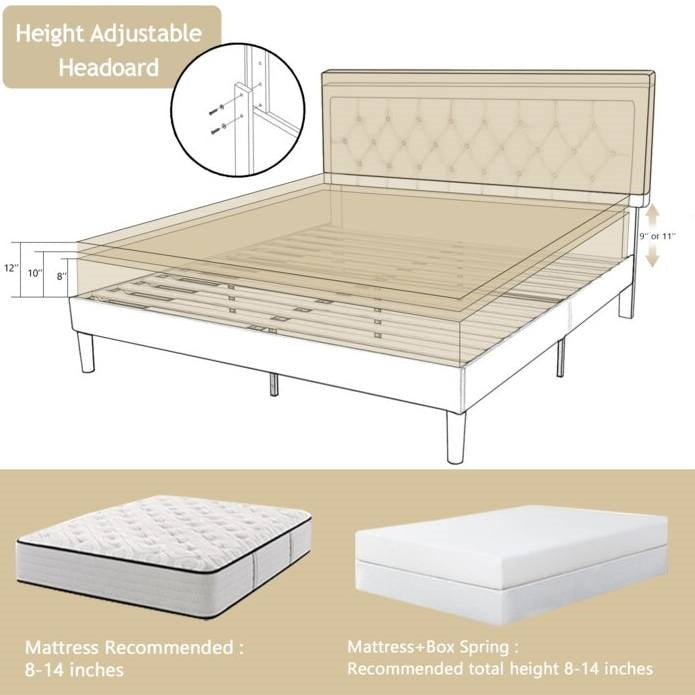
Check Compatibility and Weight Capacity
Do not raise a platform bed until you know how its load reaches the floor. The new support must carry the same load path as the original design.


A typical load includes the frame, mattress, bedding, people, and movement during use. A bed may hold more weight when someone lies still than when someone sits hard on one edge. That is why a simple body-weight calculation may not provide enough safety margin.
Inspect the frame
Look for:
- Cracked wood
- Bent metal
- Loose bolts
- Pulled-out screws
- Split leg mounts
- Missing corner blocks
- Sagging slats
- A center rail that does not touch the floor
- Uneven contact with the floor
Repair these problems before adding height. New risers or taller legs will not correct a weak frame.
Confirm the center support
Many queen and king platform beds need a center rail and one or more legs that reach the floor. If you raise the outside corners but leave the center support short, the center may sag or the rail may float above the floor.
The center support should:
- Touch the floor firmly
- Stay vertical
- Match the new height
- Have a stable foot
- Connect securely to the frame
Do not use loose scraps of wood as a center support. A support that shifts can damage the frame and create a sudden drop.
Check the floor
Hard floors may allow a small foot to slide. Carpet can hide an uneven floor or allow some risers to tilt. Place support feet on a firm, level surface.
If the floor is uneven, use an approved adjustable leg or a suitable leveling pad. Do not balance the bed with folded cardboard, stacked books, loose tiles, or random wood pieces.

How to Add Height With Replacement Legs
Replacement legs are usually the most integrated method for a bed designed with removable legs.
What you need
Prepare:
- Replacement legs with the correct attachment
- Matching bolts or screws, if required
- A tape measure
- A wrench or screwdriver
- A level
- A second person
- Furniture pads, if needed
Use the manufacturer’s assembly instructions when available. If the frame has threaded inserts, identify the thread size before ordering parts.
Step-by-step process
-
Remove the mattress and bedding.
Set them aside on a clean, dry surface. -
Ask another adult to help lift the frame.
Do not drag a heavy bed across the floor. Dragging can loosen joints and scratch flooring. -
Remove one original leg at a time.
Keep the old hardware in case the new legs require different fasteners. -
Compare the new and old mounting points.
The new leg should sit fully against the frame. It should not rock or leave a gap. -
Install each new leg by hand first.
Start all bolts or screws before tightening any one fastener fully. -
Tighten the hardware evenly.
Stop if the fastener spins, strips, or pulls out. That may signal a damaged insert or incorrect hardware. -
Adjust the center support.
If the bed has a center rail, raise or replace its support so it meets the floor. -
Set the frame upright and test it.
Push gently at each corner and along the side rails. -
Check for level.
Place a level across the frame in several directions. Add approved leveling hardware if needed. -
Replace the mattress and test again.
Sit on each side of the bed, then lie down and shift position. Listen for movement or creaking.


Signs the installation worked
The bed should remain stable when you sit near a corner or move across the mattress. Each leg should stay in full contact with the floor. The frame should not twist, lean, or make new popping sounds.
If the bed moves, remove the mattress and inspect the joints before using it again.

How to Add Height With Bed Risers
Bed risers are simple, but they must match the legs and the load.
Select safe risers
Choose risers that:
- Fit the full bottom of each bed leg
- Have a non-slip surface or a secure cup
- Support the combined load
- Match the number of support points
- Have a broad, stable base
- Are made for furniture, not decorative display
Avoid stacking one riser on top of another. Stacking increases the chance of sliding and tilting.
Do not place a narrow leg on a large riser unless the riser has a shaped recess that holds the leg in place. A flat platform does not automatically prevent movement.
Installation steps
- Remove the mattress and all bedding.
- Inspect every bed leg and foot.
- Place each riser on a clean, level floor.
- Lift the frame with help and center each leg in its riser.
- Confirm that all legs sit at the same height.
- Check that the center support also reaches the floor.
- Test the frame from several directions.
- Replace the mattress and repeat the stability check.
If a riser shifts during testing, do not keep using it. The riser may be too small, too smooth, too tall, or incompatible with the leg shape.

Add Storage Without Making the Bed Unstable
Raising a bed often aims to create under-bed storage. Measure the clear space from the floor to the lowest frame part, not just to the bed rail.
For example, a 10-inch riser may not create 10 inches of usable storage if the frame has a low center beam or cross support.
Use storage containers that slide fully under the bed without hitting the legs. Keep heavy items low and spread them evenly. Avoid storing items that can leak, attract pests, or block required ventilation.
Do not use the space beneath the bed as a reason to remove a required center support. The support is part of the frame’s structure.
If the bed has drawers, check that the drawers still open. Raising only one part of a bed can twist the frame and cause drawer misalignment.

Common Mistakes When Raising a Platform Bed
Several quick fixes create more risk than useful height.
Stacking risers
Stacked risers can slide apart or lean under load. Use one properly sized riser per support point, or install taller legs.
Using books, bricks, or concrete blocks
Household objects may crack, slide, or crush. They also may not provide a level surface. Do not use books, paint cans, loose boards, or cinder blocks as bed supports.
Raising the corners but not the center
A raised outer frame with a low or floating center support can cause sagging. Match every support point to the new height.
Ignoring the headboard
A taller bed may expose a gap between the mattress and headboard. A freestanding headboard can tip if it is not attached correctly. Wall-mounted headboards must use suitable hardware for the wall type.
Overlooking mattress support
A platform bed may require a specific slat gap or a solid deck. Adding a foundation can change the support surface. Check the mattress maker’s instructions before changing the setup.
Tightening hardware too much
Over-tightening can strip wood, crush particleboard, or damage threaded inserts. Tighten firmly, but stop when the joint is secure.
Making the bed too high
A very tall bed can make it harder to get in and out, especially for children, older adults, or anyone with limited balance. If standing up is the goal, a stable handhold or a lower, wider step may help more than extra riser height.

Troubleshooting an Unstable Raised Bed
Stop using the bed if it rocks, leans, shifts, or makes sharp cracking sounds. Remove the mattress before checking the structure.
| Symptom | Likely cause | First check |
|---|---|---|
| One corner rocks | Uneven floor or unequal leg height | Check each foot and use a level |
| Bed slides on hard flooring | Smooth riser or small foot | Use a non-slip, furniture-rated support |
| Center sags | Short or missing center leg | Measure and restore center support |
| Frame creaks after raising | Loose joint or frame twist | Recheck bolts and corner connections |
| Mattress shifts | Changed support surface or missing retainer | Check the platform and mattress fit |
| Drawers bind | Frame is no longer square | Measure diagonals and inspect supports |
| Riser cracks or bends | Excess load or poor material | Replace it with a correctly rated product |
If the frame remains unstable after tightening and leveling, lower it to its original height. A replacement frame may be safer than continued modification.
Seek help from a qualified furniture repair professional if a load-bearing insert has pulled out, a metal frame is bent, or a wood rail is split. Do not keep testing a damaged bed with people on it.

Which Method Should You Choose?
Use this quick comparison to narrow the choice.
| Method | Best for | Main benefit | Main limitation |
|---|---|---|---|
| Taller replacement legs | Beds with removable legs | Clean, stable, integrated change | Must match the mounting hardware |
| Bed risers | Small to moderate height increases | Simple and often low cost | May slide or wobble if poorly matched |
| Compatible foundation | Beds designed to accept one | Broad support and added height | May affect mattress support and warranty |
| New platform bed | Fixed, weak, or badly designed frames | Correct height and structure | Costs more and requires replacement |
As a general rule, use replacement legs when the frame supports them. Use risers only when the feet fit securely and the center support remains effective. Replace the frame when the current design cannot safely carry the new height.

Key Takeaways
- Measure the current and desired mattress height first.
- Match every support point, including center legs, to the new height.
- Use furniture-rated risers or properly fitted replacement legs.
- Never use books, loose blocks, or stacked risers.
- Check the combined load of the frame, mattress, bedding, and sleepers.
- Test for rocking, sliding, creaking, and frame twist before normal use.
- If the bed remains unstable, return it to its original height or replace the frame.
Frequently Asked Questions
Can I put a platform bed on bed risers?
Yes, if the legs fit securely, the risers are made for furniture, and the total load stays within the riser and bed-frame limits. The center support must also reach the floor.
How much height can I safely add to a platform bed?
There is no universal safe height. The limit depends on the frame design, leg width, support spacing, floor surface, and load rating. Small increases are usually easier to stabilize than large increases.
Can I add wheels to a platform bed to raise it?
Only if the frame and casters are designed for that use. Wheels change how the bed responds to side loads and may allow it to roll during use. Locking casters do not always prevent movement on every floor.
Will raising my bed void the mattress warranty?
It may, if the new setup fails the mattress maker’s support rules. Check the current warranty and foundation requirements before adding a riser or foundation.
Should I raise a bed for an older adult?
A higher bed can make standing easier, but too much height can increase fall risk. Measure the seated height, keep the bed stable, and consider professional advice if balance or mobility is limited.
Can I raise only one side of the bed?
No. The frame should remain level and supported at every required point. Raising one side can twist the frame, shift the mattress, and create a fall hazard.
Conclusion
To add height to a platform bed, start with measurements and the bed’s support design. Taller replacement legs are usually the most secure option when the frame allows them. Properly fitted risers can work for smaller increases, while a new frame is safer for major changes or weak designs.
After installation, check every leg, center support, joint, and floor contact point. A raised bed should feel solid, stay level, and remain stable when someone sits on the edge or moves across the mattress.

Appliance Review Expert
Lucas Ramirez is a trusted voice at HomeFixGrid.com, known for his clear, practical, and creatively written guides that simplify appliance care for everyday homeowners. With a strong focus on hands-on testing and real-world problem-solving, Lucas brings expert insight into appliance reviews and troubleshooting techniques. Her work empowers readers to confidently maintain, repair, and choose the right appliances for their homes.